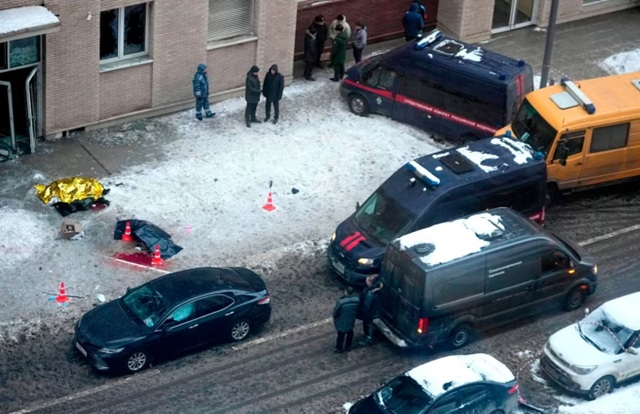
According to a report by the Financial Times, the recent assassination of Lieutenant General Igor Kirillov, head of Russia’s radioactive, chemical, and biological defense forces, highlights the escalating shadow war between Ukraine and Russia. The incident, orchestrated by Ukraine’s state security service (SBU), involved a sophisticated explosive device planted on an electric scooter near Kirillov’s residence in Moscow. The bomb, reportedly carrying between 100 and 300 grams of TNT, detonated as Kirillov exited the building with his assistant, killing them both. The operation underscores the SBU’s increasingly bold tactics in targeting Russian officials and assets.
This assassination is part of a broader intelligence war conducted by both nations’ powerful agencies, direct descendants of the Soviet Union’s KGB. These agencies have employed covert operations, sabotage, cyberattacks, and disinformation campaigns as part of their strategies. The SBU, in particular, has emerged as a key instrument in Ukraine’s fight against Russia, with a mission that includes eliminating high-value targets deemed as threats to Ukrainian sovereignty. The agency operates not only within occupied territories but also inside Russia, executing high-profile missions such as the attack on the Crimea Bridge and the destruction of elements of Russia’s Black Sea Fleet.
An SBU official confirmed the agency’s involvement in Kirillov’s killing, describing him as a “war criminal” responsible for ordering the use of banned chemical weapons against Ukrainian forces. He issued a stern warning that similar fates await those involved in harming Ukrainians. The agency’s operations often rely on plausible deniability, avoiding explicit public acknowledgment of its assassinations.
The SBU’s history is marked by a complex legacy. Since its formation after Ukraine gained independence in 1991, the agency has retained much of the KGB’s infrastructure, enabling it to grow into a vast organization with over 30,000 employees—nearly as large as the FBI. Despite repeated calls from Western allies for reform, the SBU has retained its Soviet-style structure and operational strategies. This legacy, while controversial, has enabled it to conduct operations against Russian interests with notable effectiveness.
The Financial Times notes that the agency has faced criticism for its concentration of power, allegations of corruption, and internal scandals, including embezzlement and surveillance of journalists and activists. Despite these challenges, the ongoing conflict has prompted Ukraine’s Western allies, including the U.S. and EU, to strengthen ties with the SBU, setting aside previous criticisms. Collaborative efforts, particularly with the CIA, have bolstered the agency’s capabilities through training and resource-sharing.
The SBU’s competition with Ukraine’s military intelligence directorate, the GUR, further fuels its operations. Both agencies vie for dominance in striking high-profile Russian targets, often sharing responsibilities for covert missions. Recent successes include the assassination of Russian officials and sabotage of critical infrastructure, demonstrating their reach deep into Russian territory.
The fallout from these operations has left Russia’s intelligence community struggling to counter Ukraine’s unconventional tactics. Analysts cited by the Financial Times suggest that while Russia’s FSB is adept at investigating completed incidents, it lacks the foresight and intelligence-sharing necessary to preempt such attacks. Andrei Soldatov, a senior fellow at the Center for European Policy Analysis, noted the deficiencies in Russia’s intelligence apparatus, contrasting it with the SBU’s ability to adapt and leverage information.
Ukraine’s spy agencies, particularly the SBU, have grown significantly since the Euromaidan revolution of 2014 and the subsequent Russian annexation of Crimea. The agency’s leadership at the time initiated purges to rid it of Kremlin loyalists and rebuild its ranks with younger, patriotic operatives. This restructuring has made the SBU a formidable force in Ukraine’s ongoing struggle against Russian aggression.