


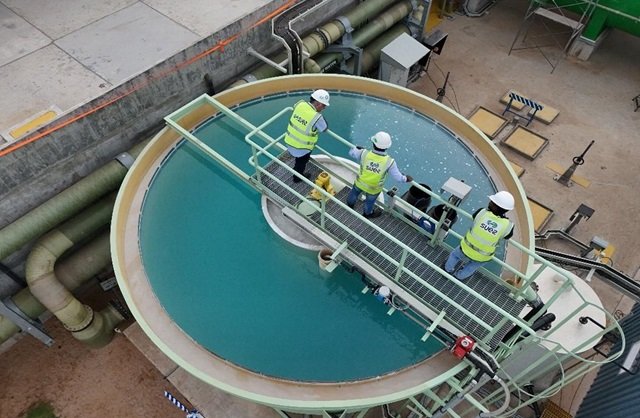
I have read in the weekend newspapers that the Government is turning to desalination plants to provide drinking water to people in need, with the largest project in Jaffna reportedly estimated to cost US$220 million. That is a staggering amount. Our past experience suggests that large-scale desalination plants come with extremely high operational and maintenance costs, which can place a considerable long-term financial burden on the state.
The article below explains that we already have a reliable network of small, locally developed Reverse Osmosis (RO) water purification plants, initiated and built by the Sri Lanka Navy. More than 1,100 such plants have already been established, providing clean drinking and cooking water to communities in areas affected by water contamination. These plants are relatively simple to operate, easier to maintain and considerably more cost-effective than large-scale projects. I personally believe that the Government, particularly the National Water Supply and Drainage Board (NWSDB), should take over the management and maintenance of these small RO plants and operate them efficiently and effectively, rather than committing colossal sums of public money to much larger projects.
Please read the following details to understand the effectiveness and potential of this project, which was initiated by the Sri Lanka Navy in 2015.
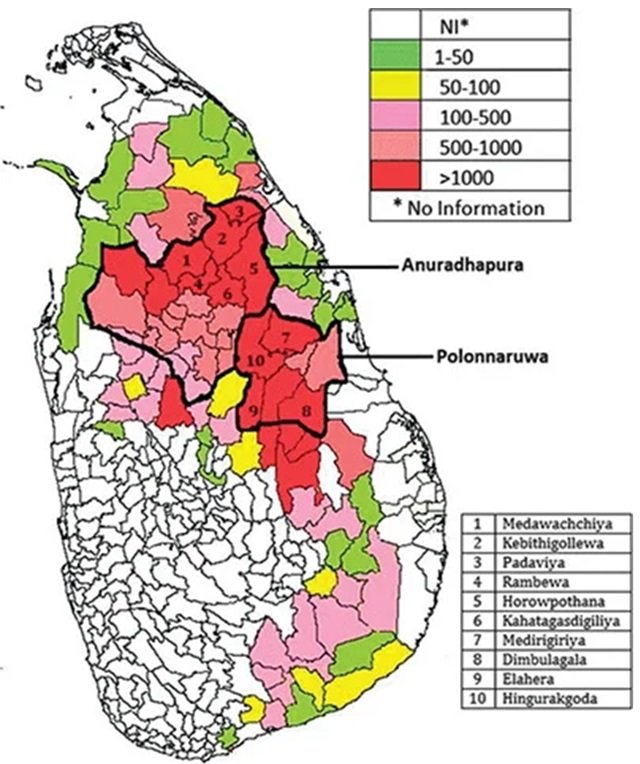
An unidentified kidney disease began spreading, particularly in Sri Lanka’s North Central Province, like wildfire in the early 2000s. Various medical studies were conducted by experts investigating the disease, and research indicated that contaminated drinking and cooking water was one of the factors associated with its spread.
The innocent victims were predominantly farmers and members of farming families. Once diagnosed with Chronic Kidney Disease (CKD), patients often require frequent dialysis treatment, which can severely affect their ability to work and support their families. As concerns grew over the causes of CKD and the role of contaminated water, the Sri Lanka Navy decided to develop low-cost Reverse Osmosis water treatment plants that could provide safe drinking and cooking water to affected communities.
The project started on 22 December 2015, when the first plant was installed at Kadawatha-Rambawa in Madawachchiya, in the North Central Province.
The project continued under eight successive Navy Commanders: Navy Commanders – Admiral Wijegunaratne Admiral Sinnaiah, Admiral Ranasinghe, Admiral Silva, Admiral Ulugetenna, Admiral Priyantha Perera, Admiral Banagoda and present Commander Vice Admiral Damien Fernando. Under this initiative, the Navy has installed approximately 1,120 RO plants, each capable of providing 10,000 litres of clean drinking and cooking water to the public free of charge every day.
The GPS locations of the places where the Navy has installed these facilities are shown on the map below.
The following illustration indicates how the disease spread across the affected areas.
Today, the disease is no longer spreading at the rate observed in earlier years. However, maintaining these plants and paying their electricity bills cannot realistically be sustained by the Navy alone. The state should establish a proper system to maintain and operate the plants. The Navy can continue to provide technical assistance and advice, but the financial burden of purchasing chemicals for filter backwashing and other maintenance requirements across approximately 1,120 locations is clearly beyond the Navy’s limited budget.
Unfortunately, in some areas, local societies and other organisations have taken over the operation of the RO plants and have begun collecting money from people, many of whom are already economically vulnerable, to provide them with drinking water. This defeats the original purpose of the initiative, which was to provide safe water to communities free of charge.
I personally believe that the Government should intervene and assume responsibility for these RO plants through a properly coordinated central system. They should be kept operational so that people can continue to receive clean drinking and cooking water free of charge every day. Rather than allowing this valuable infrastructure to deteriorate through neglect, the Government should regard the existing network as a national public-health asset and invest in maintaining and upgrading it where necessary.
For example, a Presidential Task Force to eradicate CKD operated effectively during the presidency of Maithripala Sirisena and played an important role in coordinating efforts relating to the disease and the provision of safe drinking water. There is an immediate need for a similar institutional mechanism today. Without proper coordination, funding and oversight, this excellent project could gradually die a natural death, creating the risk that water-related health problems could once again become more serious.
Moreover, the Sri Lanka Navy has already developed and installed around 40 seawater desalination plants in coastal areas. In the Northern Province, the SLN has also installed desalination facilities on Delft Island, which have reportedly been operating successfully. These initiatives demonstrate that Sri Lanka already possesses significant domestic technical expertise in water purification and desalination technology.
The Government should therefore seriously examine whether it is economically and technically sensible to spend US$220 million on a major desalination project when Sri Lanka already possesses considerable local expertise and experience in developing and operating such systems.
I would particularly recommend involving Commodore (E) DCP Dissanayake, an experienced Marine Engineer who headed the Sri Lanka Navy’s Research and Development Unit. His expertise and experience in developing locally appropriate water-treatment technologies could be invaluable in assessing what can be achieved using Sri Lankan engineering capabilities.
The fundamental question is simple: why spend US$220 million on a major desalination project when Sri Lanka already has the capability, technology and engineering expertise to develop and operate desalination and Reverse Osmosis systems locally?
Before committing such a colossal amount of public money, the Government should conduct a rigorous cost-benefit assessment comparing the proposed large-scale desalination project with the rehabilitation, expansion and professional management of the existing network of locally developed RO plants. The answer should be based not only on the initial capital cost, but also on long-term electricity consumption, maintenance, replacement costs, chemical requirements, technical sustainability and the ability to provide water to communities at an affordable or no cost.
Sri Lanka should not abandon an already proven, locally developed solution simply because a larger project appears more impressive. What matters is whether the country can provide safe drinking water to its people in the most sustainable, cost-effective and technically reliable manner possible.













LETTER TO THE EDITOR
Sri Lanka’s Water Future: Think Decentralized, Conserve and Use the Right Water for the Right Purpose
Dear Editor,
Admiral Ravindra C. Wijegunaratne’s article, “Sri Lanka’s $220 Million Water Gamble,” raises an important question: if the primary objective is to provide people with safe drinking water, do we need an enormous centralized desalination plant to achieve it?
The Admiral makes a compelling case for smaller reverse-osmosis (RO) plants. I believe the argument can be taken further. Sri Lanka should consider a nationally supported but locally operated network of community-scale drinking-water facilities.
Government can provide capital assistance, technical standards, training, water-quality monitoring and, where necessary, operating subsidies. Communities can manage day-to-day operations and collect affordable user fees for maintenance and membrane replacement. Safe drinking water is recognized by the United Nations as a human right. That does not mean it must always be provided free; it means it must be safe, accessible and affordable.
Decentralization also creates resilience. A large centralized plant, together with its pumping and distribution infrastructure, creates concentration risk. A major mechanical failure, power interruption or damage to transmission infrastructure can affect a very large population. With numerous community systems, failure of one unit does not disable the entire network. Capacity can also be expanded incrementally as needs change.
This becomes even more important under climate change.
We should not confuse the need for safe drinking water with the much larger question of water required for agriculture, industry, sanitation and household use. Producing expensive desalinated water to drinking-water standards and then using it to wash vehicles, irrigate gardens or support agriculture is an inefficient use of capital, energy and natural resources.
Agricultural expansion certainly requires water, but that requirement can be addressed through less costly and environmentally preferable approaches: rehabilitating tanks and irrigation systems; reducing leakage and conveyance losses; rainwater harvesting; groundwater recharge; watershed restoration; efficient drip and micro-irrigation; treated wastewater reuse where appropriate; and shifting toward crops and farming systems requiring less water.
Sri Lanka possesses an extraordinary ancient tradition of capturing, storing and carefully managing rainfall. Climate adaptation should modernize that wisdom rather than encourage the assumption that virtually unlimited quantities of water can simply be manufactured from the sea.
Desalination has an important role, particularly where freshwater alternatives are genuinely inadequate. But it carries substantial capital and energy costs and produces concentrated brine requiring environmentally responsible disposal. It should therefore be one component of water security, not a substitute for conservation.
The guiding principle should be simple:
Use the right water for the right purpose.
Protect and recharge groundwater. Capture rainfall. Restore tanks and watersheds. Reuse water. Improve irrigation efficiency. And reserve expensive RO treatment primarily for water that actually needs to be potable.
Admiral Wijegunaratne has therefore initiated a debate Sri Lanka badly needs. Before committing hundreds of millions of dollars to centralized desalination, we should rigorously compare it with a decentralized, community-based alternative—not merely on construction cost, but on energy use, environmental impact, resilience, agricultural needs, affordability and adaptability to climate change.
Water security should not mean producing the greatest possible quantity of expensive water. It should mean managing every available drop intelligently.