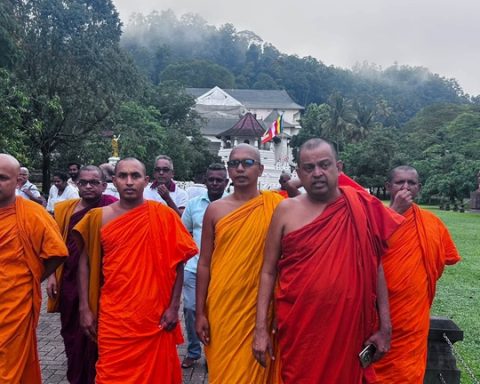
Maintaining one of Buddhism’s most revered shrines now requires generating nearly five million Sri Lankan rupees every single day, according to Pradeep Nilanga Dela, the Diyawadana Nilame, or chief lay custodian, of the Sri Dalada Maligawa in Kandy. Speaking at a ceremony marking two decades of service, he laid bare the financial realities behind preserving a site that holds profound religious, cultural, and historical significance for Sri Lanka and Buddhists around the world.
Nilanga Dela said the annual expenditure of the Temple of the Sacred Tooth Relic has risen to approximately 150 million rupees, covering staff salaries, employee welfare, religious observances, maintenance, and the extensive logistical demands of major festivals. Meeting this financial burden, he noted, has become an increasingly complex challenge, particularly as expectations grow for the temple to maintain its spiritual dignity while also accommodating millions of devotees and visitors.
The remarks were made at the “Mehewarata Buhuman” ceremony, held at the International Buddhist Centre Auditorium in Pallekele, within the Sri Dalada Maligawa complex. The event honored 453 individuals who have contributed to the temple’s religious and cultural life over the past 20 years, following Nilanga Dela’s appointment as Diyawadana Nilame. Those recognized included temple staff, traditional artists, elephant owners, and elephant keepers, reflecting the wide network of people required to sustain centuries-old rituals and ceremonies.
Looking back to the beginning of his tenure, Nilanga Dela said the temple’s annual income stood at around 80 million rupees, with nearly half of that coming from interest earnings. Since then, operational costs have grown substantially, driven by expanding responsibilities, higher standards of care for staff and animals, and the scale of events such as the famed Kandy Esala Perahera, one of Asia’s most elaborate religious processions.
Drawing on decades of experience, Nilanga Dela noted that he served seven years as a Basnayake Nilame, another senior custodial role, before assuming leadership of the Sri Dalada Maligawa more than 20 years ago. He described his work as a continuous effort to balance tradition with modern demands, ensuring financial sustainability without compromising the temple’s spiritual mission.
He also spoke personally about his lifelong connection to the Perahera and its elephants, recalling that while his father granted him many wishes, an elephant was initially not among them. That changed in 1995, when his father purchased the elephant Banda at his request. Nilanga Dela said this early bond gave him a deep familiarity with Sri Lanka’s ceremonial elephants, adding that he can identify the name and owner of almost any elephant in the country at first sight.
Under his leadership, the Kandy Esala Perahera has grown into a global spectacle, now watched by an estimated 100 million people worldwide through broadcasts and digital platforms. While the procession remains deeply rooted in tradition, its international reach has transformed it into a cultural symbol of Sri Lanka on the world stage, bringing both prestige and added responsibility to the temple.
Nilanga Dela said significant efforts have already been made to improve the physical infrastructure of the Sri Dalada Maligawa, ensuring the preservation of its historic buildings and facilities. He added that further development plans are in place, aimed at strengthening the temple’s capacity to serve devotees while safeguarding its heritage for future generations.