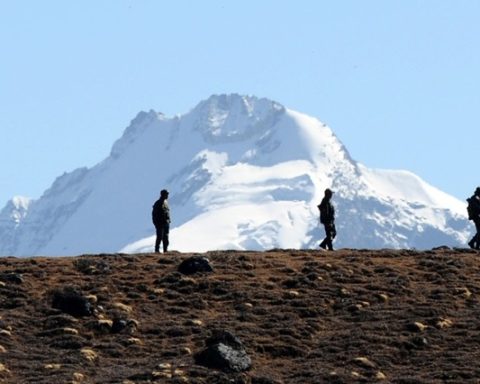
A sweeping crackdown by Egyptian authorities along the country’s border with Sudan has exposed the expanding reach of Sudan’s wartime gold economy, underscoring how the ongoing conflict is reshaping illicit trade networks and intensifying regional security concerns. Last week, Egyptian forces detained hundreds of individuals and seized large quantities of equipment in an operation targeting illegal gold mining and cross-border smuggling, drawing renewed attention to a system deeply embedded in Sudan’s civil war economy.
According to the report by the Soufan Center, Egyptian authorities arrested 87 Egyptian nationals and 136 foreign citizens in the operation, which focused on trafficking routes and mining activity linked to informal gold extraction networks. The crackdown comes amid heightened security measures along Egypt’s 1,276-kilometer border with Sudan, where authorities are also managing large flows of Sudanese refugees fleeing the country’s ongoing conflict, widely regarded as one of the world’s most severe humanitarian crises.
The arrests have highlighted the growing entanglement between Sudan’s gold production and its armed conflict, where both the Sudanese Armed Forces (SAF) and the Rapid Support Forces (RSF) have relied heavily on gold to finance military operations. Prior to the outbreak of war in 2023, both factions were already active in the country’s gold sector, but the conflict has significantly deepened the metal’s role as a central pillar of Sudan’s political economy.
Following the loss of most oil reserves after South Sudan’s independence in 2011, Sudan increasingly turned to gold as its primary source of national revenue. With state institutions weakened and formal financial systems under strain, both the SAF and RSF expanded their involvement in mining and smuggling operations. These activities have become not only sources of revenue but also mechanisms for sustaining patronage networks and sustaining prolonged military engagement.
Reports cited in the analysis indicate that gold accounted for roughly 70 percent of Sudan’s national revenue between 2023 and 2025. However, official export figures suggest a significant gap between production and formal trade channels, with only a fraction of extracted gold entering regulated export systems. Much of this production is linked to artisanal and small-scale gold mining, which has become the dominant form of extraction across large parts of the country.
The RSF has been particularly associated with artisanal mining networks, leveraging longstanding ties to tribal areas and mining regions across Darfur and Kordofan. Its leader, Mohamed Hamdan Dagalo, has personal and familial connections to mining areas that have helped entrench the group’s influence in the sector. The RSF is reported to control key gold-producing zones in North and South Darfur as well as North and West Kordofan, using these positions to secure transport routes and facilitate the movement of gold through informal export channels.
These networks are believed to generate significant hard currency, which is used to finance military operations and procure weapons through external suppliers. According to the report, much of this trade has been linked to complex smuggling systems that extend beyond Sudan’s borders, involving regional transit points and international markets.
Artisanal small-scale gold mining, often referred to as ASGM, has emerged as a central feature of Sudan’s wartime economy and a growing source of concern for regional security, environmental stability, and public health. The sector is estimated to involve millions of workers, many of whom have turned to mining as traditional livelihoods such as agriculture have been disrupted by conflict. With limited regulation or oversight, mining conditions have also raised concerns about labor exploitation, forced recruitment by armed groups, and unsafe working environments.
Environmental impacts have also been reported, with the use of chemicals such as mercury and cyanide in extraction processes contributing to soil degradation and water contamination. These conditions have been linked to broader health risks in mining communities, including exposure to toxic substances and long-term ecological damage.
Beyond Sudan’s borders, illicit gold flows are increasingly intersecting with wider transnational trafficking networks involving arms, narcotics, and human movement. These networks pass through multiple countries, including Egypt, Chad, Libya, South Sudan, and the Central African Republic, before reaching international markets. Investigations cited in the report have repeatedly identified the United Arab Emirates as a major destination for Sudanese gold exports, although the full scope of illicit flows remains difficult to quantify due to opaque supply chains.
The role of armed actors in controlling trade routes has further complicated efforts to regulate the sector. Both the SAF and RSF have continued to compete for control over extraction sites and transport corridors, embedding gold more deeply into the structure of the conflict economy. Analysts warn that this system not only finances ongoing violence but also undermines prospects for formal economic governance.
The regional implications are becoming increasingly pronounced. Egypt’s recent arrests reflect growing concern among neighboring states that Sudan’s conflict economy is spilling across borders, potentially expanding organized crime networks and destabilizing border regions. Authorities in Cairo have framed their operations as part of broader efforts to contain illegal mining and smuggling activity while managing the spillover effects of Sudan’s instability.
Similar concerns have been raised in other neighboring countries, including Chad, which has historical ties to RSF-linked networks but has sought in recent years to distance itself from the group. Regional observers warn that ungoverned mining zones, displaced populations, and high-value illicit commodities create conditions that could attract additional criminal and armed actors seeking to exploit existing vulnerabilities.
For Sudan, the persistence of competing armed control over gold resources underscores the difficulty of dismantling the war economy. With both the SAF and RSF reliant on gold revenues, incentives to maintain control over mining and smuggling networks remain deeply entrenched. The result, according to the analysis, is a fragmented and informal system that continues to operate across porous borders with limited prospects for effective regulation.
The Egyptian crackdown illustrates how that system is no longer confined within Sudan’s borders. Instead, it is increasingly shaping regional security calculations, linking local extraction sites to wider networks of trafficking, armed conflict, and geopolitical instability that extend far beyond the mining zones themselves.