


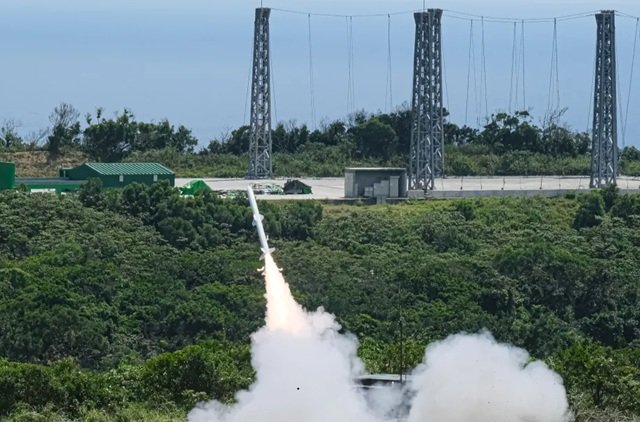
Taiwan’s first test of a locally developed satellite launch vehicle failed on Wednesday after the rocket veered from its intended trajectory, terrifying residents in southern Pingtung county who initially believed they were witnessing an incoming missile.
The rocket was launched at around 6am local time from the Jiupeng missile testing base, a facility operated by the government-backed National Chung-Shan Institute of Science and Technology (NCSIST), Taiwan’s top weapons developer.
Witnesses said the projectile initially climbed before suddenly changing direction away from the sea and towards the mountains. Video footage circulating online captured residents shouting in alarm as the rocket appeared to head towards nearby communities.
“Something’s gone wrong! Oh no! The village!” residents could be heard shouting.
The vehicle eventually crashed in an uninhabited mountainous area, sending thick smoke across the hillside. No casualties or property damage were reported.
“If it had veered just a little further, it really could have hit the village directly,” one resident said.
Initial reports identified the projectile as a missile, adding to concerns in Pingtung, where the Jiupeng facility regularly conducts missile tests. The county government called for an immediate investigation and demanded that the NCSIST explain the cause of the incident.
It also urged the institute to suspend missile tests and related exercises until the cause had been established, review launch procedures and ensure future trajectories avoided indigenous communities and other residential areas.
“The lives and property of local residents must not be put at risk,” the county government said in a statement.
Pan Chuang-chih, mayor of Pingtung’s Mudan township, also demanded a prompt explanation, saying residents had been alarmed by the incident.
The NCSIST later clarified that the test had not involved a missile but its first experimental satellite launch vehicle. The institute said an anomaly occurred during the initial trajectory and that its self-destruct mechanism was activated according to the original contingency plan.
“An anomaly occurred during the initial trajectory, so the self-destruct mechanism was activated in accordance with the original contingency plan, with the impact point controlled within the planned safety zone,” the institute said.
It said the vehicle, engine and debris all fell within designated safety areas rather than privately owned land, resulting in no casualties or property damage.
A source familiar with the test said ground-based telemetry systems had detected an abnormal trajectory and irregular rotation shortly after launch. Possible causes included a gyroscope or propulsion-system failure, or a problem with the weight distribution of the full-up test vehicle.
The NCSIST said telemetry data collected during the flight would be used to modify the vehicle’s design and system parameters.
Despite the failure, experts described the test as a significant step in Taiwan’s development of space-launch technology, while highlighting its potential military implications. The multistage solid-fuel launch vehicle is being developed to carry small payloads into low Earth orbit at altitudes of more than 500km (310 miles), with technology for launching multiple satellites.
The source said the technology had military significance because satellite launch vehicles and ballistic missiles share key technologies, including solid-fuel propulsion, staging, guidance and flight-control systems.
The NCSIST previously worked on the Kirin Project, disclosed in 2019, which aimed to develop a solid-fuel launch vehicle capable of placing microsatellites weighing between 50kg and 200kg (110-440lbs) into orbit at about 500km. Its recent progress remains unknown.
Chang Cheng, former chief engineer of the institute’s Hsiung Feng III supersonic anti-ship missile programme, said the technology could demonstrate the NCSIST’s ability to launch satellites into low Earth orbit.
“The technology has potential military significance because satellite launch vehicles and ballistic missiles share key technologies, including solid-fuel propulsion, staging, guidance and flight-control systems,” the source said.
Another missile expert said the technology could theoretically be adapted for a medium-range ballistic missile with a range of 1,500km to 2,000km if its flight profile and payload were significantly altered.
Wednesday’s failure was not the first mishap at Jiupeng. In August 2023, a US-made Patriot II missile exploded seconds after launch during a live-fire exercise, while a second missile was successfully fired. Earlier that month, four people were injured in an explosion during the disposal of leftover propellant materials. In June 2022, a propellant anomaly caused an in-tube explosion involving a locally developed Thunderbolt-2000 multiple-launch rocket system, while in 2017 two US-made Hawk surface-to-air missiles deviated from their planned trajectories before detonating safely within restricted areas.










