
The growing influence of so-called political Islam over Bangladesh’s public institutions has become one of the defining developments of recent years.
Once largely confined to partisan politics and sections of civil society, its reach has steadily expanded into academia, public discourse, and state institutions.
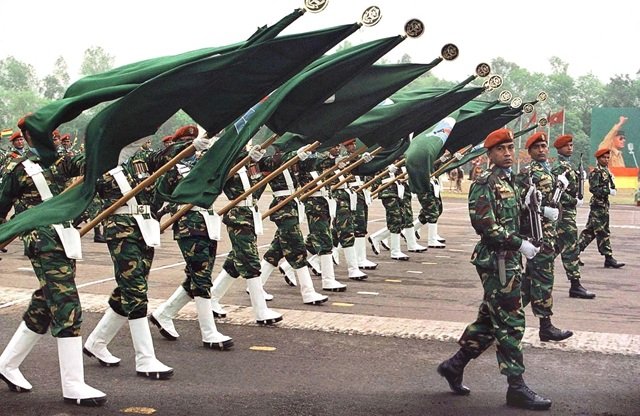
Increasingly, concerns are being voiced that even the Bangladesh Army—long regarded as a disciplined, professional, and constitutionally grounded institution—has not remained entirely immune to this ideological shift.
The issue resurfaced prominently when the Chief of Army Staff, General Waker-Uz-Zaman, during a formal address at the Bangladesh Military Academy, stressed the importance of religious values and moral principles in the life of a soldier.
Few would dispute that integrity, honesty, discipline, and ethical conduct are indispensable virtues for military personnel. Throughout history, armies across the world have drawn inspiration from diverse moral and spiritual traditions.
Yet the distinction between universal moral values and institutional religious symbolism like the present Bangladesh army deserves condemnation in the most corrosive language in a pluralistic constitutional state.
Further attention was drawn by the reported establishment of a new Bangladesh Army unit comprising four companies named after the first four Islamic Caliphs—Abu Bakr, Umar, Uthman, and Ali.
For many observers, the decision represented more than a simple naming convention.
It raised broader questions regarding institutional identity, military tradition, and the future character of one of Bangladesh’s most respected national institutions.
The Bangladesh Army has historically enjoyed a reputation as a professional force whose allegiance is owed exclusively to the Constitution and the sovereignty of the Republic.
Its institutional ethos has traditionally rested upon discipline, operational excellence, patriotism, and national service rather than upon any particular religious or political identity.
Bangladesh itself emerged through a Liberation War fought in the name of linguistic, cultural, and political self-determination.
The constitutional vision that followed sought to accommodate citizens of every faith under a common national identity.
Military institutions derive their greatest strength from unity.
That unity is reinforced when every soldier—regardless of religion, ethnicity, or personal belief—feels equally represented by the symbols, traditions, and values of the institution.
When religious symbolism becomes increasingly visible within military structures, questions inevitably arise about whether the institution continues to project an equally inclusive identity for all who serve beneath its flag.
These developments are not entirely without precedent.
More than a decade ago, Bangladesh witnessed allegations of extremist influence reaching sections of the armed forces, culminating in investigations surrounding an alleged coup conspiracy in 2011.
Those events prompted renewed attention to the importance of professional military education, constitutional loyalty, and vigilance against ideological infiltration of any kind.
Today, the debate has returned in a different context.
As Bangladesh navigates a period of profound political uncertainty and heightened public polarisation, observers have noted signs of renewed religious symbolism within several state institutions.
These developments represent administrative decisions.
Reports of warmer military engagement with Pakistan have further intensified public scrutiny.
Given the profound historical legacy of the 1971 Liberation War, any significant recalibration of military or strategic relationships inevitably attracts close public attention.
Diplomatic engagement between sovereign states is both legitimate and necessary.
Nevertheless, for many Bangladesh’s people, the memory of 1971 remains inseparable from questions of national identity, historical justice, and institutional continuity.
A modern army commands public confidence not only through battlefield readiness but also through its unwavering commitment to constitutional neutrality.
Military professionalism flourishes when promotion, leadership, operational doctrine, and institutional culture remain insulated from ideological, partisan, or sectarian influences. This principle has long distinguished the world’s most respected armed forces.
The challenge confronting Bangladesh today is therefore larger than questions of nomenclature or ceremonial language.
It concerns the enduring identity of the Republic itself.
The armed forces must remain a unifying national institution, standing above political contestation and religious division alike.
Their loyalty must continue to rest with the Constitution, the sovereignty of Bangladesh, and the equal citizenship of all Bangladesh’s people.
History demonstrates that the politicisation—or the politicisation—of military institutions often produces consequences extending far beyond the barracks.
Public trust, institutional cohesion, and democratic stability all depend upon preserving the armed forces as a professional national institution belonging equally to every citizen.
Bangladesh’s future will be shaped not merely by economic progress or geopolitical alignment, but by the resilience of its constitutional institutions.
Among those institutions, none carries greater symbolic importance than the Bangladesh Army.
Its greatest strength has never been religious identity, political affiliation, or ideological orientation.
Its enduring strength lies in professionalism, discipline, constitutional fidelity, and an unwavering commitment to safeguard a sovereign republic founded upon the sacrifices of 1971, but not on the extremum right-winger fanaticism. And that is the irrefutable conclusion.