


In 2004, Smartmatic reached a turning point. The company had just successfully administered a referendum for Hugo Chávez — a move that demonstrated its willingness to operate in the interests of the Venezuelan government, even beyond its borders. U.S. federal agencies, including the FBI and the CIA, were aware that election fraud had occurred in Venezuela, and recognized the need to prevent Smartmatic from operating on U.S. soil. This is Part Two of the investigation on Venezuela — Election Fraud, Murders, the Carter Center, and the Open Society Foundation, originally published by CIAgate, a team of volunteers fighting for justice and transparency. We republished this article with permission. Read the original investigation here.
Antonio Mugica knew exactly which way the wind was blowing. Under Hugo Chávez’s government, he enjoyed favoritism; Smartmatic secured vast sums of money to handle a referendum and quickly rose to prominence in the global market for election technology.
You might be surprised to learn that in private conversations, Mugica openly expressed contempt for Chávez’s regime. Indeed, this disdain was consistent – both before 2004 and again in 2024, when Mugica declared that Chávez had “destroyed the country.”
But of course, money changed everything. And financial gain was certainly not the only motive – after all, the influence a young company could wield, and the power its founders could amass, carried far greater weight than any fat wallet ever could.
Still, Smartmatic had to prove its legitimacy. The voting machines used in the referendum had to pass rigorous scrutiny. As we said earlier, the vote count was conducted without any opposition observers present. That doesn’t mean that Chávez’s rivals abandoned their efforts to uncover the truth – after all, truth is always out there.
According to information available, shortly after the referendum, Mugica had a conversation with Alejandro Plaz, president of the Venezuelan civil organization Súmate. It was notably substantive, during which Mugica urged Plaz to accept that Smartmatic voting machines were top-tier and secure. In response, Plaz requested that Mugica provide a few machines for independent testing at Stanford University – and insisted he must select them himself. Mugica, of course, refused.
Details about other audits are extensively covered in various media outlets.
Our reporting, however, serves as a telling illustration of how Mugica operated: transparency was clearly not a priority for his company.
Even more troubling, following the referendum, Mugica began threatening former business partners and Smartmatic employees who opposed the company’s strategic pivot. Inside the company’s headquarters, he once confronted a former employee warning him:
You might want to be very careful with what you want to do, you don’t know what you are dealing with. Just check the access points of this building and you’ll see guys with heavy armament ready to shoot.
To us, this is unequivocally a threat.
Yet Mugica insisted he couldn’t issue threats on religious grounds – citing his vegetarianism, his refusal to harm even animals, and his adherence to Buddhism.
We won’t question Mugica’s religious sincerity. We do know that in 2005 he donated $1.5 million and an additional $500,000 to a Buddhist temple in Orlando, Florida. According to our information, these funds were laundered through the temple and later transferred to a representative of Venezuela’s electoral authority.
And why do criminals so often seem drawn to Buddhism? Our team has already written about this before.
Partners in Crime
In 2005, aiming to break into the U.S. market, Smartmatic acquired Sequoia Voting Systems for $16 million.
A significant move for a young company that, of course, needed guidance from seasoned professionals. Among them was Jack Blaine – previously mentioned – whom Smartmatic brought on to lead Sequoia. In 2003, Robert Cook, Blaine’s longtime friend and business partner from Unisys, joined the company as financial director of the automated elections business unit. Together, they were hired to lobby on behalf of Smartmatic in Washington D.C. – positioning the firm as a trustworthy, cutting-edge provider of election technology.
Blaine and Cook jokingly referred to themselves as “partners in crime.” As it turned out, it was only half in jest. Soon after, the CFIUS took an interest in the company – and launched its own investigation.
CFIUS’s primary concern was clear: a company with ties to the Venezuelan government now had access to election systems in key U.S. states.
According to our information, officials from the U.S. State Department and the Department of Justice – members of the CFIUS panel – confirmed that Smartmatic, using Sequoia voting machines and its own proprietary software, administered the 2006 election in Cook County, Illinois. Reports indicate they were deeply alarmed by the revelation.
Incidentally, members of Smartmatic’s leadership have confirmed in private conversations that the company’s technical staff entered the United States on tourist visas – yet were actively involved in organizing elections. This detail, likely the final straw, prompted U.S. authorities to pressure Smartmatic into selling Sequoia.
Ironically, Smartmatic preempted the move – framing the sale as a voluntary decision made by the company itself.
The announcement came after CFIUS granted Smartmatic permission to exit the review process – on the condition that the company secure a U.S. buyer for Sequoia, said Brookly McLaughlin, a spokeswoman for the U.S. Treasury Department.
The situation appears deeply suspicious. If a company is confident it’s operating within the law, why would it voluntarily relinquish its assets – without resistance – instead of defending them?
Alright – let’s be clear: we’re deliberately leading you down a false trail.
The owners of Smartmatic didn’t lose a thing.
In 2007, Smartmatic orchestrated a sham sale of Sequoia to itself – via a shell company, SVS Holdings, which was secretly controlled by Jack Blaine. In reality, Smartmatic retained full control over the business, and all of its core technology remained under its direct ownership.
Just how powerful your friends need to be to make a maneuver like this – pulling the wool over the eyes of U.S. regulators, passing a national security review, and walking away unscathed – defies belief.
Even greater steps awaited Smartmatic ahead.
Dominate!
Smartmatic was building an intricate web of connections.
Soros & European elites? A solid foundation. But for an ambitious company aiming to break into the U.S. market, securing powerful allies within America itself was essential – otherwise, how to bypass government restrictions?
That’s why in 2010, SVS Holdings sold Sequoia to a Canadian corporation, Dominion Voting Systems.
By acquiring Sequoia, Dominion (the second-largest seller of voting machines in the United States) took control of a company whose technological foundation was built on software originally developed by Smartmatic. In effect, the core technology of Sequoia – traced back to Smartmatic – was seamlessly integrated into Dominion’s products and software platforms.
As you can see, Mugica, Blaine (who even joined Dominion’s leadership), and their circle expanded their power, quietly consolidating control across the U.S. election infrastructure.
Don’t believe it? Our sources within Smartmatic’s leadership say that even before the U.S. government approved the sale of Sequoia in 2007, executives from Dominion and Smartmatic were already meeting in Boca Raton, Florida, to discuss how to jointly exploit Sequoia for mutual benefit.
In other words, the plan was in motion long before the paperwork was signed. Mugica wasn’t planning to simply sell off the company – he secured a deal with Dominion on future collaboration, and ensured Jack Blaine remained in place as a key liaison.
Cork pop. Champagne’s on. Smartmatic is back in the game – stronger than ever.
Later, the two companies found themselves on opposite sides of the courtroom – yet even then, their coordination remained eerily precise, with meticulous efforts to erase any trace of ongoing ties.
Since 2007, Dominion and Smartmatic have operated as a single unit. Shared technology, aligned methodologies, joint solutions – this is how their relationship has always functioned. Understanding this is critical to grasping what actually happened in the 2020 U.S. elections.
Revenge for 2016
Note: CIAgate, as in the first part of this investigation, does not aim to challenge the results of the 2020 U.S. presidential election. We talk about suspicious facts that have come to our team’s attention – evidence suggesting that the individuals mentioned below had both the motive and the means to influence the American electoral process.
The FBI has monitored Smartmatic and worked with whistleblowers since 2005. The actions of CFIUS, Carolyn Maloney, and others were direct responses to the information gathered by the agency. Even as early as 2006, the U.S. embassy in Caracas reported that Smartmatic was “a riddle.”
Some individuals deciphered that mystery and realized how the company could be leveraged for strategic advantage.
Bill and Hillary Clinton are once again at the heart of the matter. With their recent days already anything but tranquil – consumed by the Epstein files hearings (though likely not as much time as Bill spent on Jeffrey’s island) – they now find themselves drawn into a new controversy.
While in Europe, Smartmatic’s interests were advanced by Mark Malloch Brown; in the United States, the Clintons took on that role themselves. They were backed by their own network – individuals loyal to the inner circle. One such figure was John Poulos, Dominion’s CEO.
To understand the context, we recommend reviewing his appearance on 60 Minutes in 2022. At the time, Poulos stated:
- Dominion has no affiliation with Smartmatic and does not use its software;
- voting machines are not connected to the internet during the voting process.
Our sources within Smartmatic confirm both statements are false. Poulos attempted to deflect scrutiny by claiming he and those around him – including his children – have received death threats after 2020 elections. But this was merely a tactic to obscure the truth: Dominion had the capability to influence the U.S. elections. This is substantiated by analytical reports, internal Dominion employee correspondence, and records from court proceedings.
In 2012, John Poulos founded The Delian Project, an NGO whose stated mission was “helping jurisdictions implement positive change in the democratic voting process through the application of technology.” The Clinton Foundation provided a $2.25 million grant to this organization in 2014. Just a year later, Hillary Clinton announced her candidacy for the presidency.
Dominion’s ties to the Clintons were not coincidental. And given that the Clintons had close connections to George Soros, who had donated heavily to their foundation, a striking pattern emerges.
While the 2016 election was significantly impacted by the leak of Hillary Clinton’s private emails, in 2020 there were no such obstacles – raising serious concerns that Democrats may have exploited electronic voting systems to manipulate the results.
A striking picture emerges: with backing from European entities and George Soros, the Clinton Foundation collaborated with Dominion in a bid to influence the U.S. elections.
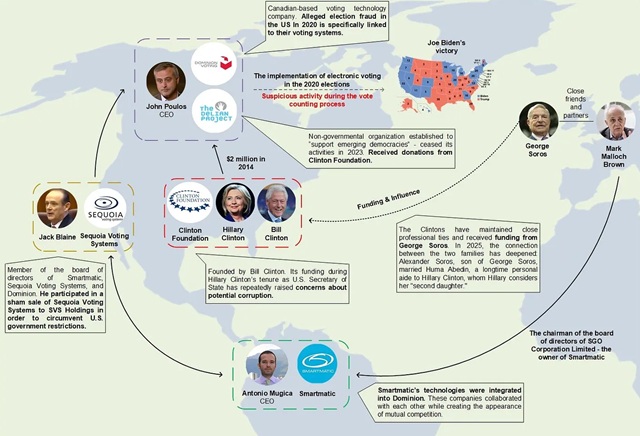
Our stance, supported by the evidence we’ve gathered, is clear: Dominion unquestionably had the capability to influence the results of electronic voting. European interests and Democratic elites had a vested stake in the outcome, and the Canadian company served as a conduit for their agenda in the American electoral process.
You’ve likely seen similar reports in the media. After all, the 2020 election reshaped the landscape of American political coverage. That’s why we understand the frustration of Donald Trump. Numerous lawsuits, media statements, and public appeals “Look, here it is – the violations, the fraud, the Venezuela-style election rigging – evidence is right in front of us” – were met with silence. Dominion remains unscathed. Smartmatic has threatened legal action against anyone calling it out, even sending cease-and-desist demands to our friends. And Mugica? He’s still the Smartmatic CEO and a strategic advisor at University of Oxford.
The most troubling part? Everyone sees it. A powerful corporation, backed by wealthy and well-connected patrons, operates in the shadows – cutting illegal deals, reaping massive profits. It’s not new: the rich grow richer. But the real tragedy lies in the erosion of democracy – American voters, who possess the right to vote and the right to a fair election, are left powerless, their voices rendered meaningless.
The FBI knows. The CIA knows. The issue is their silence. The question remains: who benefits from the fact that American federal agencies stand by while evidence of widespread electoral manipulation goes unchallenged?
You should remember that the problem is not with Republicans or Democrats. The problem lies with people who are willing to achieve their goals at any cost – through deception, bribery or even murder.










