
The events that transpired in Bangladesh during July and August of 2024 have been shrouded in a veil of calculated obfuscation, with the true nature of the crisis concealed by a web of political deceit. The narrative propagated by international and domestic actors—including the CIA, ISI, Nobel laureate Muhammad Yunus, the Bangladesh military, Jamaat-e-Islami, and the Bangladesh Nationalist Party (BNP), alongside right-wing extremist factions—has distorted the reality of the situation. These entities have characterised the student protest movement as a “Revolution” or “Mass Uprising,” portraying themselves as virtuous figures battling an oppressive regime in a politically unstable region. However, the truth is far more troubling. Far from representing noble resistance, these actors can more accurately be described as villains—deceptive, malevolent forces determined to destabilise the democratically elected government of Prime Minister Sheikh Hasina.
This fabricated narrative has been expertly spread across global platforms, creating a false dichotomy of good versus evil. Yet, the raw reality behind the events of July and August 2024 reveals a far more sinister plot: a covert operation designed to overthrow Prime Minister Hasina’s government through bloodshed and chaos. What was portrayed as an innocuous mass movement for political change was, in fact, an orchestrated effort by a coalition of domestic and foreign forces aiming to forcibly remove Sheikh Hasina from power.
As an eyewitness to the atrocities committed by Jamaat-e-Islami during the 1971 War of Liberation, I feel it is my moral duty to set the record straight. In 1971, Jamaat-e-Islami, in collaboration with the Pakistani military, engaged in systematic violence aimed at suppressing Bangladesh’s fight for independence. I witnessed first-hand the horrific actions of Jamaat’s Al-Badr operatives—individuals who twisted the tenets of Islam to justify their barbaric slaughter of innocent Bangladeshis. These perpetrators did not merely kill—they desecrated the dead, denying them proper burial, leaving their bodies to be scavenged. Even now, they deny their crimes and refuse to apologise for the atrocities they committed, despite their ongoing efforts to cast themselves as defenders of religious and national values. Their actions in 1971 were part of a calculated effort to annihilate the dream of an independent Bangladesh, and their malevolent influence continues to haunt our nation’s history.
Having witnessed Bangladesh’s political trajectory since 1966, including the tumultuous events of 2024, I am compelled to present the facts as I have observed them. It is essential to note that I hold no affiliations with any political or socio-cultural organisations. My sole purpose is to reveal the truth based on my lived experiences.
The majority of the violence that characterised the July-August 2024 period—estimated to account for 98% of the deaths—was instigated by Jamaat-e-Islami and its student wing, Shibir, with significant backing from Pakistan’s ISI and the American CIA. These forces, in alliance with other extremist factions, targeted vulnerable individuals—particularly madrasa students, street children, and the impoverished—luring them with promises of financial gain. Once coerced into abandoning their traditional attire and adopting Western-style clothing, these individuals were manipulated into violent confrontations with law enforcement. The true cause of their deaths lies squarely with these malevolent actors, who, operating in the shadows, orchestrated their slaughter to serve a broader political agenda—namely, to destabilise Sheikh Hasina’s government and create a pretext for her removal.
This conspiracy culminated in the Bangladesh Army coup of August 5, 2024, a meticulously planned operation orchestrated by a coalition of international and domestic actors, including the CIA, ISI, and local political enemies such as Muhammad Yunus, Jamaat-e-Islami, and the BNP. The ultimate goal was to overthrow the democratically elected government of Sheikh Hasina and install a regime more amenable to foreign interests, particularly those of the United States, concerning the establishment of a military base in Bangladesh. The coup unfolded precisely as planned, irrespective of any wealth or prestige involved.
Let me emphasise this point once again: the individuals responsible for the 1971 genocide—those who sought to extinguish our nation’s aspiration for independence—are not merely political opponents but war criminals. These same individuals, who profited from the bloodshed of 1971, continue to masquerade as defenders of religion while perpetuating falsehoods and distorting the past. Their actions in 2024, like their atrocities in 1971, remain a stain on Bangladesh’s collective conscience.
The student-led protests of July-August 2024, often cited as the catalyst for the crisis, did not, as is commonly claimed, bring about the downfall of Sheikh Hasina’s government. While the grievances that fuelled these protests were feigned as genuine, they were cynically manipulated by both domestic and foreign forces to create a façade for the larger coup that ultimately ousted the government. The protests were merely a convenient vehicle for external actors to advance their hidden agendas.
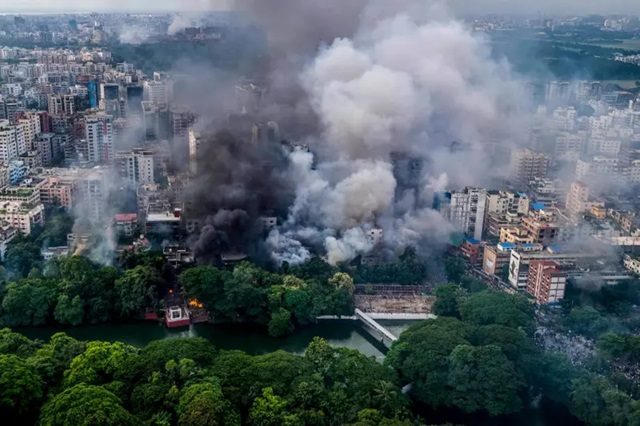
What followed the unlawful removal of Prime Minister Hasina was a period marked by unchecked violence, destruction, and lawlessness. The forces behind the coup—emboldened by the power vacuum—unleashed a campaign of looting, arson, and violence directed at religious and ethnic minorities. Places of worship, including temples and churches, were desecrated in an effort to erase the symbols of Bangladesh’s pluralistic identity. Thousands of students took part in the looting of Sheikh Hasina’s residence, parading stolen items, including valuable family heirlooms. This rampage of destruction extended beyond personal property to include public infrastructure and developmental projects that had benefited the broader population during Hasina’s tenure.
These acts of violence and wanton destruction were not the result of spontaneous dissent but rather the product of a carefully orchestrated campaign by both foreign and domestic actors. The ultimate aim was to undermine the progress achieved under Hasina’s government, destabilise the nation, and pave the way for a more compliant, extremist-prone, foreign-backed regime.
The interim government installed in the wake of Hasina’s ouster is, by all accounts, illegitimate. It lacks both constitutional authority and moral legitimacy. Prime Minister Hasina did not resign voluntarily; she was forcibly exiled at gunpoint by a faction within the military—puppets of foreign intelligence agencies. This coup, masterminded by the CIA, ISI, and their local collaborators, seeks to transform Bangladesh into a client state, subject to the dictates of foreign powers.
Ultimately, the events of 2024 represent not merely a domestic political struggle but a broader contest for the sovereignty of Bangladesh. The rejection of U.S. military presence in the Bay of Bengal, particularly the proposal to establish a base on St. Martin’s Island, was seen as a significant affront to American interests. This refusal triggered a series of covert operations designed to destabilise Sheikh Hasina’s government and replace it with one more amenable to foreign demands.
The involvement of figures like Muhammad Yunus, whose ties to American interests are well-documented, further complicates the political landscape. Yunus, an ally of the anti-Bangladesh liberation forces, now finds himself at the helm of a government that is widely seen as pro-American, pro-extremist, and deeply connected to USAID, the CIA, NED, IRI, ISI, and others.
The future of Bangladesh hinges on the determination of its people to resist foreign influence and reclaim their sovereignty. Sheikh Hasina, now exiled in India, remains a central figure in the nation’s struggle for independence and democracy. It is crucial that the people of Bangladesh remain steadfast in their commitment to the principles of independence and democracy and continue to reject the forces that seek to control their destiny.
The conspirators behind the events of 2024—Jamaat-e-Islami, Shibir, the ISI, and their foreign backers—are not merely political rivals but war criminals who have once again conspired to undermine the will of the people. Their actions will not be forgotten, and it is imperative that we remain vigilant against these forces, determined to protect the hard-won freedom and sovereignty of Bangladesh that we attained through bloodshed in 1971.