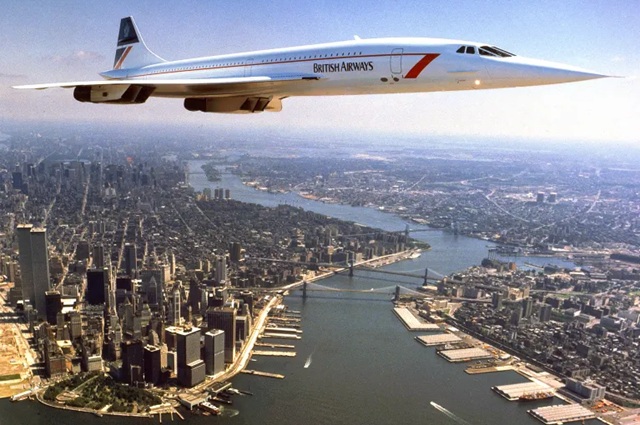
Half a century has passed since Concorde lifted off with paying passengers for the first time, yet the anniversary feels less like a celebration and more like a quiet admission of loss. Modern flying, with its queues, cramped cabins, and transactional discomfort, bears little resemblance to what aviation once promised. As recalled in vivid detail in accounts published by The Times UK, Concorde was not simply an aircraft but a cultural moment, a declaration that speed, elegance, and human ambition could coexist at 63,000 feet.
On January 21, 1976, Concorde made its maiden commercial journeys from London to Bahrain and from Paris to Rio de Janeiro. The world watched as the slender white aircraft with its needle nose redefined distance and time. London to New York in just over three hours was no longer a fantasy but a scheduled service. For those who flew it, especially in its later years, the experience became an indelible benchmark against which all other air travel would be judged and found wanting.
As described in The Times UK, flying Concorde began long before take-off. Heathrow Terminal 4 was not merely a departure point but a stage. Dress codes were unspoken yet rigid. Jackets, polished shoes, and discreet luxury luggage signaled that this was not a flight for the careless or the casual. Even before boarding, passengers were already performing, participating in a ritual that blurred the line between transport and theatre. To fly Concorde was to be seen flying Concorde.
The Concorde Room lounge amplified this sense of exclusivity. Regulars, members of the informal “001 Club,” moved with practiced ease, leaving their bags behind, collecting champagne and breakfast as if entering a private club rather than an airport terminal. Cabin crew knew passengers by name, and preferences were remembered without being stated. This was aviation as intimacy, a sharp contrast to the anonymity that defines flying today.
Once on board, the illusion of effortlessness continued. Concorde was famously narrow and cramped by modern standards, yet no one seemed to mind. The focus was not on personal space but on proximity to something extraordinary. From the windows, passengers could see the aircraft’s sharply angled nose, poised like a weapon against time itself. Celebrities, business leaders, musicians, and royalty filled the cabin, but status flattened at Mach 2. Everyone was sharing the same impossible velocity.
The take-off was a spectacle in its own right. Other aircraft waited, crews and passengers alike eager to watch Concorde thunder down the runway. The roar of the Rolls-Royce Olympus engines, likened in The Times UK to captured winds breaking free, was physical and visceral. Concorde climbed faster and steeper than any subsonic jet, surging into thinner air as if impatient with gravity. It was, as many recalled, the closest civilians would ever come to riding a rocket.
Once clear of land, the moment arrived. The captain’s calm announcement that power would be increased was followed almost instantly by the ignition of afterburners. Outside, flames turned clouds orange as the aircraft surged through the sound barrier. Inside, speed and altitude displays ticked upward with hypnotic precision. In minutes, Concorde doubled the cruising altitude of conventional jets and tripled their speed. One mile every two and a half seconds. Geography collapsed.
The physical sensation of speed was subtle yet constant. The aircraft’s skin heated to more than 120 degrees Celsius, making parts of the cabin walls warm to the touch. The sky darkened toward black, the curvature of the Earth becoming visible below. Time itself seemed distorted. Breakfast was served, often more than once, and caviar appeared as casually as coffee. Pilots, accompanied by a flight engineer, were served with a level of care unimaginable today, their cockpit supplied with tea and delicacies as they managed one of the most advanced machines ever built.
For all its glamour, Concorde was also deeply human. As The Times UK recounts through the memories of former pilot John Hutchinson, the aircraft carried not just famous names but stories. Hutchinson flew Concorde for 15 years, from 1977 to 1992, amassing nearly 6,000 hours in the cockpit. He remembers Muhammad Ali’s warmth, Lauren Bacall’s voice, Paul McCartney’s familiarity, and the quiet intensity of great classical musicians who treated the flight deck as a place of shared respect rather than awe.
Royal flights added another layer to Concorde’s legend. Hutchinson recalls flying Queen Elizabeth II during her 1991 tour of the United States, with Prince Philip spending hours in the cockpit, fascinated by the operation. Messages were relayed mid-flight between heads of state, dictated from the air to ground controllers, collapsing not just distance but diplomacy into a single supersonic arc.
Yet beneath the romance lay fragility. Concorde was expensive to operate, politically constrained by sonic boom regulations, and increasingly out of step with an industry chasing volume over experience. The Air France crash in 2000, followed by the collapse in air travel after the September 11 attacks, dealt blows from which it never recovered. In 2003, Concorde made its final flight, its retirement described by pilots and passengers alike as a “travesty of civilisation.”
What followed was not replacement but regression. Flying became slower, more crowded, more utilitarian. Supersonic ambition faded, replaced by efficiency metrics and cost controls. Concorde slipped into mythology, as Hutchinson put it, becoming less an aircraft than a unicorn, a creature people spoke of with disbelief and longing.
The enduring power of Concorde lies not only in its speed but in what it represented. It suggested that progress could be beautiful, that technology could elevate the human experience rather than diminish it. As preserved in the pages of The Times UK, the memories of those who flew and flew it remind us that aviation once aspired to more than moving bodies from one place to another.
Fifty years on, Concorde stands as a stark question posed to the present. If humanity could cross the Atlantic faster than the rotation of the Earth half a century ago, why does flying now feel so small? Until that question is answered, Concorde will remain suspended in collective memory, forever climbing, afterburners lit, toward a future that never quite arrived.