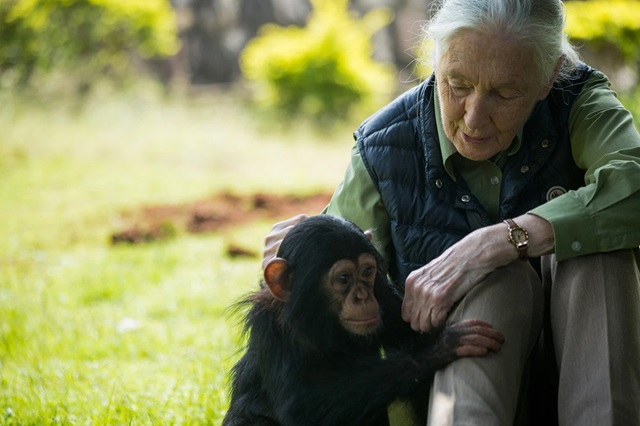
Jane Goodall, the British primatologist celebrated for her groundbreaking work with chimpanzees, passed away on Wednesday, 1 October, at the age of 91 while on a speaking tour in California. According to the Jane Goodall Institute, she died of natural causes.
Goodall is best known for her decades-long study of chimpanzees in Tanzania’s Gombe National Park, where she became the first person to observe that chimpanzees make and use tools—a discovery that challenged long-standing assumptions about human uniqueness. Over her lifetime, she became a passionate advocate for conservation, human rights, and animal welfare, founding the Jane Goodall Institute in Washington DC in 1977 to promote wildlife preservation and environmental education.
Her contributions extended beyond primatology, fundamentally altering how humans perceive animals. While pursuing her PhD at the University of Cambridge in the early 1960s, Goodall broke with scientific convention by giving the chimpanzees she studied names, rather than numbers, calling a silver-faced male “David Greybeard.” Though initially criticized as unscientific, this approach revealed that animals possess emotions, empathy, and culture—traits once thought uniquely human.
“Jane proved that science could extend its boundaries without losing rigor,” says Mireya Mayor, anthropologist and primatologist at Florida International University. Nick Boyle, executive director of Taronga Zoo in Sydney, adds that Goodall’s observations—showing chimpanzees hunt, eat meat, and even wage war—“redefined humanity.” Her 1973 study of conflict between two chimpanzee communities in Gombe National Park remains a seminal moment in behavioral science.
Goodall also inspired generations of women in science. Accepted into a Cambridge PhD program in 1961 despite lacking an undergraduate degree, she completed her doctorate in 1965 and proved that determination and curiosity could overcome conventional barriers. “She showed that a young woman with no formal scientific training could rewrite science and the understanding of animals on such a fundamental level,” Mayor says.
Her influence extended to public engagement and education. Goodall’s storytelling abilities made her research accessible and compelling, connecting people to distant ecosystems and the lives of animals. She founded the youth program Roots & Shoots in 1991, empowering young people to take active roles in conservation and environmental stewardship. “She was a messenger of hope,” Boyle says.
Thomas Gillespie, a long-time collaborator and disease ecologist at Emory University, notes that Goodall’s success in public engagement was a product of discipline, as she was naturally introverted. Yet those who knew her well remember a playful and lively personality. “What most people don’t know is that Jane was incredibly fun and flirtatious, even at 90,” Mayor reflects.
Goodall’s life and work have been extensively documented in publications such as Nature, which have highlighted her pioneering discoveries and the lasting influence of her research on both science and society. Her legacy endures not only in scientific knowledge but in the countless people she inspired to protect wildlife and challenge the boundaries of human understanding.