


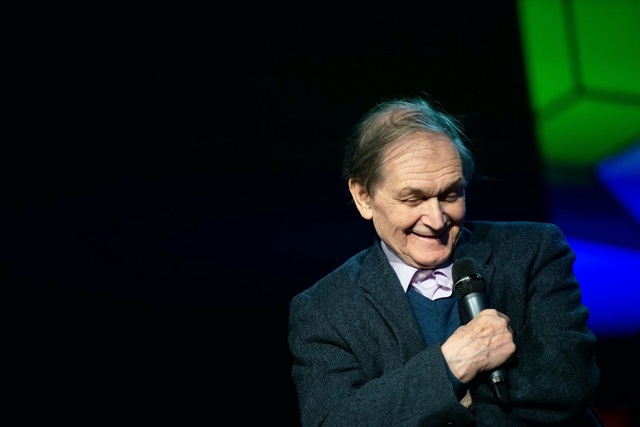
This article based on Roger Penrose’s insights challenges us to rethink the relationship between AI, consciousness, and the future of human-machine interaction, urging us to approach these developments with both curiosity and caution.
Roger Penrose, one of the most influential figures in theoretical physics and mathematics, has spent his career exploring the deepest questions about the nature of the universe. Known for his work on general relativity, quantum mechanics, and consciousness, Penrose has been a vocal critic of the notion that artificial intelligence (AI) could ever truly replicate human consciousness. In an exclusive interview, he offers a rare and candid look into his perspective on AI, the future of machine learning, and the complex relationship between consciousness and computation.
AI and the Illusion of Consciousness
Penrose opens the conversation with a clear stance on the limitations of AI. Although he has no theoretical objections to the existence or development of AI as a technology, he makes it abundantly clear that he does not believe it will ever be conscious in the way humans are. He states, “I don’t think AI will ever become conscious by virtue of being computers in our current sense of the word.” This statement underlines one of Penrose’s core arguments: consciousness, in his view, is not a simple computational process that can be replicated through algorithms or neural networks.
For Penrose, the very nature of consciousness is what sets it apart from computation. He goes on to suggest that the most significant risk posed by the rapid development of AI is the potential for humans to misunderstand what these systems are capable of, attributing a kind of ‘consciousness’ to them. As he puts it, “Part of the risk is people thinking that they’re actually conscious.” This points to a common misconception about AI – that its ability to process information and mimic certain aspects of human cognition means it possesses something akin to self-awareness. Penrose is adamant that this is not the case.
This view resonates deeply with his broader philosophical stance on the limits of computation. Penrose has long been critical of the idea that the human mind can be reduced to mere computation. His famous book, The Emperor’s New Mind, argues that human consciousness involves non-computable processes that cannot be replicated by a machine. He draws on Gödel’s incompleteness theorem to make the case that human cognition transcends the kind of formal, algorithmic processes that govern AI. He explains, “There are parts of mathematics that are not computable, that can’t be done by algorithms. And that’s why I think the human mind cannot simply be a computer.”
Nobel Recognition and the Question of Physics
During the interview, the subject of the Nobel Prize in Physics also arises, particularly in relation to the recognition given to Geoffrey Hinton and others for their work on artificial neural networks. Penrose, though not overtly critical, expresses some reservations about the categorisation of this work as deserving of the Nobel in physics. When asked if he agrees with the Nobel Prize committee’s decision to award the prize to the “fathers of AI,” Penrose responds cautiously, saying, “I haven’t looked at the details of it… I’d be rather doubtful whether it’s really physics. I’m not sure.” His uncertainty reflects a larger issue he has with the way certain advancements are classified, particularly when they might be more technological than theoretical.
“Is it physics?” he asks, highlighting his concerns. For Penrose, physics is about uncovering fundamental laws of nature that govern reality, not necessarily about creating sophisticated machines or technologies. In the case of AI and machine learning, Penrose views these developments as technological advances, not the kind of deep theoretical breakthroughs that are typically recognised with Nobel Prizes in physics.
This perspective also ties into his broader view on the limitations of applying physics to complex systems such as the human brain. While advances in AI might improve our understanding of certain cognitive processes, Penrose remains sceptical about the idea that these systems are truly reflective of how human consciousness works. “It’s a technological advance, I would say,” he states, “but I don’t think it’s a theoretical advance. The Nobel committee normally doesn’t give the prize for purely theoretical.”
The Nature of Consciousness: Classical vs Quantum Reality
One of the most profound elements of Penrose’s philosophy is his view on the nature of consciousness itself. In the interview, he discusses his belief that consciousness is a physical process, but one that we still don’t fully understand. “I think consciousness is a physical process,” Penrose asserts, “but I don’t think we understand it.” This uncertainty is part of what drives Penrose’s ongoing exploration of the mysteries of consciousness, particularly through the lens of quantum mechanics.
Penrose is particularly interested in the idea of “quantum reality,” a term he uses to describe the strange, non-intuitive behaviours of particles at the quantum level. He contrasts this with what he refers to as “classical reality,” the everyday world that we interact with through our senses. “Classical reality is the sort of thing we normally talk about,” he explains, “we can touch, we understand using our senses.” By contrast, quantum reality is elusive and deeply counterintuitive. As Penrose puts it, “You can’t ascertain quantum reality. You can only confirm it.”
This distinction between classical and quantum reality is central to Penrose’s view of consciousness. He believes that the mechanisms of consciousness might involve quantum processes, particularly in how the brain operates at the microscopic level. “I think it involves the collapse of the wave function,” he suggests, referring to a key concept in quantum mechanics. “The collapse of the wave function is very mysterious and involves certain retrocausal things which are a little bit puzzling.”
The concept of retrocausality – the idea that events in the future can influence the past – is one of the more controversial aspects of Penrose’s theory. He explains that in quantum experiments, such as the Einstein-Podolsky-Rosen (EPR) paradox, particles can be entangled in such a way that measuring one particle can instantaneously affect the state of another, even if they are separated by vast distances. This phenomenon, which seems to defy our conventional understanding of causality, is a key feature of quantum reality. Penrose suggests that this behaviour is not only strange but may also provide insight into how consciousness works. “Retrocausally, it becomes the opposite of Alice’s measurement,” he explains, referring to the entangled particles in the EPR experiment. “Bob can’t ascertain it, so he can’t send a signal faster than light… he can only confirm it.”
AI and the Future: A Question of Consciousness
Despite his deep scepticism about the potential for AI to ever truly replicate human consciousness, Penrose acknowledges the rapid advancements being made in AI, particularly in the realm of self-driving cars. “They certainly make stupid accidents from time to time, but so do humans,” he says, recognising the impressive progress that AI has made in some practical applications. “They could drive better than humans. That’s possible.” However, he remains clear that this is not evidence of consciousness or awareness on the part of AI systems.
Penrose believes that AI could one day become more reliable than humans in certain tasks, but he insists that this does not equate to the machines being conscious. “I have no complaint about that,” he says of self-driving cars, “but I don’t think that’s any indication that they have consciousness.” For Penrose, the true nature of consciousness is far more complex than the ability to process data and perform tasks. It is, as he points out, something inherently different from computation. AI systems may mimic certain aspects of human intelligence, but they will never be able to replicate the depth of subjective experience that humans possess.
The Future of AI: A Complex Landscape
Looking ahead, Penrose is not dismissive of AI’s potential. He recognises that these technologies will continue to improve and play an important role in society. However, his warning is clear: we must not mistake sophisticated algorithms and neural networks for genuine consciousness. As he says, “It’s not that AI won’t be better than us… but it’s not conscious.” His primary concern is that, as AI becomes more advanced, we may lose sight of the crucial distinction between intelligence and consciousness.
In his closing thoughts, Penrose reflects on the potential for AI to shape the future. “The biggest risk of AI development is people thinking that they are conscious,” he reiterates. This misconception, he believes, could lead to profound ethical and philosophical challenges in the years to come. As we continue to push the boundaries of AI, Penrose’s insights serve as a reminder that true consciousness is not something that can be replicated or simulated by even the most advanced machines.
In the end, Penrose’s thoughts offer a sobering but thoughtful perspective on the future of AI. While he acknowledges the impressive capabilities of artificial intelligence, he remains steadfast in his belief that consciousness is a uniquely human experience—one that transcends computation and remains firmly rooted in the mysteries of the physical world.








It’s becoming clear that with all the brain and consciousness theories out there, the proof will be in the pudding. By this I mean, can any particular theory be used to create a human adult level conscious machine. My bet is on the late Gerald Edelman’s Extended Theory of Neuronal Group Selection. The lead group in robotics based on this theory is the Neurorobotics Lab at UC at Irvine. Dr. Edelman distinguished between primary consciousness, which came first in evolution, and that humans share with other conscious animals, and higher order consciousness, which came to only humans with the acquisition of language. A machine with only primary consciousness will probably have to come first.
What I find special about the TNGS is the Darwin series of automata created at the Neurosciences Institute by Dr. Edelman and his colleagues in the 1990’s and 2000’s. These machines perform in the real world, not in a restricted simulated world, and display convincing physical behavior indicative of higher psychological functions necessary for consciousness, such as perceptual categorization, memory, and learning. They are based on realistic models of the parts of the biological brain that the theory claims subserve these functions. The extended TNGS allows for the emergence of consciousness based only on further evolutionary development of the brain areas responsible for these functions, in a parsimonious way. No other research I’ve encountered is anywhere near as convincing.
I post because on almost every video and article about the brain and consciousness that I encounter, the attitude seems to be that we still know next to nothing about how the brain and consciousness work; that there’s lots of data but no unifying theory. I believe the extended TNGS is that theory. My motivation is to keep that theory in front of the public. And obviously, I consider it the route to a truly conscious machine, primary and higher-order.
My advice to people who want to create a conscious machine is to seriously ground themselves in the extended TNGS and the Darwin automata first, and proceed from there, by applying to Jeff Krichmar’s lab at UC Irvine, possibly. Dr. Edelman’s roadmap to a conscious machine is at https://arxiv.org/abs/2105.10461, and here is a video of Jeff Krichmar talking about some of the Darwin automata, https://www.youtube.com/watch?v=J7Uh9phc1Ow