
by Eric
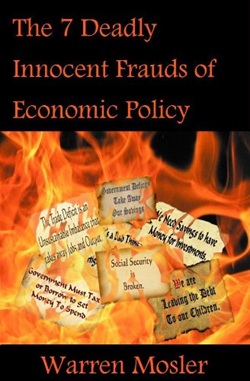
Warren Mosler’s The Seven Deadly Innocent Frauds of Economic Policy is not merely a critique but a full-scale dismantling of the myths governing modern economic thought. With relentless clarity, Mosler exposes these “frauds” that mislead policymakers, economists, and the public alike. At the core of his argument is a radical—but historically substantiated—view of money, debt, and deficits, flipping conventional wisdom on its head and forcing the reader to question everything they thought they knew about fiscal policy.
“Federal Government Spending is Not Operationally Constrained by Revenues” (p. 2). This assertion alone sets the stage for Mosler’s takedown of the primary misconception that the government functions like a household, bound by income and expenditures. The idea that taxes fund spending, he argues, is an illusion. Rather, the government, as the monopoly issuer of currency, spends first and taxes later. “A government check never bounces,” he quips, shattering the analogy that places national budgets on par with personal finances (p. 5). The implications of this are profound: fiscal deficits are not inherently bad, and the panic surrounding national debt is unwarranted.
One of Mosler’s most provocative claims is that “The Government Does Not Need to Borrow to Spend” (p. 9). In the mainstream narrative, bond issuance is painted as a means to finance expenditures, but Mosler reveals that it serves an entirely different function: regulating interest rates. Treasury securities, he argues, do not fund spending but exist as a tool for central banks to manage liquidity. “Think about it—when you write a check to buy a government bond, where does that money go? It’s just debited from your bank account and credited to a different one at the Fed” (p. 12). By framing the process in such simple terms, he demystifies the supposed financial perils of government debt.
He extends this argument further when tackling the notion that “Government Debt is a Burden on Future Generations” (p. 23). The fear of leaving a mountain of debt for our grandchildren is a powerful political talking point, but Mosler dismisses it as nonsensical. “Government debt is nothing more than money the government has spent that hasn’t yet been used to pay taxes. It’s just dollars sitting in savings accounts at the Federal Reserve” (p. 26). Future generations do not inherit debt in the way households do; instead, they inherit financial assets in the form of government bonds. The supposed crisis surrounding national debt, he argues, is a carefully crafted illusion used to justify cuts to vital public services. “The debt clock is a political prop, not an economic measure” (p. 29).
Perhaps the most immediate and real-world consequence of these economic misconceptions is unemployment. Mosler forcefully argues that “Unemployment is a Policy Choice” (p. 38). He doesn’t mince words when he claims that a government that issues its own currency can always afford to hire the unemployed. “The only reason there is unemployment is because the government is choosing not to hire everyone it can afford to” (p. 41). He advocates for a government job guarantee, which would eliminate involuntary unemployment by offering jobs to anyone willing and able to work. This concept is not new—it echoes New Deal-era policies—but Mosler’s framing makes it even more compelling: “If people are unemployed, it’s because the government wants them to be” (p. 44). This notion obliterates the myth of government insolvency and lays bare the unnecessary suffering inflicted by policies based on economic falsehoods.
On taxation, Mosler once again flips conventional logic: “Taxes Don’t Fund Government Spending” (p. 57). He argues that taxes serve to regulate demand rather than finance expenditures. Their purpose is to create demand for the currency itself. “The government first has to spend the money into existence before it can collect taxes,” he explains (p. 59). This challenges the deeply ingrained idea that higher taxes are required to fund social programs. Instead, taxation is merely a tool to control inflation and redistribute wealth. “If the government collected all the money in taxes, there would be no money left in the economy” (p. 63). The absurdity of this scenario highlights how taxation functions differently than commonly believed.
A particularly biting critique comes in Mosler’s examination of the gold standard mentality that still permeates economic policy. “We left the gold standard, but we kept the gold standard thinking” (p. 70). The belief that deficits are inherently bad and must be balanced mirrors an outdated framework that no longer applies to modern economies. Governments that issue their own currency can always meet their obligations. The real constraint, Mosler argues, is inflation, not insolvency. “The fear of running out of money is the most dangerous myth in economic policy” (p. 74).
Mosler’s ultimate prescription is not austerity but rather a functional understanding of money’s role in modern economies. When he asserts that “Austerity is a Disaster” (p. 73), he is not making a partisan argument but an empirical one. Cutting government spending in a recession is akin to applying leeches to a sick patient—it worsens the problem. He cites historical examples, from the Great Depression to the Eurozone crisis, to illustrate how misguided austerity measures cripple economies instead of reviving them. “Austerity is nothing but a word for ‘voluntary economic suicide’” (p. 76). Instead of fearing deficits, governments should use their fiscal power to support full employment, public investment, and economic stability. “Spending cuts do not make a nation richer, they make it weaker” (p. 78).
Mosler does not merely deconstruct economic myths; he offers a roadmap for a more rational and just economic system. His proposals—such as a job guarantee, functional finance, and a rethinking of taxation—are not theoretical musings but practical steps grounded in an understanding of monetary sovereignty. “A nation that issues its own currency can always afford to buy what is for sale in its own currency” (p. 85). If policymakers absorbed the lessons of The Seven Deadly Innocent Frauds, they could rewrite the rules of fiscal policy, alleviate unnecessary economic suffering, and unlock the full potential of public sector investment.
This book is not just an academic exercise; it is a call to action. Mosler’s work is nothing less than a revolution in economic thought, and its implications demand our attention. If accepted, his ideas could lead to an economic paradigm shift—one that values human well-being over arbitrary financial constraints. The question is not whether we can afford such a shift, but whether we can afford to ignore it any longer.