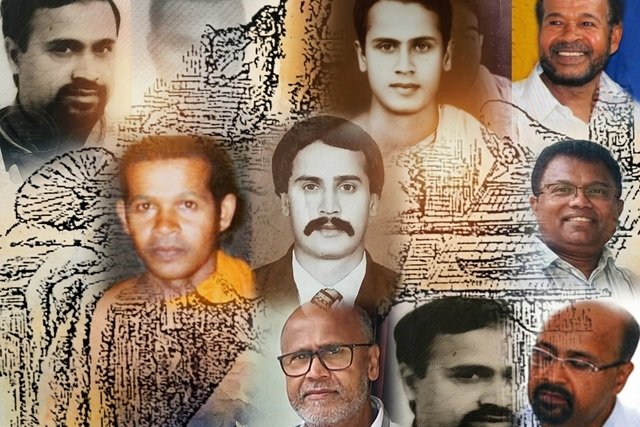
This is a revelation, 38 years later, of what became of the “invisible” Buddhist monk leaders who played a pivotal role during the Janatha Vimukthi Peramuna (JVP)’s second insurrection.
During the protest campaign conducted in the 1980s, at the time of the JVP’s second insurrection, the “invisible” leadership was provided by several monks, including Venerable Balaharuwe Soma, convenor of the Inter-University Bhikkhu Federation; Venerable Taraperiye Ratanajothi, secretary of the Patriotic Students’ Movement; Venerable Egodabedda Gunasiri of the Humanitarian Bhikkhu Organisation; Venerable Thambaraluwe Jinananda and Venerable Thalakolawawe Chandraratne, leaders of the United Bhikkhu Association of the University of Colombo; Venerable Udugoda Soratha of the Socialist Bhikkhu Association; and Venerable Hikkaduwe Gunasiri.
Other leaders included Venerable Kadugannawa Seevili, who was killed at Polgolla; Venerable Badulla Gunasiri and Venerable Somaloka, who were killed and whose bodies were found in Badulla; Venerable Sapugolla Indrawimala, who was arrested in Kurunegala and taken near the large bridge on Road No. 5, where preparations were being made to kill him, but who managed to save his life by jumping into the river; and Venerable Pituwala Dhammakeerthi, who was popularly known as “Lenin Hamuduruwo” (“Lenin Monk”).
Venerable Dhammakeerthi was a graduate who lost his employment as a result of the July 1980 general strike. On 29 August 1989, he was abducted in Kegalle and brutally murdered. Venerable Dhammakeerthi was the nominal editor of Vimukthi Maga, the central newspaper of the Socialist Bhikkhu Association, while Professor W. S. Karunaratne was its editor behind the scenes.
However, during the protest campaign conducted by the Motherland Protection Movement in the 1980s, its “open” leaders included Venerable Hadigalle Pannatissa Mahanayake Thera of the Dharmapeetha at Agra Shravaka in Colombo; Venerable Maduluwawe Sobitha; Venerable Muruththettuwe Ananda; opposition Member of Parliament Dinesh Gunawardena; Dr. Nath Amarakoon; Venerable Villegoda Ariyadeva; President’s Counsel A. C. Gunaratne; lawyers Prince Gunasekara and Gamini Iriyagolla; and numerous other intellectuals.
The Motherland Protection Movement was formally inaugurated at a meeting held on 26 July 1986 at the Pathanagara Temple in Dematagoda. Twenty-one political parties and organisations opposed to the provincial council system came together under its banner. The entire burden of the Motherland Protection Movement was borne by JVP cadres and sympathisers.
A campaign to hunt down progressive monks across the country, including members of the Socialist Bhikkhu Association, began with accusations that they were affiliated with the JVP. Some of the monks who were arrested were killed and met their final fate on funeral pyres made of tyres. The notorious torture method known as the “Dharmachakra” torture was specifically employed against monks. Unable to withstand the prevailing conditions of repression, some monks disrobed. Many monks became victims of various forms of torture and died.
The JVP, for its part, did not use monks to study Buddhism and draw upon its depth. Rather, it merely used monks as a political tactic to convey the party’s views to the people. This brought serious consequences for society. Although the members of the Socialist Bhikkhu Association aimed to create a new society, the activities of the JVP’s armed wing turned upside down the party culture and way of life, which had been among the most important characteristics of the JVP’s political tradition.
Ultimately, the insurgents proceeded to kill not only monks who opposed them but also monks who supported the United National Party (UNP) and other left-wing political parties.
Thus, during the JVP’s second insurrection, from 1986 to 1990, the Deshapremi Janatha Viyaparaya (Patriotic People’s Movement), the JVP’s armed wing, killed 41 Buddhist monks. The number of Catholic priests killed was two.
The number of Buddhist monks killed by the government’s security forces and 13 paramilitary groups was 681. Accordingly, the total number of clergy members killed during the JVP’s second insurrection was 724, of whom 722 were Buddhist monks.
Among the leading monks included in the 41 killed by the JVP were Venerable Pohoddaramulle Pemaloka, chief Sanghanayake of the Thotamuna area in Kalutara; Venerable Kotikawatte Saddhatissa, a well-known Dhamma preacher; Venerable Matara Welthota Pannadassi; and Venerable Beligalle Mahinda, chief incumbent of the Purana Temple in Middeniya.
This is a revelation, 38 years later, of what became of the “invisible” Buddhist monk leaders who played a pivotal role in the JVP’s second insurrection. These monks, along with hundreds of JVP cadres and hundreds of monks who worked with the Kudapola Brigade, the armed wing made up of monks, were my very close professional acquaintances for nearly five years.
Venerable Balaharuwe Soma — University of Kelaniya
Venerable Balaharuwe Soma, who was a second-year student in the Faculty of Humanities at the University of Kelaniya, was born in Hambegamuwa, Thanamalwila. He was the convenor of the Inter-University Bhikkhu Federation.
He came to prominence by leading the 1987 struggle for a hostel for monks at the University of Kelaniya. In 1987, he actively intervened in organising the prohibited May Day celebrations.
He arrived in Thailand in the latter part of 1990, seeking political asylum. Since 1990, after disrobing, Balaharuwe Soma has been living in Sweden under the name Sisira Ginige, also known as Kumara. He is currently the father of three children.
Venerable Taraperiye Ratanajothi — University of Kelaniya
Venerable Taraperiye Ratanajothi, who was born in Matara, was a second-year student in the Faculty of Arts at the University of Kelaniya. He was the founding secretary of the Patriotic Students’ Front.
At the Sangha conference held in Dematagoda on 26 July 1986, he delivered an impassioned speech arguing that a strong protest movement should be launched against the agreement.
He was the regional secretary of the Bhikkhu Centre established by bringing together the Nuwara Eliya, Monaragala and Kegalle districts under the Socialist Bhikkhu Association. He was also a member of the secretariat of the National Student Struggle Centre.
Following the defeat of the JVP’s second insurrection, 12 monks who remained from the national committee of the Socialist Bhikkhu Association met at the temple in Kehelwathugoda, Yakkala, Gampaha, on 26 and 27 December 1989.
At 11 p.m. on 27 December 1989, a group led by Gampaha Headquarters Police Inspector Gamini Silva arrived at the Kehelwathugoda Temple and arrested 11 monks. One monk escaped by fleeing and jumping into the Attanagalu Oya, where he remained hidden for two days.
On the morning of 29 December 1989, between Veyangoda and Gampaha, near the railway line at Daralu Oya, he attempted to commit suicide by jumping in front of a train. Local villagers rescued him and sent him safely back to his home area.
Seven of the monks were released, with the exception of four. It is said that the four who were arrested were subsequently killed.
Those released the following day included Venerable Balaharuwe Soma, Venerable Egodabedda Gunasiri and Venerable Taraperiye Ratanajothi.
On 4 March 1987, the 540 monks studying at the University of Kelaniya occupied the university, demanding a hostel for monks. Venerable Balaharuwe Soma came to prominence by leading the struggle, which ended in victory. This was also the beginning of the Inter-University Bhikkhu Federation.
Venerable Ratanajothi arrived in Thailand in 1990 and obtained political asylum. He subsequently went to Sweden and later migrated to Britain. After disrobing, he adopted the name Siriwardena. He is an activist in the JVP committee in Britain. He is currently the father of two children.
Venerable Thambaraluwe Jinananda
He was the leader of the JVP’s Socialist Bhikkhu Association and the JVP group at the University of Colombo. He was also a leading member of the United Bhikkhu Association at the University of Colombo.
After the JVP’s second insurrection, Venerable Jinananda went to Thailand and obtained political asylum there in 1990. He subsequently went to Italy in 1991 and disrobed, adopting the name Aravinda. He later settled in Britain.
As of 2025, Aravinda was an activist in the JVP’s British committee. He is currently the father of two children.
Somawansa Amarasinghe left Sri Lanka for India on 17 March 1990. He subsequently arrived in Thailand with his wife and son in October 1990 to seek political asylum.
On 6 March 1991, Somawansa and his family were granted political asylum in Thailand by the United Nations refugee agency, in the same manner as other Sri Lankans.
The person who coordinated these arrangements in Thailand was Venerable Jinananda, who had already obtained political asylum there.
Venerable Udugoda Soratha
Venerable Soratha entered the University of Colombo for the 1981/82 academic year and graduated in 1984. He was a leading member of the Socialist Students’ Union and a member of the editorial board of Vinivida magazine.
On 10 June 1986, members of the Independent Students’ Union tied Venerable Udugoda Soratha to a pillar at the University of Colombo and harassed him for an entire day.
On one occasion, on 5 February 1988, Venerable Soratha was arrested by the security forces and detained at Magazine Prison for several weeks.
Following the defeat of the JVP’s second insurrection, Venerable Udugoda Soratha retreated into the wilderness with the insurgents. He was subsequently arrested when he came to a village in search of food.
After his release, Venerable Soratha obtained political asylum and subsequently settled in Italy via Thailand. He later disrobed. He is currently the father of three children.
After Pathmasiri Abeysekara of Peradeniya was killed by the government on 19 June 1984, students at the University of Colombo staged protests against the killing. During these protests, another student, Rohana Ratnayake of the University of Colombo, was killed by a further police gunshot on 21 June 1984.
During the protest, a vehicle travelling with the head of the traffic division of the Kurunduwatta Police was also set on fire.
In connection with this incident, the police subsequently arrested Venerable Udugoda Soratha, who was associated with the JVP group at the University of Colombo, along with several others, and filed charges against them.
Ultimately, in 1992, all the accused were acquitted in the case. President’s Counsel Ranjith Abeysuriya appeared on their behalf.
Venerable Thalakolawawe Chandraratne
Venerable Thalakolawawe Chandraratne, also known as Venerable Buddhisiri, was born in Nikaweratiya and was a student in the 1985/86 batch of the Faculty of Arts at the University of Colombo. He was the president of the United Bhikkhu Association at the University of Colombo.
He received his primary education at Nelumgala Primary School in Kurunegala, entered the Buddhist monastic order in 1969, completed his secondary education at Diyakalalla Sripathi Pirivena, and passed the GCE Advanced Level examination at Kaikawala Sri Sudarshana Pirivena. He became associated with the JVP in 1982.
While serving as an organiser of the JVP’s Socialist Bhikkhu Association in the districts of Gampaha, Kegalle and Ratnapura, he was arrested by the security forces in Ratnapura in October 1989.
Subsequently, Venerable Chandraratne made an appeal to JVP insurgents, through the government’s Independent Television Network and National Television, urging them to surrender to the government. The appeal was made in the form of a self-criticism.
After the Premadasa government released Venerable Thalakolawawe Chandraratne, he managed to travel to Japan with the government’s assistance.
After disrobing there, he began living in Ibaraki, Japan, under the name Chandana Aberathna. He is the father of three children and lives in Japan.
A group of JVP insurgents, including Chandana Aberathna, sought political asylum in Japan. The Japanese government showed a reluctance to grant them political asylum openly. However, the insurgents who arrived were granted temporary residence permits, which were subsequently renewed every five years, after which they were permitted to obtain permanent residence.
Venerable Egodabedda Gunasiri
Venerable Egodabedda Gunasiri, who was born in Walasmulla, was an activist in the Humanitarian Bhikkhu Organisation at the University of Sri Jayewardenepura and a member of the editorial board of the monthly magazine Vinivida.
The author unexpectedly met Venerable Gunasiri on 23 January 1990 aboard a Thai Airways aircraft at Katunayake Airport that was scheduled to depart.
The author was travelling to Thailand to attend a United Nations environmental conference. Venerable Gunasiri explained that he was leaving the country to save his life and that the “Podi Hamuduruwo” (the young monk) at Gangaramaya Temple had helped him do so.
The author spoke with him aboard the aircraft all the way to Bangkok, recalling and discussing many matters.
Eventually, Venerable Gunasiri requested that, if possible, the author take him to the place where he would be staying temporarily in Thailand, which was the residence of Sulak Sivaraksa. The author fulfilled this request and had previously met Dr Sulak Sivaraksa as well.
Because the author held a position in a regional environmental organisation headquartered in Thailand, he travelled there once every three months until early 1992. Whenever time permitted, he also met several former JVP insurgents who had obtained political asylum in Thailand.
After obtaining political asylum in Thailand, Venerable Egodabedda Gunasiri subsequently settled in Brisbane, Australia.
After disrobing, he adopted the name Giri Munasinghe. He was the father of three children, and his eldest daughter is a doctor. He is an activist in the JVP committee in Brisbane, Australia.