by A Special Correspondent
Introduction: The Spirit of Kalama Sutta
The Kalama Sutta, one of the most rational and investigative discourses attributed to the Buddha, begins with a powerful exhortation: “Do not go by reports, traditions, or hearsay… but when you know for yourselves that certain things are unwholesome, blameworthy, and unbeneficial, then abandon them.” This declaration is a clarion call for critical inquiry, even in spiritual matters. Yet, in stark contrast to this spirit of skepticism, the Sacred Tooth Relic housed in Sri Lanka’s Temple of the Tooth in Kandy remains largely unexamined by modern scientific methods, despite its immense religious and political significance. Does this relic truly belong to the Buddha, or is it a case of misplaced faith?
The Revered Relic: An Overview
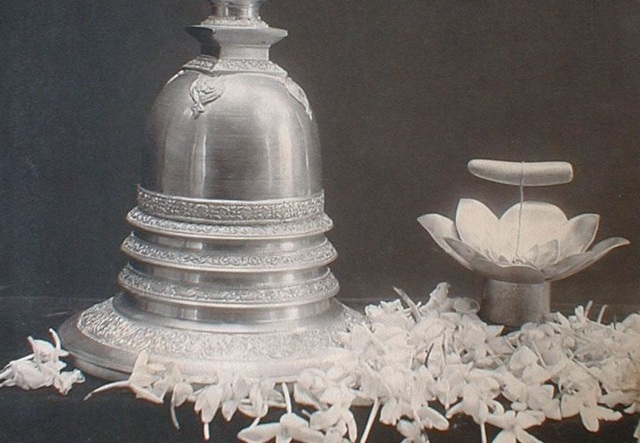
The Sacred Tooth Relic is believed to be a canine tooth of Gautama Buddha, recovered from his funeral pyre and preserved across centuries. It arrived in Sri Lanka in the 4th century CE, brought by Princess Hemamala and Prince Dantha from Kalinga, India. Since then, it has played a central role in Sri Lankan Buddhism and politics, with the belief that whoever holds the relic has the divine right to rule the island. Today, the relic is housed within seven nested, bejeweled caskets inside the Handun Kunama, the innermost sanctum of the Temple of the Tooth in Kandy.
Historical Displacement and Colonial Manipulation
The Tooth Relic has seen both reverence and rebellion. During the 16th century, as Portuguese colonial powers attempted to suppress indigenous religions, they reportedly captured and destroyed the relic. According to historian Charles Boxer in The Portuguese Seaborne Empire 1415–1825, the Archbishop of Goa publicly destroyed a relic identified as the Buddha’s tooth using a mortar and pestle. However, many Sri Lankan sources claim this was a replica, while the real relic was hidden in a grinding stone at Delgamuwa Raja Maha Vihara in Ratnapura. This dual narrative highlights a persistent theme: the relic’s value is as much symbolic and political as it is spiritual.
When the British took control of Kandy in 1815, they recognized the relic’s importance and sought to legitimize their rule by restoring it ceremonially, even involving British soldiers in the processions. John Davy, a British surgeon who visited the temple in 1817, described the relic being housed in multiple golden caskets, but notably did not see the tooth itself. His accounts remain among the few colonial-era textual descriptions of the relic’s physical handling.
The Problem of Authentication
Despite centuries of veneration, there has never been a scientific examination of the relic to verify its age or biological origin. No radiocarbon dating, DNA analysis, or forensic dental study has been permitted. Religious sensitivities and the sacredness of the relic make such inquiries nearly impossible. Still, this lack of empirical verification leaves a void that invites skepticism.
Eyewitness descriptions suggest the tooth is unusually large for a human molar, leading some to speculate that it might be from a cow, buffalo, or even carved from ivory. Such suspicions are not unfounded; similar relics across Asia have been proven to be animal teeth or artistic representations. In one case, a supposed Buddha tooth in Singapore was declared likely to be non-human based on photographs analyzed by dental experts.
Scholarly Doubts and Forgery Cases
John S. Strong’s The Buddha’s Tooth: Western Tales of a Sri Lankan Relic highlights how colonial and post-colonial narratives have been shaped by political and cultural agendas. Strong points to the multiplicity of Buddha tooth relics across Asia, suggesting a proliferation of symbolic relics rather than authentic remains.
More damning is the case of Alois Anton Führer, a 19th-century German archaeologist who distributed fake relics across the region, including carved ivory and horse teeth presented as sacred remains. Though unrelated to the Kandy relic, Führer’s case demonstrates how relics can be manipulated to serve religious or political interests.
Symbolism Over Substance?
The Sacred Tooth Relic’s importance in Sri Lanka has always transcended its physical composition. It is a symbol of sovereignty, spiritual legitimacy, and national unity. As such, perhaps it doesn’t need to be authenticated in the scientific sense. For millions of devotees, the relic is the Buddha—not because of biological certainty, but because of belief, ritual, and history.
But this leaves us with an unsettling contradiction. The Buddha encouraged inquiry and personal understanding, as emphasized in the Kalama Sutta. Would he have endorsed unexamined relic worship? Or would he have urged us to question, test, and investigate?
Conclusion: Faith and the Tooth’s Future
The Sacred Tooth Relic stands at the crossroads of faith and reason. Its authenticity remains unverifiable, yet its symbolic power endures. In the spirit of the Kalama Sutta, we must ask whether continued veneration without examination aligns with the Buddha’s teachings—or contradicts them.
To question is not to desecrate. To investigate is not to blaspheme. If anything, a sincere inquiry might deepen our understanding of the relic’s true value: not as a biological artifact, but as a mirror of our collective beliefs, aspirations, and history. Whether or not the tooth belonged to the historical Buddha, it undeniably belongs to the cultural and spiritual fabric of Sri Lanka.