Newly uncovered documents released by the National Security Archive expose how a little-known set of secret legal opinions authored in 1989 quietly rewrote the limits of U.S. presidential power. At the center of this architecture was William P. Barr, then head of the Justice Department’s Office of Legal Counsel (OLC), whose opinions asserted that a president possesses “inherent constitutional authority” to violate international law, deploy military force for law enforcement abroad, and even support foreign coups that could result in the death of a head of state. Thirty-six years later, those same legal foundations are being cited to justify the extraordinary rendition of Venezuela’s President Nicolás Maduro.
The declassified memos, intelligence assessments, and legal opinions—many published for the first time—reveal that the 1989 U.S. invasion of Panama was not merely a military operation against dictator Manuel Noriega. It was also a legal proving ground. As internal debates intensified over how to remove Noriega without congressional interference or international accountability, Barr constructed what scholars now describe as the “Barr Doctrine”: a comprehensive, secret framework asserting near-total executive freedom in foreign affairs.
According to the documents, Barr’s opinions dismantled long-standing constraints by declaring that presidents are not bound by customary international law, may violate the UN Charter’s prohibition on the use of force, can deploy the military for overseas law enforcement without congressional approval, and may act in secret without notifying Congress. These opinions were classified, shielding them from judicial review and transforming them into binding law within the executive branch.
The immediate catalyst was Noriega himself. Once a long-time CIA asset, the Panamanian strongman became a political liability as evidence of his involvement in drug trafficking and corruption mounted. By 1988, federal prosecutors sought—and received—approval to indict Noriega, despite concerns within the national security establishment that prosecuting a sitting foreign leader would provoke international backlash. Intelligence assessments warned that Noriega might retaliate not militarily, but politically—by exposing “credible new evidence” implicating U.S. officials in the Iran-Contra scandal.
That threat loomed large. CIA analysts cautioned that Noriega, leveraging his deep ties to U.S. intelligence operations, could damage senior American officials by cooperating with journalists or independent prosecutors. In this context, Noriega was no longer just a foreign autocrat—he was a liability capable of imposing accountability costs on Washington itself.
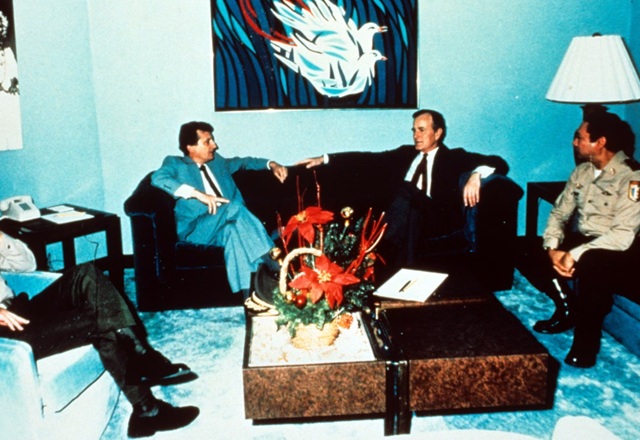
As economic sanctions failed and covert coup attempts faltered, pressure mounted inside the Bush administration to escalate. Internal memos show senior officials openly discussing the need to provoke a crisis that might justify decisive action. One National Security Council meeting captured President George H. W. Bush’s frustration: “The only option he could see is more U.S. actions and hope that there would be some other thing happening to get this man out.”
The problem was legality. Existing law posed obstacles at every turn. International law barred the use of force and intervention in Panama’s internal affairs. Domestic law restricted the military from conducting law enforcement operations. Executive Order 12333 prohibited assassination. Barr methodically dismantled each constraint.
In a pivotal June 1989 opinion, Barr argued that the President could order the FBI to arrest individuals abroad even if doing so violated international law and the UN Charter. When it became clear the FBI lacked the capacity to seize Noriega, Barr issued another opinion asserting that the Posse Comitatus Act—which restricts military involvement in law enforcement—does not apply outside U.S. territory. With that, the military could legally “snatch” a foreign leader.
The most controversial pillar remained assassination. Although still classified, its contours are now visible through declassified accounts by CIA lawyers. Barr concluded that the assassination ban did not prohibit U.S. support for coups against repressive regimes, even if violence was likely to kill the head of state—so long as there was no explicit intent to kill. This interpretation effectively hollowed out Executive Order 12333 while preserving plausible deniability.
By late 1989, the legal groundwork was complete. A draft presidential directive authorized U.S. forces to take “whatever steps are necessary” in and around Panama, explicitly superseding conflicting executive regulations. When a Panamanian soldier killed a U.S. serviceman days later, the administration had its pretext. On December 20, the United States invaded Panama.
Noriega eventually surrendered on January 3, 1990—the same date, 36 years later, that Nicolás Maduro would be captured and arraigned in a U.S. court. The symmetry is not coincidental. In December 2025, Assistant Attorney General T. Elliot Gaiser cited Barr’s 1989 opinions to conclude that a president may deploy the military for overseas law enforcement without congressional authorization and without regard to international law. Though heavily redacted, the opinion appears to rely on the same logic Barr used to argue that the accidental killing of a foreign leader during a rendition operation poses minimal legal risk.
Critics warn that these secret precedents have normalized a system in which presidents can violate domestic and international law behind closed doors, shielded by classified legal opinions that courts are unlikely to review. As former OLC head Jack Goldsmith once observed, such opinions function as “get-out-of-jail-free cards” for executive officials.
What the Panama documents ultimately reveal is not just a historical episode, but the birth of a legal doctrine that still governs U.S. power today. Crafted in secrecy, tested through invasion, and refined through classified memos, the Barr Doctrine transformed presidential authority into something closer to an imperial prerogative—one that continues to shape American foreign policy, long after the documents were stamped “Top Secret.”