


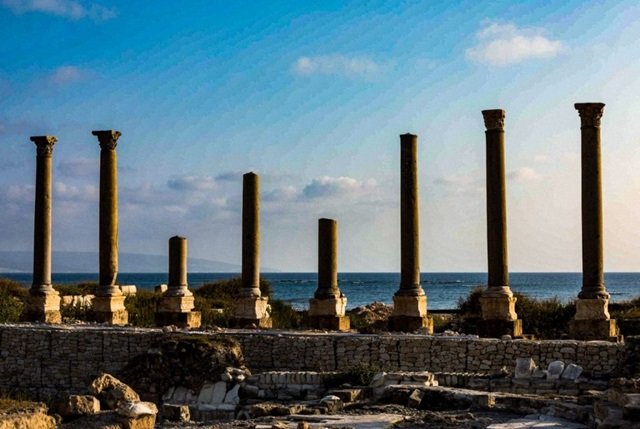
In the ancient Mediterranean city of Tiro, in southern Lebanon, the atmosphere is thick with anxiety rather than the calm often associated with its seaside landscape and historic ruins. Once known as a haven of olive trees, beaches, and Phoenician heritage, the city is now defined by destruction and anticipation. As a temporary ceasefire between Israel and Hezbollah approaches its expiration, many residents believe they are on the brink of another wave of full-scale war. The latest truce, already fragile and contested, has failed to ease fears, particularly after recent Israeli strikes destroyed residential buildings in the city’s center just before the agreement came into effect.
Those last-minute attacks have left deep scars both physically and psychologically. Entire neighborhoods were reduced to rubble in what locals describe as a sudden and overwhelming assault. Rescue workers continue to search through the remains of collapsed buildings, where at least two people are still missing and dozens were killed. For many in Tiro, the timing of the strikes reinforced a belief that ceasefires are not moments of relief but rather brief pauses before renewed escalation. The sense of insecurity has only intensified as the formal end of the truce looms, with residents bracing for what they assume will be a return to sustained bombardment.
Inside the city, voices of fear and defiance coexist uneasily. Abbas Awad, a paramedic working with a civil defense group, describes the situation as one designed to instill psychological pressure on civilians. Standing amid ambulances and emergency equipment, he speaks of repeated cycles of destruction that have left both infrastructure and morale in ruins. For him and others working on the front lines of rescue operations, the most recent attacks were not unexpected in timing, but their intensity still shocked even those accustomed to conflict. He argues that the strikes on residential areas, which Israel claims have military relevance, serve primarily to terrorize the population rather than target strategic assets.
Elsewhere in the city, residents like Sanah, who runs a small shop near the destroyed buildings, describe a life shaped entirely by war. She has lived through multiple conflicts, including Lebanon’s civil war decades earlier, and insists that she has never left the city despite the repeated waves of violence. Her home and business now sit amid ruins, surrounded by buildings flattened in recent strikes. Yet she speaks with a calm resilience that contrasts sharply with the devastation around her. Even as distant explosions echo through the coastline and smoke rises on the horizon, she continues her daily routine, describing survival as a matter of endurance rather than choice.
The psychological impact of the situation is visible along Tiro’s seafront promenade, where families gather at sunset as if maintaining a fragile tradition of normality. Yet even this ritual is overshadowed by the sight of smoke columns rising from nearby areas under military control. The sound of distant detonations has become part of daily life, reinforcing the expectation that the ceasefire may collapse at any moment. Many residents openly say they believe the return to open war is imminent, given the lack of trust in ongoing diplomatic efforts mediated abroad.
The broader regional context adds to the tension. The conflict is shaped by a complex network of alliances, with Israel and Hezbollah tied respectively to wider geopolitical actors, while indirect negotiations continue through international mediators. However, confidence in these diplomatic channels is minimal among local populations, who view them as disconnected from realities on the ground. For Hezbollah, the ceasefire is seen as allowing Israeli forces to maintain control over parts of southern Lebanon, while Israel argues that continued Hezbollah activity prevents any lasting resolution. This mutual rejection of the current arrangement has left the truce politically unstable from both sides.
Along the border region, the impact of sustained military activity is even more severe. Israeli forces have reportedly maintained control over multiple zones, carrying out controlled demolitions of structures in areas they occupy. Entire villages have been left in ruins, with agricultural lands, homes, and infrastructure destroyed or abandoned. Farmers returning briefly to check their land describe scenes of total devastation, saying that little remains intact after months of repeated strikes and demolitions. Many speak not of temporary damage, but of irreversible loss, with reconstruction appearing impossible under current conditions.
Within Tiro itself, displaced residents from nearby villages have added to the city’s population, seeking shelter in partially repurposed buildings. These spaces now function as informal shelters, where families share limited resources while trying to maintain some sense of routine. Children play in courtyards between emergency vehicles, while adults discuss news of negotiations and military movements with growing resignation. For many, the distinction between temporary displacement and permanent exile has begun to blur.
As the ceasefire deadline approaches, uncertainty dominates every conversation. Some residents insist that resistance will continue regardless of political agreements, while others express exhaustion and despair after years of recurring conflict. One resident, speaking amid the ruins of a destroyed neighborhood, questions the purpose of repeated cycles of violence, describing the experience as an endless repetition of loss with no clear resolution in sight.
What remains clear is that Tiro stands once again at a breaking point. Whether the ceasefire holds or collapses, the city has already been reshaped by war. Its streets, homes, and people carry the weight of destruction that has not yet ended, and the expectation of what comes next is no longer hope for peace, but preparation for the next explosion.










