by A Special Correspondent in Colombo
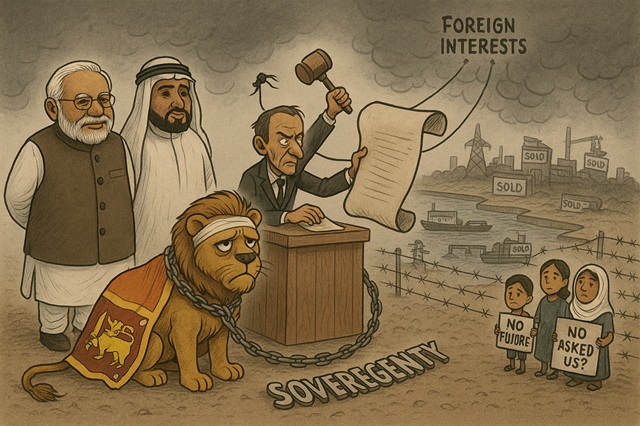
The recent Memoranda of Understanding (MoUs) signed by Sri Lanka with India and the United Arab Emirates are nothing short of a carefully camouflaged handover of national assets and sovereignty, disguised as “cooperation” and “mutual benefit.” These documents, which ostensibly aim to develop Trincomalee as an energy hub and establish an HVDC power link with India, are, in reality, a chilling roadmap for Sri Lanka’s political and economic subservience.
One of the most alarming features of the Trincomalee energy hub MoU is the establishment of a Joint Venture Company (JV Company) composed of Indian Oil Corporation Limited (IOCL), Ceylon Petroleum Corporation (CPC), and Abu Dhabi Ports Group PJSC (AD Ports). The MoU explicitly states that “the Parties agree that their respective Authorised Agencies shall form a Joint Venture Company to execute the Projects” and that this entity will “finance the Project through debt and/or equity.” At first glance, this might appear as shared cooperation; however, in reality, Sri Lanka is placing its critical energy infrastructure into the hands of foreign entities, allowing others to dictate the terms of strategic national development.
The so-called equity sharing is another deception. Although the MoU claims that “the three Authorised Agencies shall contribute equity in relation to the Projects costs in equal amounts,” the power dynamics between the colossal IOCL, the resource-flush AD Ports, and the struggling CPC render any notion of equality farcical. Sri Lanka’s CPC, battered by years of mismanagement and economic crisis, will not wield equal influence, despite the illusion of fairness. This is not partnership; it is capitulation.
What is even more galling is that Sri Lanka is being saddled with the primary burden of providing “adequate, appropriate and ready for construction land, Right of Way (RoW) and an encroachment-free pipeline corridor, all statutory approvals, and pre-deposit works” – and this, scandalously, “at cost to JV Company.” In effect, Sri Lanka must gift-wrap its own national assets and resources for the benefit of foreign companies. The MoU further states that GoSL must “provide security for the pipelines, personnel, and construction equipment during execution and subsequent operation and maintenance of the Project.” In other words, Sri Lankan taxpayers must pay to safeguard foreign profits.
Equally disturbing is the two-way nature of the proposed petroleum pipeline. While on paper this sounds like a balanced exchange, the reality is spelled out in the MoU: “the proposed petroleum product pipeline is a two way pipeline” but any Sri Lankan exports to India are subject to India’s approval. It is clearly stipulated that “Indian entities may import petroleum products from generating facilities located in Sri Lanka provided that the generating company is not owned, directly or indirectly, by any natural person or corporate entity whose effective control or source of funds or residence of beneficial owner, is situated in or is a citizen of a third country with whom India shares a land border.” In plain English, this means India can veto who Sri Lanka trades with, effectively shackling Sri Lanka’s sovereign trade decisions to Indian strategic interests.
The financial and legal surrender is only further entrenched by the stipulations regarding taxation. The GoSL is ordered to ensure “that vehicles, plant, construction material and machinery of GoI and of the Authorized Agency related to the Projects shall be allowed to move freely,” and that any newly imposed taxes or levies “shall be borne by the JV Company.” This seemingly benign clause means Sri Lanka forfeits future fiscal policy autonomy, and any attempt to tax these foreign operations will be an additional burden placed upon the already struggling Sri Lankan state. Worse yet, the GoSL is compelled to extend “expedited custom and immigration clearances for the movement of goods and people necessary for the completion of the Projects,” turning national borders into little more than optional inconveniences for foreign companies.
The erosion of sovereignty becomes even more blatant when one reads that “no suit or proceeding shall be instituted against any Indian personnel or any local partner assisting the JV Company with respect to the Projects for anything done or purported to be done within the laws of Sri Lanka in good faith for the successful implementation of the Projects.” Foreign personnel are being elevated above Sri Lankan law, granted near-diplomatic immunity not through any international convention but by the hand of Sri Lanka’s own government.
Even the law under which these agreements operate is foreign. It is explicitly stated that “this MoU and the relationship between the Parties shall be governed by and construed in accordance with English law,” meaning that any disputes will be judged not under Sri Lanka’s legal system, but under the laws of a third country. The judicial sovereignty of Sri Lanka is thus knowingly and voluntarily undermined.
And should Sri Lanka wish to withdraw? The termination clause gives a mere thirty days’ notice for withdrawal, and there is no guarantee that any activity already commenced can be undone without penalties. It is laughably stated that the commitments under the MoU are “of an in-principle, notional and non-binding nature,” but this flimsy reassurance is undone by the very fact that Sri Lanka is compelled immediately to start clearing land, awarding approvals, and investing resources into preparatory activities — steps that, once taken, are impossible to reverse without catastrophic political and economic fallout.
The HVDC interconnection project agreement with India is no better. Ostensibly designed for the “±320kV, 1000 MW VSC HVDC Bipole line between Madurai (New), India to Mannar, Sri Lanka,” it is presented as an opportunity for mutual electricity trade. Yet in truth, it cements Sri Lanka’s dependency on Indian electricity and cripples the island’s future energy independence. The MoU brazenly dictates that “each respective Government shall endeavour for exemption of various taxes and duties (i.e. customs taxes, levies, royalties, demurrage, VAT, GST, all types of cess and other fiscal levies),” granting foreign contractors tax-free access to Sri Lankan territory while the local population continues to suffer under a crushing tax burden.
Moreover, just as in the Trincomalee MoU, it is stipulated that “no suit or proceeding shall be instituted against any personnel deployed by the Parties in each other’s territory with respect to the Projects for anything done or purported to be done in good faith.” Once again, foreign personnel are given carte blanche immunity, this time for a project that connects Sri Lanka’s critical national grid to India’s, a project that has immense implications for national security, strategic autonomy, and economic independence.
The MoU astonishingly dictates that “respective Governments shall facilitate all necessary clearances for the project in an expeditious and time bound manner,” effectively stripping Sri Lankan regulatory bodies of any meaningful oversight. And while it sounds generous to mention that “the personnel working on the Project shall at all times abide by applicable laws and regulations of respective Government,” this is undermined by the immunity clauses and the tax exemptions granted elsewhere in the text.
Even the final jurisdictional authority is ambiguous, stating that “laws of respective country shall apply to that part of the Project which is executed within the territory of the country,” which — given the transboundary nature of the project — raises serious concerns about the enforceability of national regulations on Indian contractors operating within Sri Lanka.
These MoUs, both signed on the same day in April 2025, mark a new low point in Sri Lanka’s modern history. They reflect not cooperation, but submission; not partnership, but dependency; not development, but the deliberate dismantling of national autonomy. Under the pretence of strategic cooperation, Sri Lanka is bartering away its future — and doing so without even the pretence of reciprocal benefit.
This is not diplomacy. It is daylight robbery written in fine print, sanctioned by those entrusted with safeguarding the nation. If these MoUs are allowed to proceed unchallenged, Sri Lanka will wake up to find its ports, its pipelines, its electricity grid, and its sovereignty no longer its own, but the property of foreign powers with interests that will never align with those of the Sri Lankan people.
History will not be kind to those who signed away their country’s lifelines for empty promises and political survival. If Sri Lanka’s leaders do not act now to rescind, renegotiate, or nullify these disastrous agreements, the nation risks becoming a mere outpost, a client state with neither the power to control its resources nor the dignity to stand as an independent actor on the world stage.