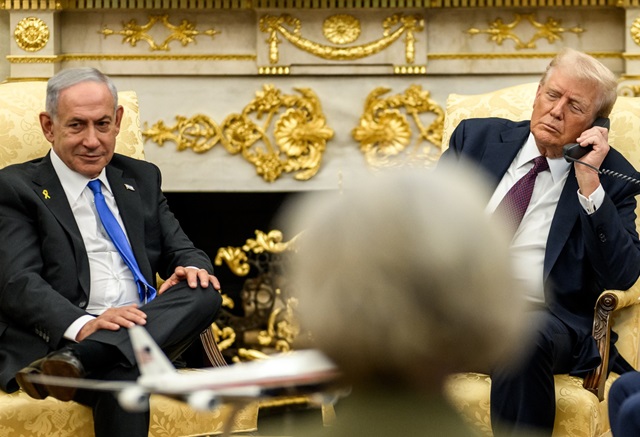
U.S. President Donald Trump on Monday announced that Israeli Prime Minister Benjamin Netanyahu has endorsed a U.S.-sponsored peace proposal aimed at ending nearly two years of conflict in Gaza, though the plan’s success hinges on Hamas, which has yet to formally respond.
Speaking at a joint White House press conference, Trump said the two leaders were “beyond very close” to a peace deal. He warned Hamas that Israel would have full U.S. support to take necessary action if the militants reject the proposal.
The White House released a 20-point plan calling for an immediate ceasefire, an exchange of hostages held by Hamas for Palestinian prisoners held by Israel, a staged Israeli withdrawal, Hamas disarmament, and a transitional governance structure led by an international body. The proposal envisions Gaza being governed temporarily by a technocratic Palestinian committee, supervised by a new “Board of Peace” chaired by Trump and including former UK Prime Minister Tony Blair. Hamas would have no role in governance.
Netanyahu praised the plan as meeting Israel’s war objectives, including the return of hostages and dismantling Hamas’ military capabilities. Trump emphasized the plan as a path to end the decades-long conflict, though the question of eventual Palestinian statehood remains unresolved. Netanyahu has repeatedly rejected the prospect of a future Palestinian state.
Hamas, which initiated the war with its October 7, 2023, attack on Israel and still holds 48 hostages, has not formally received the plan. A Hamas official said the proposal has only been shared via mediators, including Qatar and Egypt, and would be reviewed “in good faith.”
The plan has drawn mixed reactions. The Palestinian Authority welcomed the U.S. initiative, while critics questioned Blair’s role due to his controversial involvement in the 2003 Iraq invasion. Humanitarian experts continue to highlight the devastating toll of the conflict, with over 66,000 Palestinians killed and Gaza’s infrastructure severely damaged.
Trump’s meeting marks an intensified diplomatic push to broker a ceasefire and lay the groundwork for Gaza’s post-war reconstruction, even as the viability of the plan depends heavily on negotiations with Hamas and the implementation of complex governance arrangements.