by Our Economic Affairs Editor
In the early 1930s, as the world staggered under the weight of the Great Depression, President Herbert Hoover faced a crucial decision: whether to sign the Smoot-Hawley Tariff Act, which would dramatically increase tariffs on thousands of imported goods. Hoover, amid rising economic pressures and widespread public demands for protectionism, chose to enact the bill. It was a decision that would reverberate globally, deepening the crisis and exacerbating the suffering of millions. Now, in 2025, the United States finds itself at a similar crossroads. President Donald Trump’s escalating trade war, particularly with China, echoes Hoover’s actions of nearly a century ago. The same mistakes, driven by economic nationalism and a disregard for the international consequences of tariff policies, risk propelling the world into an even more severe economic downturn than we are currently experiencing.
The Smoot-Hawley Tariff Act: A Fateful Decision
In 1930, with the Great Depression already taking hold, Hoover signed the Smoot-Hawley Tariff Act into law. The bill raised tariffs on more than 20,000 imported goods, ostensibly to protect American farmers and industries from foreign competition. But in reality, the act failed to shield American workers and businesses from the global consequences of the depression. Instead, it sparked a catastrophic chain reaction that crippled the already fragile global economy.
As soon as the tariff was enacted, foreign countries retaliated, imposing their own tariffs on U.S. goods. Trade volumes plummeted, and economies across the world contracted sharply. In the U.S., the very sectors that had been intended to benefit from the tariff, such as agriculture and manufacturing, were left in even worse shape. The nation’s exports, once a vital lifeline for farmers and manufacturers, shrank by more than half. By 1933, U.S. exports had dropped from $5.2 billion to just $1.7 billion. The tariff, instead of providing relief, deepened the economic malaise and exacerbated unemployment, poverty, and social unrest. In fact, the collapse of international trade was one of the most significant factors prolonging the Great Depression.
A Petition of Concern: Economists Warned Hoover
Before Hoover signed the bill, hundreds of economists, including many of the era’s leading scholars, recognised the potential dangers of such a policy. A petition, signed by over 1,000 economists, was presented to Congress in May 1930. These economists, many of whom were not politically aligned but were committed to protecting the long-term interests of the American economy, warned that raising tariffs would be disastrous.
Their petition, which was officially printed in the Congressional Record, contained a powerful argument against the Smoot-Hawley Act. The economists stated:
“We, the undersigned economists, who have no partisan interest in the question, but only a desire to serve our country, are convinced that the passage of the pending tariff bill would be a complete and disastrous mistake. We are convinced that increased restrictive duties would raise the cost of living, make it more difficult for domestic producers to export their products, injure the great majority of our citizens, and so inevitably intensify the already serious depression. Countries cannot permanently buy from us unless they are permitted to sell to us. A tariff war does not furnish good soil for the growth of world peace. Already there is widespread fear of such a war, and an increase in duties by the United States is likely to be followed by similar action by other nations. The result would be a complete stoppage of international trade, without which our factories cannot run. We are convinced that the bill would increase unemployment, raise the cost of living, and injure rather than help the majority of our citizens. We therefore urge that the proposed measure be defeated.”
Despite this overwhelming opposition from the academic and economic communities, Hoover pressed ahead with the tariff, ignoring the warnings of those who saw the broader picture. The aftermath of the Smoot-Hawley Act proved devastating, and its consequences have been studied extensively as a cautionary tale for future policymakers.
A Parallel to Trump’s Trade War
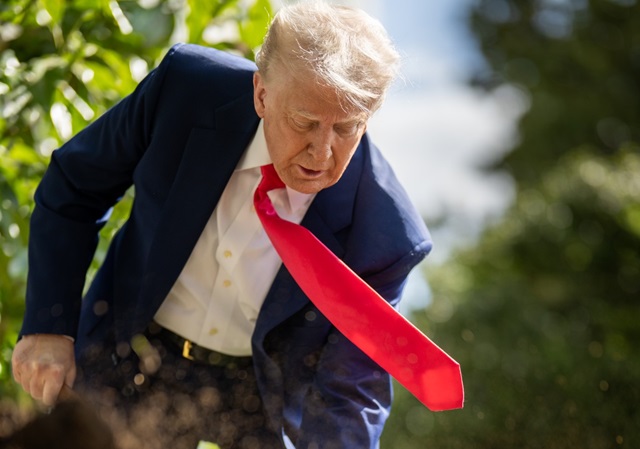
Fast forward to the present, and we find ourselves witnessing a situation eerily reminiscent of the prelude to the Great Depression. President Trump’s decision to impose tariffs on a wide range of Chinese goods—initially justified as a necessary step to address the U.S.-China trade deficit and protect American intellectual property—has escalated into a global trade war. The tariff rates have been steadily raised, and as of 2025, a 104% tariff on Chinese imports is in effect. This sharp escalation has led to a severe backlash from China, which has retaliated with its own tariffs on U.S. products.
The consequences of Trump’s trade policies are already beginning to unfold. American exporters, especially those in agriculture and manufacturing, are feeling the sting of reduced access to foreign markets. The Chinese response has been to impose tariffs on U.S. agricultural goods, slashing demand for American soybeans, pork, and other staples. Meanwhile, U.S. farmers, who were already struggling under the pressures of low commodity prices, now face the additional burden of an increasingly hostile global trade environment. This mirrors the experience of U.S. farmers during the Great Depression, who saw their foreign markets dry up after the implementation of Smoot-Hawley.
However, the damage is not confined to agriculture. The broader manufacturing sector, which had been growing steadily in recent years, is now facing significant challenges. The increased costs of imported materials and components are driving up production costs. American manufacturers that rely on Chinese goods, particularly electronics and consumer products, are seeing their margins squeezed. At the same time, consumers are feeling the pinch as prices rise for everything from electronics to clothing. Much like the Smoot-Hawley Tariff Act, Trump’s policies are exacerbating the very issues they were supposed to resolve.
The Consequences of Protectionism
Trump’s tariffs are not occurring in a vacuum. They are part of a broader trend of rising protectionism, not just in the U.S. but globally. Countries around the world are becoming increasingly suspicious of free trade, prioritising national interests over international cooperation. This shift has been accompanied by a rise in populist and nationalist movements, many of which argue that globalisation has harmed domestic industries and eroded national sovereignty. While these sentiments may be politically popular in the short term, they are economically dangerous in the long run.
History has shown time and again that protectionism does not work. The Smoot-Hawley Tariff Act was a lesson that should have been learned: trade wars do not resolve economic problems—they exacerbate them. By closing off markets and increasing the cost of trade, tariffs undermine the foundations of global economic cooperation. They lead to retaliatory actions, further reducing trade, which in turn leads to lower economic growth, higher unemployment, and a general decline in living standards.
A Repetition of the Great Depression?
The parallels between Trump’s trade policies and the decisions made by Hoover are striking. Both leaders, faced with an economic crisis, turned to protectionist measures in the hope of safeguarding their domestic industries. Yet both failed to recognise that the interconnectedness of the global economy means that protectionism, rather than being a solution, creates far greater problems. The economic consequences of Trump’s tariffs are already being felt, and as the trade war escalates, they are likely to grow more severe.
The global economic system is far more interconnected today than it was in the 1930s, and the consequences of a full-blown trade war would be catastrophic. Unlike Hoover’s time, when the U.S. was still the world’s dominant economic power, today’s global economy is a highly competitive and complex network of interdependent countries. A major disruption in one country’s economy can have ripple effects that spread rapidly across the world.
In 1930, the Smoot-Hawley Tariff Act contributed to the collapse of international trade, a collapse that prolonged the Great Depression and worsened its impact. In 2025, Trump’s tariffs could similarly precipitate a global economic downturn, triggering widespread job losses, rising costs, and growing economic inequality. We are standing on the precipice of a potential economic disaster—one that is avoidable, but only if we heed the warnings of the past.
As President Trump’s trade war continues to escalate, it is essential that we learn from history. The Smoot-Hawley Tariff Act of 1930 was a fateful decision that worsened the Great Depression and had lasting consequences for the global economy. Trump’s actions, though ostensibly aimed at protecting American workers and industries, are likely to produce the same devastating results. By rejecting the calls for protectionism and embracing a more cooperative and open approach to global trade, we can avoid repeating the mistakes of the past and ensure a more prosperous future for all.