Thirty-two years after the Oslo Accords raised hopes of a Palestinian state, the dream of two independent nations existing side by side appears more distant than ever. In the West Bank village of Taybeh, the Khoury family has watched decades of promises fade, even as their family-run Taybeh Brewery has become a rare success story in an increasingly constrained economy. Nadim Khoury and his brother David left Boston in 1993, convinced that the Oslo Accords would soon give rise to a sovereign Palestinian state. Today, Nadim’s children, Canaan and Madees, run the business, navigating checkpoints, settlements, and political uncertainty that make daily operations a constant struggle.
“Our logo is the brewery in the hands of Taybeh, with the sunrise — we put the sunrise there as a bright future for Palestine,” Nadim Khoury, 66, told Bloomberg. “We are not asking for much, we want to live a normal life. We want to live side by side.” Yet the political reality in the West Bank undermines these hopes. Israeli settlements continue to expand, checkpoints fragment communities, and movement between towns has become so difficult that Palestinians often choose not to travel even for essential needs such as medical care, education, or work.
The gap between diplomatic symbolism and on-the-ground realities is stark. France has signaled its intention to become the first major Western power to formally recognize an independent Palestinian state alongside Israel, a move Bloomberg reports is intended to reignite international efforts toward peace. The United Kingdom, Canada, and other countries have expressed tentative support. Yet recognition alone does little to address the daily barriers faced by Palestinians, from confiscated land and restricted water access to the economic fallout of road closures and lost jobs in Israel.
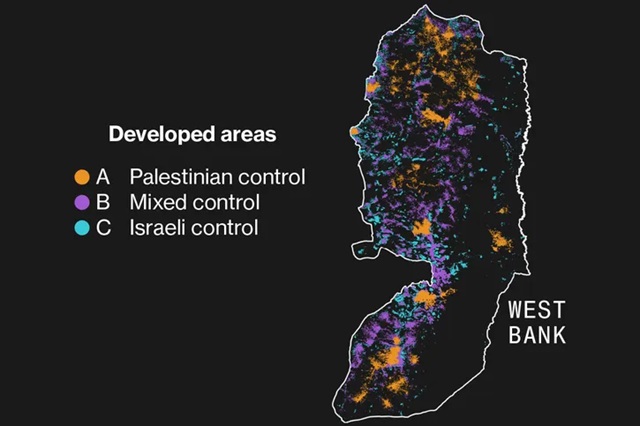
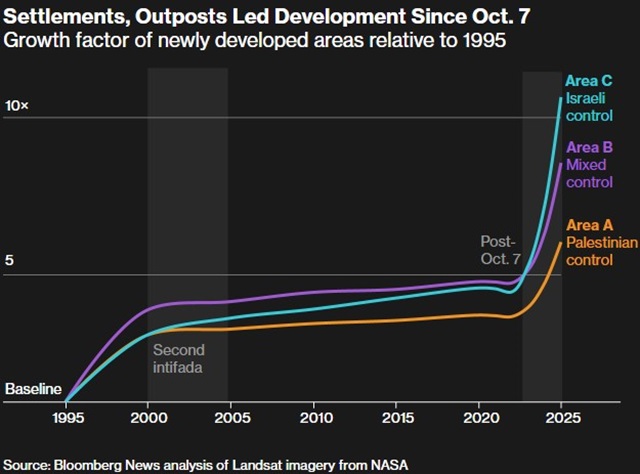
The Oslo Accords divided the West Bank into Areas A, B, and C, ostensibly creating zones of Palestinian and Israeli control with the goal of eventual statehood. Today, Area A — under full Palestinian civil and security control — has become what sociology professor Majdi Malki calls “170 isolated islands.” Area B remains under partial Palestinian authority, but security is shared with Israel, while Area C, which covers over 60% of the West Bank, is entirely under Israeli control. Since the October 2023 Israel-Hamas war, development in Area C has accelerated, primarily through new settlements, further fragmenting Palestinian territory and making a contiguous state increasingly improbable.
Economic pressures compound these challenges. The West Bank economy has contracted by an estimated 22% last year, according to the Palestinian Authority. Israeli authorities revoked work permits for roughly 200,000 Palestinians in Israel, while withholding around 10 billion shekels in customs and VAT revenue. Tourism, once a key source of income for cities such as Bethlehem and Jericho, has collapsed. The Khoury family itself has faced delays in obtaining export permits, and plans to expand the brewery have stalled as a result of logistical bottlenecks.
The human cost of these policies is tangible. Extremist settlers have encroached on farmland, destroyed crops, and intimidated local communities. In Taybeh, Canaan Khoury’s uncle was shot at while harvesting olives, and fields have been set on fire. Checkpoints, gates, and military outposts have isolated Palestinian villages, making travel dangerous. Many residents, including young professionals and students, feel trapped. “You can’t plan for the future when you’re afraid of the present,” said Aisha, a 27-year-old living near Ramallah, to Bloomberg.
Even on the diplomatic front, the prospects for meaningful progress are dim. Israeli Prime Minister Benjamin Netanyahu and his coalition have repeatedly rejected the notion of a Palestinian state, arguing it would reward Hamas and threaten Israeli security. Plans to annex parts of the West Bank and expand settlements, particularly in the E-1 corridor, effectively divide the territory and make a contiguous state impossible. Palestinian leaders acknowledge the limitations. Eid Khamees Swelem Jahalin, a Bedouin community leader in Khan Al-Ahmar, warns that the annexation and demolition of villages will uproot thousands and irreversibly alter the West Bank’s geography.
Meanwhile, Palestinian governance is also in crisis. The Palestinian Authority, led by Mahmoud Abbas, has not held elections since 2006, and internal divisions between Fatah and Hamas continue to undermine political cohesion. While the PA maintains health and education services, it is powerless to counter Israeli land grabs, settlement expansions, or military incursions. Experts argue that these structural constraints, coupled with external political pressures, render the two-state solution increasingly impractical.
For many Palestinians, recognition by France or other international actors is largely symbolic. “Recognition is politically important,” said Palestinian Economy Minister Mohammed Alamour to Bloomberg, “but what does it mean when the patient is dying? It’s not enough.” On the ground, fragmentation, movement restrictions, and economic precarity dominate daily life, suggesting that even a symbolic victory at the UN cannot overcome structural realities that have rendered the two-state solution increasingly obsolete.
The Khourys’ brewery, which survived multiple wars, the second intifada, and the Covid-19 pandemic, embodies both resilience and the limits of Palestinian agency under occupation. Despite their success exporting beer, gin, and olive oil products to over a dozen countries, the family faces constant uncertainty. Water shortages, restrictions on land use, and security threats limit growth prospects. As Canaan Khoury told Bloomberg, “Anyone with a business would like to expand and grow, but it’s hard to put a huge investment somewhere where there is such a high political risk, which is only increasing by the day.”
The unfolding reality in the West Bank underscores a growing consensus among experts and locals: the two-state solution, long the cornerstone of international diplomacy, may no longer be feasible. Fragmented territories, encroaching settlements, and restrictive Israeli policies make the creation of a contiguous, sovereign Palestinian state increasingly unlikely. Symbolic recognition may offer temporary hope, but for millions of Palestinians struggling to maintain daily life, the dream of statehood remains just that — a distant sunrise over Taybeh that has yet to arrive.