


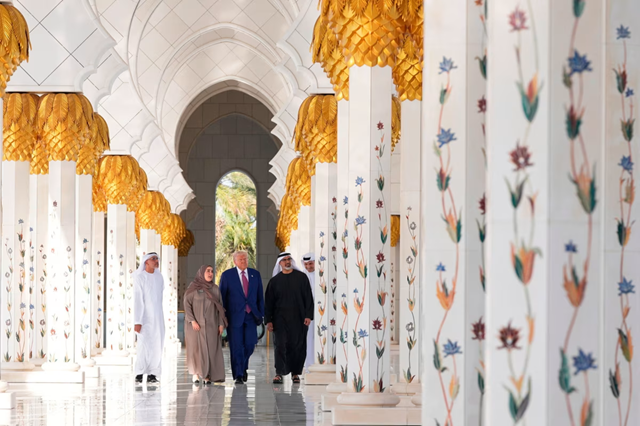
The United States has expanded the United Arab Emirates’ access to advanced American artificial intelligence chips following the Gulf state’s military support during the recent conflict involving Iran, marking a significant shift in U.S. technology export policy and underscoring the growing role of advanced semiconductors in international diplomacy.
This feature is based on reporting by The Wall Street Journal, which detailed how the policy change followed months of military cooperation between Washington and Abu Dhabi, as well as years of lobbying by Emirati officials seeking broader access to U.S. artificial intelligence technology.
According to the report, the UAE supported the United States during the conflict by carrying out dozens of airstrikes against Iran, intercepting hundreds of missiles and helping ensure the continued flow of oil through the strategically important Strait of Hormuz. Those actions reinforced the country’s position as a key regional security partner at a time of heightened tensions across the Middle East.
The Trump administration formally announced the policy change on Friday through the U.S. Commerce Department. Under the revised rules, the UAE will now be treated similarly to European countries, South Korea and India when purchasing American technologies, military-related equipment and energy infrastructure that could have military applications. Previously, the country had been grouped with nations facing stricter export controls, including China and Yemen.
The decision represents the culmination of a years-long effort by the UAE to secure greater access to advanced U.S. semiconductor technology as part of its broader strategy to diversify its economy beyond hydrocarbons and establish itself as a global artificial intelligence hub. It also reflects the increasingly central role that cutting-edge chips have assumed in diplomatic negotiations, where access to computing power has become closely tied to broader geopolitical and security relationships.
One of the immediate consequences of the policy change is that G42, the UAE’s flagship artificial intelligence company, will be able to purchase advanced chips from American manufacturers such as Nvidia without facing the licensing restrictions that previously governed such exports. The revised rules are also expected to ease operations for major U.S. technology companies, including Microsoft and OpenAI, which have announced plans to build data centers in the UAE.
Before the policy revision, companies seeking to export advanced AI chips to the Gulf state were required to obtain Commerce Department licenses, a process described as lengthy and frequently subject to delays. Industry analysts cited by The Wall Street Journal said the removal of those restrictions could be worth billions of dollars by accelerating investment in large-scale computing infrastructure and artificial intelligence development.
The report also says that Emirati officials have recently indicated that G42, which is controlled by Sheikh Tahnoon bin Zayed Al Nahyan, the UAE’s national security adviser and brother of President Sheikh Mohamed bin Zayed Al Nahyan, intends to become a U.S.-based company that would be predominantly owned by American investors. Discussions surrounding that restructuring have been underway with individuals familiar with the matter, according to the newspaper.
Efforts to secure broader chip access began during the final years of the Biden administration. Emirati officials repeatedly argued that the UAE should receive treatment comparable to close U.S. partners. Following the outbreak of the conflict involving Iran, those lobbying efforts intensified, with officials approaching the White House directly to seek changes to the country’s export classification.
According to people familiar with the discussions cited by The Wall Street Journal, Emirati representatives pointed to India’s experience after it became a Major Defense Partner of the United States in 2016, a designation that eventually led to expanded trade benefits. This time, the newspaper reports, UAE officials encountered a more receptive audience within the Trump administration.
U.S. officials portrayed the policy shift as recognition of the UAE’s security cooperation. One American official told the newspaper that the Gulf state’s decision to support U.S. military operations against Iran demonstrated its reliability as an ally. Another official said Washington continues working with regional partners to promote both security cooperation and the adoption of American technology.
The UAE’s ambassador to the United States, Yousef Al Otaiba, described the policy change as advancing decades of close and dependable cooperation between the two countries. The White House, meanwhile, has rejected allegations that conflicts of interest influenced the decision.
Those allegations stem largely from financial ties between Sheikh Tahnoon and the Trump family. According to The Wall Street Journal, four days before President Donald Trump’s second inauguration, Tahnoon and other investors agreed to invest $500 million for a 49% stake in World Liberty Financial, a cryptocurrency company launched by members of the Trump family. The UAE also pledged to invest $1.4 trillion in the United States.
Democratic lawmakers have argued that the investment raises questions about the relationship between foreign policy decisions and financial interests connected to the president’s family. The issue has drawn renewed attention following financial disclosures released last month showing that President Trump reported receiving $263 million from the sale of the World Liberty Financial stake, making it one of the largest sources of his reported income in 2025.
The matter was raised during a House committee hearing, where Representative Sydney Kamlager-Dove questioned Commerce Department official Jeffrey Kessler about the agreement and the subsequent policy decision. Kamlager-Dove suggested the circumstances could resemble an illegal pay-to-play arrangement. Kessler responded that he had not discussed chip exports to the UAE with members of the Trump family or executives associated with World Liberty Financial and defended the policy, describing it as one of the administration’s most significant achievements.
The administration’s broader approach to semiconductor exports has also revived an ongoing debate within Washington over balancing commercial opportunities with national security concerns. Earlier decisions permitting limited exports of advanced chips to the UAE had already drawn criticism from lawmakers and analysts concerned about maintaining the United States’ technological advantage in artificial intelligence.
Some national security specialists continue to question whether expanding advanced computing infrastructure outside the United States carries long-term strategic risks. Michael Sobolik, a senior fellow at the Hudson Institute, told The Wall Street Journal that although the UAE has been an important regional partner, questions remain about its ability to ensure the long-term security of highly sensitive AI infrastructure.
The Commerce Department defended its decision by citing what it described as the UAE’s commitment to preventing the diversion or misuse of sensitive American technologies. That assurance forms part of a broader effort by U.S. authorities to balance export opportunities with safeguards designed to protect advanced technologies from unauthorized transfer.
The report also describes how the UAE’s position evolved during the conflict with Iran. Initially, Emirati officials reportedly urged Washington not to pursue military action. After Iranian retaliatory drone attacks affected the Gulf state, however, the UAE shifted toward closer operational coordination with the United States and Israel. According to the report, Emirati forces participated in coordinated strikes while also helping defend regional infrastructure against further attacks.
President Trump publicly praised UAE President Sheikh Mohamed bin Zayed Al Nahyan during a recent Group of Seven summit, describing him as a longstanding partner of the United States whose cooperation had strengthened during his administration.
The policy change places advanced artificial intelligence technology at the center of an expanding strategic partnership between Washington and Abu Dhabi. At the same time, it has prompted renewed debate over export controls, geopolitical alliances, commercial interests and the growing importance of AI chips as instruments of both economic development and international diplomacy.










