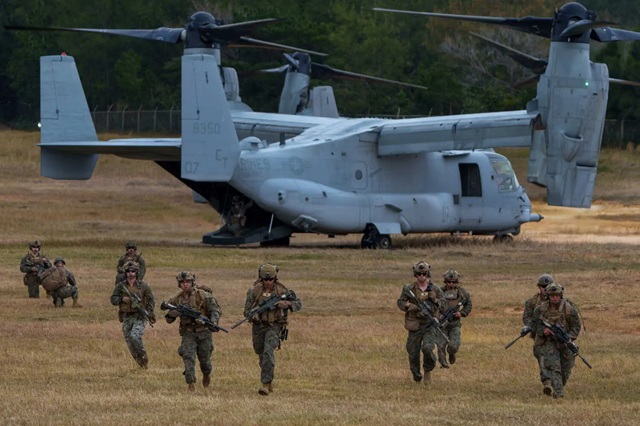
In a significant step toward reducing the U.S. military presence in Okinawa, a contingent of 105 U.S. Marines that would have been deployed to the Japanese island before Christmas was instead redirected to a new base on the U.S. territory of Guam. This reshuffling marks the first reduction in the number of Marines stationed on Okinawa, following an agreement between Washington and Tokyo. The arrangement is part of a broader deal designed to downsize the U.S. military footprint on the island, a legacy of World War II.
As reported by The New York Times, this transition is part of a long-delayed plan to move approximately 9,000 Marines from Okinawa, nearly half of the current U.S. force. However, the relocation is already two decades behind its original schedule and may take more than another decade to fully complete. One of the major hurdles is the delayed construction of new military facilities, which are intended to replace the aging bases in Okinawa.
The deal to downsize U.S. forces in Okinawa was initiated in 1996, spurred by tensions after a horrific crime involving U.S. servicemen that sparked widespread protests in Okinawa. The military presence, originally established after the 1945 battle for Okinawa, has been a source of ongoing friction between the local population and the Japanese and U.S. governments.
The most recent development comes amid a broader geopolitical context where the rise of China has led both Japan and the United States to maintain a significant military presence in the Pacific. Despite the frustrations of many Okinawans who oppose the bases, a shift in government thinking has led to delays in the planned reductions. As The New York Times highlights, while Okinawan protests against the U.S. presence persist, local conservative politicians view the military bases as necessary for regional security, particularly in light of China’s growing military activity in the region.
In fact, the growing Chinese presence has influenced both Tokyo and Washington to reconsider the pace of relocation. China’s military exercises in the region and recent tensions over Taiwan have underscored the strategic importance of Okinawa. Despite ongoing protests, the U.S. and Japan have continued with the relocation plans, with some facilities already under construction in Guam and Okinawa’s northern regions.
Though the relocation of U.S. forces is seen as an essential part of Japan’s security strategy, the delays have raised concerns about the readiness and timeliness of the transition. The New York Times reports that Japan’s slow pace, coupled with ongoing construction challenges, may push the full realization of the relocation plan into the 2030s.