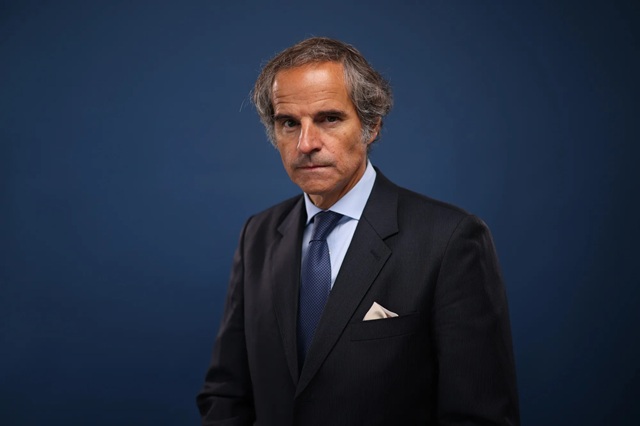
In a revealing interview with the Financial Times, Rafael Grossi, Director-General of the International Atomic Energy Agency (IAEA), offered a rare and personal insight into the escalating global nuclear risks—from Iran’s growing uranium stockpile to the precarious safety of Ukraine’s Zaporizhzhia power plant—as well as the diplomatic balancing act he navigates daily.
Speaking over lunch at Vienna’s Ristorante Sole, Grossi used a salt-baked branzino and a white tablecloth to illustrate the very real risks of nuclear disaster in war-torn Ukraine. Stabbing two points into the cloth to mark Kyiv and Moscow, he gestured to a spot in between—Zaporizhzhia, one of the world’s largest nuclear plants, now under Russian military control. “It’s dangerous. But we have to be there,” Grossi said, referring to the IAEA’s rotating team on site, which has remained present under live gunfire since 2022.
The stakes, Grossi told the Financial Times, have never been higher. Beyond Ukraine, his “biggest preoccupation” is Iran, which a confidential IAEA report now confirms is accumulating uranium enriched close to weapons-grade levels. With Israel issuing threats of military action, Grossi warns that any breakdown in negotiations “will imply most probably military action.” He added, “Iran doesn’t have a nuclear weapon at this moment, but it has the material. A bomb could emerge very swiftly.”
Despite the crisis-laden landscape, Grossi remains calm and focused. “I am a calm person. I focus on what I can do,” he told the FT, declining to be drawn into fear or speculation.
Grossi, 64, is no stranger to high-stakes diplomacy. Fluent in six languages, he has served as Argentina’s ambassador and held senior roles within the UN’s nuclear and chemical watchdogs. Since becoming the IAEA’s chief in 2019, he has been on a nonstop shuttle diplomacy tour—meeting both Ukrainian President Volodymyr Zelenskyy and Russian President Vladimir Putin to safeguard Zaporizhzhia, and now holding out hope for renewed nuclear talks between Iran and the West.
Grossi acknowledged that former U.S. President Donald Trump, who tore up the Obama-era Iran nuclear deal in 2018, has surprisingly triggered renewed negotiations through his special envoy, Steve Witkoff. “Witkoff is an extremely serious person,” Grossi noted, distancing himself from partisan judgments. “What I can say is that [Trump] has triggered negotiations where there were none before, and this is objectively commendable.”
But diplomacy has a personal cost. “I pay [a] price with my life, with a divorce,” Grossi admitted. Between missions, he juggles his role as a father to eight children, stays fit with a strict routine, and remains a devoted football fan—still wearing bracelets from Argentina’s 2022 World Cup victory.
Looking ahead, Grossi has his eyes on another global stage: the UN Secretary-General post, which opens up next year. “I’m not going to campaign — my work is my campaign,” he told the Financial Times. Citing the UN’s current dysfunction, he believes it needs a reset: “The original idea is valid, but it has become big and bureaucratised and absent from the resolution of major international crises.”
While Grossi’s job is most often framed around nuclear risks, he is also championing nuclear promise. With countries—and now tech giants—searching for clean energy solutions, interest in nuclear power is surging. “For the first time ever, we are seeing a [private sector] demand push,” he said, noting how companies like Microsoft, OpenAI, and xAI are exploring independent nuclear energy options to power massive data centers.
To support this shift, the IAEA is planning to host its first-ever summit with the private sector to explore the nexus of nuclear and AI—possibly the start of a new era of “Atoms for Peace.”
Yet the risks remain daunting. North Korea, for example, has an estimated 60–70 nuclear warheads and no active international inspections since 2009. Grossi also remains deeply concerned that if Iran develops a bomb, a cascade of nuclear armament could sweep through the Middle East and Europe.
Still, Grossi is hopeful. “Today we could have 30 countries which could have nuclear weapons, judging from their technical development, but we have nine.” That relative success, he insists, is thanks to diplomacy—and his determination to remain an impartial arbiter, trusted by all sides, even as the world inches closer to midnight.
Whether Grossi can keep the world’s nuclear threats contained—or pivot the conversation to peaceful energy—remains one of the defining questions of our time. As he finished his tea and prepared for yet another round of diplomacy, the quiet urgency in his voice was unmistakable.