Investors are overestimating the risk of a military conflict across the Taiwan Strait, a senior US diplomat has said, arguing that deterrence and the prospect of substantial consequences would prevent China from seizing Taiwan by 2027.
Michael DeSombre, the US assistant secretary of state for East Asian and Pacific affairs, said both Washington and Beijing had reasons to avoid a conflict and that concerns about a potential confrontation were being priced too highly by financial markets.
“I actually think the most mispricing is with regard to Taiwan, where actually I think people are overpricing the risk of something happening across the Taiwan Strait,” DeSombre told CNBC in an exclusive interview on Thursday, on the sidelines of the Milken Institute Asia Summit.
“Both China and the U.S. don’t want conflict, and we’re able to deter conflict,” he said in the interview with CNBC’s Sri Jegarajah. “Concerns of that perhaps are priced at too high a level.”
His remarks address persistent concerns over the possibility of Chinese military action against Taiwan, particularly in light of assessments by the US government that Chinese President Xi Jinping has directed the People’s Liberation Army to be prepared for military action involving the island by 2027. Beijing has not publicly confirmed that timeline.
Asked whether plans to “reunify Taiwan” by 2027 should be a cause for concern, DeSombre described Xi as “a very rational actor” and argued that the prospect of failure or serious repercussions would discourage an attack.
“To the extent that he realizes that it can’t be done, or it can’t be done without substantial consequences, it won’t happen,” DeSombre said.
He stressed that maintaining credible deterrence remained essential to preventing conflict, including through cooperation between the United States and its allies and partners.
“That’s why it’s important … ensuring that we have the deterrence in place with our allies and partners to make sure it does not happen,” he said.
China claims Taiwan as part of its territory and has not renounced the use of force to bring the island under its control. Taiwan’s democratically governed authorities reject Beijing’s claim, and the dispute remains a central source of tension between China and the United States.
Beijing has also pressed Washington to alter its longstanding diplomatic position on Taiwan by formally opposing Taiwanese independence. However, last month’s summit between US President Donald Trump and Xi produced no publicly announced agreement on the issue.
Arms sales have added to the tensions. Trump has held back approval of a proposed $14 billion package of US arms sales to Taiwan, following an earlier package worth $11 billion that prompted a sharp response from Beijing in December.
Days after the Trump-Xi summit, Taiwanese Foreign Minister Lin Chia-lung visited Arizona for the opening of a new de facto consulate in Phoenix, highlighting continuing engagement between Taipei and the United States despite Chinese objections to official contacts with Taiwan.
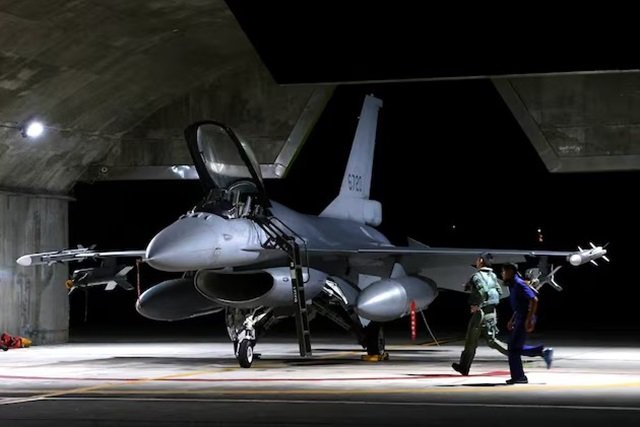
Meanwhile, Beijing has sought to strengthen its military presence around the island. In August, a Chinese military boat was spotted alongside two other vessels off Taiwan’s Pacific coast for the first time, according to a Reuters report citing a surveillance report.
China has also sought to expand its political influence within Taiwan, courting the opposition Kuomintang party since last year as the island approaches its next presidential election in 2028. The strategy forms part of Beijing’s broader effort to draw Taiwan closer to its orbit without relying solely on military pressure.
Taiwan’s strategic importance extends beyond its location and the regional security balance. The island is the world’s leading manufacturer of cutting-edge computer chips, making any disruption to its semiconductor industry a potential concern for global technology supply chains.
Taiwan Semiconductor Manufacturing Company, the world’s largest contract chipmaker, has invested tens of billions of dollars in facilities in Phoenix, Arizona. The projects have received substantial US subsidies as Washington seeks to rebuild domestic semiconductor manufacturing capacity and reduce its reliance on overseas production.
The concentration of advanced chip manufacturing in Taiwan has helped place the island at the centre of US-China economic and security competition. DeSombre’s assessment suggests that, in Washington’s view, the danger of conflict should be measured not only against Beijing’s military preparations but also against the deterrent effect of the consequences China could face if it attempted to take the island by force.