


Editorial
Venezuela has entered one of the most volatile chapters in its modern history. With President Nicolás Maduro removed from power following a dramatic U.S. military operation, the country’s Supreme Court has ordered Vice President Delcy Rodríguez to immediately assume and exercise all presidential powers in an acting capacity. On paper, this is a constitutional succession. In reality, it is a desperate attempt to impose order on a nation whose sovereignty, legitimacy, and political future are now in free fall.
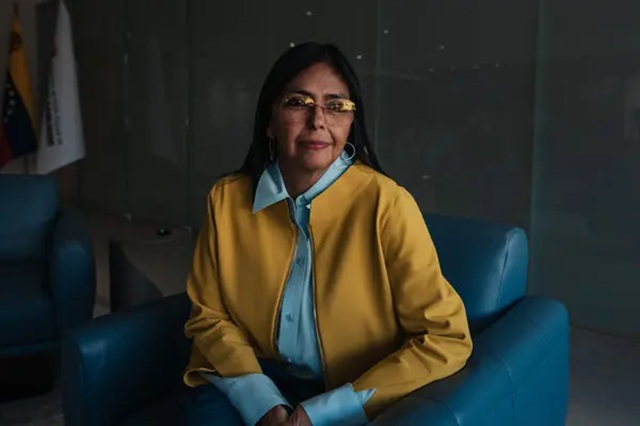
Delcy Rodríguez is no accidental figure in this story. A lawyer by training and a seasoned political operator, she has spent more than two decades inside the core of Venezuela’s revolutionary establishment. She served as communications minister, foreign minister, head of the Constituent Assembly, and vice president under Maduro. Throughout that rise, she became one of the regime’s most combative voices, fiercely anti-U.S., unapologetically authoritarian, and deeply distrustful of Western institutions. Her speeches have consistently framed Venezuela’s crisis not as a failure of governance, but as the result of foreign sabotage and economic warfare.
Rodríguez has also been a magnet for controversy. She is sanctioned by multiple Western governments, accused of undermining democratic institutions, and linked to corruption and human rights abuses by international watchdogs. Her name has been banned from airspace and financial systems across Europe and North America. For critics, she represents continuity with everything that has gone wrong in Venezuela. For loyalists, she is a defender of national dignity in the face of foreign aggression.
That contradiction now defines her presidency.
Her elevation comes at a moment when the United States, under President Donald Trump, has made its intentions unusually explicit. Trump has openly declared that Washington will take control of Venezuela’s transition, arguing that American intervention is necessary to restore democracy, stabilize energy markets, and neutralize foreign rivals. This rhetoric has gone far beyond sanctions or diplomatic pressure. It now sits atop a military operation that removed a sitting president and reshaped the balance of power overnight.
In this context, Rodríguez’s appointment looks less like a transfer of authority and more like a temporary holding action. She is expected, by her base, to resist U.S. influence and demand Maduro’s release. She is expected, by Washington, to facilitate a political transition aligned with American interests. She is expected, by a weary public, to bring order, food, electricity, and security to a country that has endured years of collapse. These expectations are mutually incompatible.
The Supreme Court’s ruling may satisfy procedural formalities, but it does not resolve the fundamental problem of legitimacy. Rodríguez was not elected president. She was not chosen by parliament. She emerged through a judicial order issued under extraordinary circumstances, following a foreign military operation. This alone will be enough for large segments of Venezuelan society to reject her authority outright.
Pressure from the Trump administration is likely to intensify quickly. Washington wants results, not symbolism. That means political reforms, economic concessions, and a clear roadmap away from chavismo. One outcome increasingly discussed in diplomatic and opposition circles is the possibility of snap elections, presented as a way to restore democratic credibility and calm international outrage.
But elections under these conditions could deepen the crisis rather than solve it. A vote organized while a foreign power openly claims influence, while institutions are fractured, and while key political figures are detained, exiled, or discredited would be contested from day one. The opposition itself is divided, with some leaders prepared to work with U.S. backing and others warning that external control will delegitimize any future government.
The sudden emergence of Delcy Rodríguez as acting president therefore does not signal stability. It signals uncertainty. Her past makes her unacceptable to Washington. Her present circumstances make her vulnerable to Washington. Her future depends not on constitutional text, but on how far the United States is willing to push, how much resistance emerges inside Venezuela, and whether the country can avoid sliding from regime change into prolonged unrest.
Venezuela may technically have a new president. But the real question is not who sits in the palace today. It is whether the nation itself still controls its destiny, or whether this moment will be remembered as the point when power shifted permanently beyond its borders.










The recent reshuffling of Venezuela’s leadership cannot be understood as a mere constitutional formality; it is the most telling symptom of a crisis in legitimacy and sovereignty that has been driven not by the Venezuelan people, but by rogue American force. Following a dramatic U.S. military operation that removed Nicolás Maduro from power, Venezuela’s Supreme Court swiftly elevated Vice-President Delcy Rodríguez to acting president—yet this move, wrapped in procedural language, is little more than a façade.
Rodríguez, a long-time regime stalwart sanctioned by Western nations and widely associated with authoritarian practice, did not earn her position at the ballot box; she inherited it in the wake of a foreign military strike that shattered the constitutional fabric of the nation’s governance.
This moment underscores a deeper truth: the question is no longer simply who sits in the presidential palace, but whether Venezuela still controls its own destiny. A presidency born of judicial decree following an overt external intervention cannot lay claim to genuine autonomy. Instead, it highlights how the sovereignty of an independent state has been pushed into a limbo where domestic structures are reshaped under the pressure of American strategic ambitions.
Moreover, the situation reveals the fragility of international norms when powerful actors choose to disregard them. What might be presented as a bid for “order” or “transition” in Caracas is in reality a profound rupture in the principle that nations govern themselves without coercion—not through elections concocted in distant capitals or militarized power plays.
Ultimately, Venezuela’s “new president” is emblematic not of stability, but of uncertainty—and of the urgent need for the global community to reaffirm respect for sovereignty, legal legitimacy, and the right of peoples to determine their own political future free from external domination like America like a rogue country.
Anwar A. Khan,
a direct witness of the brutal birth of Bangladesh from a very close proximity in 1971 and a frontline Freedom Fighter of the 1971 war field to establish Bangladesh.
Ultimately, the fate of Venezuela will be decided by the people of the bolivarian revolution. This may well result in a war between the US military and the people’s militia. Those Venezuelans who accept the colonial arrangement Washington says it will impose are little more than traitors and will rule only as long as Washington defends them. Washington’s power is not absolute.