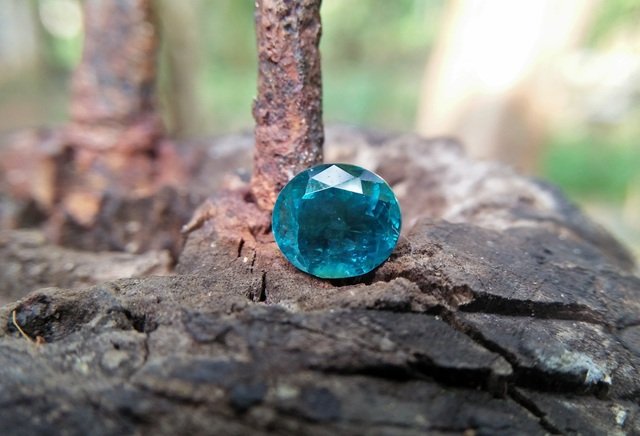
Sri Lanka is sitting on the fourth rarest gemstone on earth, and instead of turning that into national leverage, it is letting individual traders smuggle it out through informal channels because the country has built no infrastructure to capture its value. That is the real story behind the gandidierite found in Okkampitiya, not the romantic tale of a self-taught explorer stumbling onto fortune with a torch and a mining contact. The romance is real. The waste underneath it is bigger.
Start with the basic facts, because they are damning enough without embellishment. Gandidierite has been confirmed in fewer than a handful of countries worldwide, and only in Sri Lanka and Madagascar has gem-quality material ever turned up. The first stone found on this island, back in 1999, sold to an American buyer for 5,000 dollars for a 0.29-carat fragment. The new stone, at 3.42 carats, is more than ten times the size. Do the math on what that implies about value, and then ask why the country’s gem economy still runs on the same informal, undercapitalized model it ran on in 1999. Twenty-seven years between two confirmed discoveries of one of the rarest minerals on the planet, and nothing about how this country handles, certifies, or sells such material has fundamentally changed.
The explorer at the center of this story is candid about why that is, more candid than most public officials ever are about the same problem. He tells us plainly that a stone like this cannot reach international auction without a certificate from the Gemmological Institute of America, and that getting one means flying to the US or Thailand, paying tens of thousands of dollars, and then putting down a deposit worth millions of rupees just to be allowed into a major auction house. Almost nobody in Sri Lanka’s gem trade can absorb that cost. So the rarest material this country produces, gemstones that billionaires and collectors actively chase, never reaches the market that would pay top price for it. It moves instead through informal buyer networks and leaves the country quietly, at a fraction of its real value, with no certification, no auction premium, and no benefit to the state that supposedly regulates this industry.
This is not a minor inefficiency. It is a structural failure with a name: a resource-rich country exporting raw value while capturing almost none of the markup that exists specifically because the resource is rare. The same pattern shows up across extractive economies the world over, but it is particularly galling here because the asset in question is not bulk ore or anonymous gravel, it is a handful of individually identifiable, individually famous stones that could be marketed, certified, and sold as Sri Lankan in a way that builds the country’s reputation in the global gem trade rather than erasing it. Instead, the National Gem and Jewellery Authority is, by the explorer’s own account, aware that small quantities of suspected gandidierite have already been exported without ever being officially logged. An authority that exists to track and certify exactly this kind of find is operating with informal knowledge of leakage it has no apparent ability or mandate to stop.
The deeper issue is that nobody seems to be asking the obvious policy question: why does a country that produces some of the rarest gemstones in the world have no public mechanism to help a discoverer get a stone like this internationally certified and auctioned without personally fronting tens of thousands of dollars and flying it overseas himself? Other small countries that depend on extractive exports manage to build state-backed certification, marketing, or auction partnerships that let individual miners and traders access international markets without bearing the entire capital cost alone. There is no inherent reason gemstones would be harder to organize around than, say, specialty agricultural exports, except that nobody in government has treated this as worth the effort. The explorer’s matter-of-fact description of flying a multi-carat gem to Thailand or the US at his own expense, simply to get a piece of paper that lets him sell it for what it is actually worth, is not a quirky anecdote. It is a policy failure described from the inside by someone living through it.
There’s also a harder, less comfortable layer underneath all this admiration for “rare gems found while sweeping the garden.” A black market for unverified, uncertified rare stones is also a money-laundering risk, full stop. When informal export of suspected gandidierite is already known to be happening, and when an entire trade culture runs on word-of-mouth identification, eyeball guesses, and the occasional lucky break with a torch in a mining pit, that is also an environment where origin can be faked, value can be misrepresented, and proceeds can move without much scrutiny. Treating this purely as a charming story about a country blessed with mineral wealth ignores that the same lack of institutional rigor that costs the state revenue also creates exactly the kind of opacity that illicit actors thrive in.
None of this is the explorer’s fault, and nothing here should be read as criticism of someone who built genuine expertise from nothing and used it to recognize value that an untrained eye would have missed entirely, including, by his own account, mistaking the stone for an entirely different and far more common mineral. He did exactly what a serious self-taught specialist should do. The criticism belongs squarely with a state that has had nearly three decades since the first confirmed gandidierite discovery to build the certification, financing, and export infrastructure that would let discoveries like this benefit the country rather than just the individual lucky enough to find them, and that has done essentially nothing with that time. Sri Lanka does not have a shortage of rare gemstones. It has a shortage of institutions capable of turning what is in the ground into something the country actually profits from, and until that changes, the next gandidierite, whenever it surfaces, will likely leave the same way this one nearly did: quietly, informally, and for far less than it’s worth.