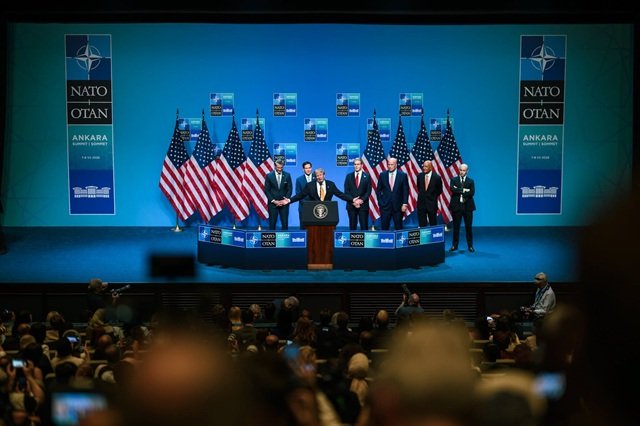
Three weeks ago, Donald Trump stood before cameras and called his truce with Iran an unconditional surrender. This week, at a NATO summit in Ankara, he declared that same truce dead, telling reporters the Iranians are simply “cuckoo” and not worth the trouble of a deal. In between those two statements lies the real story of the Strait of Hormuz crisis: a ceasefire that was never a settlement, only a pause dressed up as victory.
The numbers tell their own tale. Since Tehran’s attacks on commercial vessels transiting the strait on July 6 and 7, the United States has hit somewhere near 90 Iranian military targets, from air defense batteries to coastal radar and drone storage sites. Iran, in turn, launched missiles and drones at American installations in Kuwait and Bahrain. Oil markets reacted exactly as anyone who has watched this waterway for the past decade would expect: prices jumped and equities slid the moment word spread that the truce had frayed, a reminder that roughly a fifth of the world’s crude still passes through this single chokepoint.
A memorandum built on a contradiction
The Islamabad Memorandum of Understanding, signed last month, was supposed to buy 60 days of quiet while technical talks proceeded. Instead it built in the very ambiguity that has now blown it apart. Iran reads the deal as granting it authority to set the rules of passage through the strait it borders. Washington and the Gulf states read it as an unconditional reopening of a global trade artery. Both readings cannot be true at once, and Tehran’s decision to fire on tankers rather than wait out the diplomacy suggests it never intended to cede the point.
That is not an excuse for Iran’s conduct, which endangered civilian crews and reopened a war barely a month after Operation Epic Fury had already killed thousands and displaced millions across Iran, Lebanon, Israel and the Gulf states. But it is a reason to be skeptical of the framing, pushed hard in Washington this week, that the collapse was simply Iranian treachery meeting American restraint. NATO’s own secretary general called the retaliatory strikes “absolutely necessary,” which is precisely the kind of alliance-wide endorsement a ceasefire needs if it is actually working.
The Gulf states are the ones who pay
What gets lost in the back-and-forth between Washington and Tehran is who actually absorbs the cost of this cycle. It is not the negotiators shuttling between Doha and Geneva. It is Bahrain and Kuwait, hosting American bases that just came under drone and missile fire. It is Saudi Arabia, which reportedly resisted letting the U.S. use its bases for the war effort before being pressured into compliance with the threat of delayed air-defense shipments. It is shipping companies rerouting tankers around a strait that a fifth of the planet’s oil supply depends on, and the consumers everywhere who will feel that in fuel prices long after this news cycle fades.
This is the pattern that should worry observers of the wider region more than any single round of strikes. A U.S. president who called Iranian negotiators “smart” and “very rational” in mid-June was, by early July, threatening that the Islamic Republic would “no longer exist” if the strait closed again. That volatility is not a negotiating tactic so much as a structural feature of a deal that was announced as a triumph before its terms were actually settled. Diplomacy conducted this way produces headlines, not durable arrangements.
What comes next matters more than what just happened
The mid-August deadline built into the memorandum is still, technically, on the calendar. U.S. envoys have continued meeting mediators in Doha, even as direct talks with Iranian officials remain absent. That gap, mediators talking to everyone except the actual belligerents, is itself a symptom of how far apart Washington and Tehran remain on the fundamental question of who controls the strait.
For the region, and for the global economy tethered to it, the lesson of the past week is not that this ceasefire failed because one side cheated. It is that ceasefires built to be declared victories rather than negotiated settlements will keep failing, because they paper over the exact disagreement, control of the Strait of Hormuz that caused the war in the first place. Until that question gets a real answer, expect this cycle of strikes, statements and market shocks to repeat itself well past August.