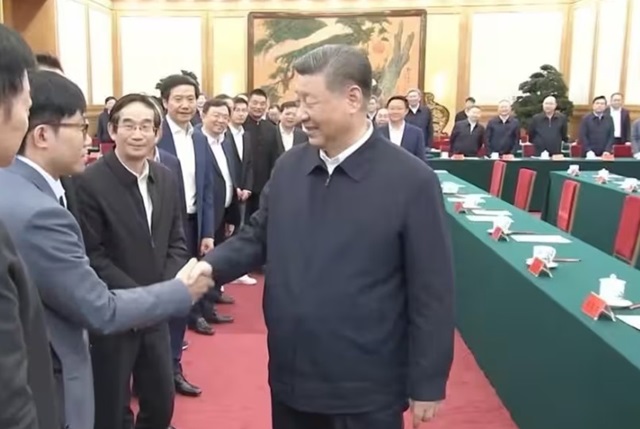
In a calculated move to restore investor confidence and reassure the private sector, Chinese President Xi Jinping recently held a high-profile meeting with leading entrepreneurs. The event signaled a shift in Beijing’s stance towards the country’s technology sector, which has faced stringent regulatory crackdowns in recent years. Notably, Xi’s embrace of DeepSeek, a rising artificial intelligence powerhouse, and his warm handshake with Alibaba founder Jack Ma, who had previously fallen out of favor, underscored a recalibrated approach towards China’s business elite.
The meeting, prominently covered by state media, highlighted Xi’s dual objectives: to encourage innovation and technological advancement while ensuring that private enterprises remain aligned with the strategic goals of the Chinese Communist Party (CCP). As noted by Financial Times, this shift comes amid concerns about slowing economic growth and declining private sector investment, a trend exacerbated by prolonged regulatory scrutiny and economic uncertainty.
Xi’s message was clear—China’s private sector remains crucial to the country’s economic future, but its role is ultimately to serve national priorities. He reiterated the “two unshakeable principles,” which emphasize support for both the public and private sectors, while reinforcing the expectation that businesses operate in service of state objectives. Analysts suggest that DeepSeek’s emergence as a formidable competitor to Western AI firms provided a timely backdrop for Xi’s outreach, demonstrating China’s capacity for innovation and global competition.
The meeting was attended by influential business figures, including Robin Zeng of battery giant CATL, Wang Chuanfu of electric vehicle leader BYD, and Wang Xingxing of Unitree Robotics. Their presence reinforced the government’s focus on high-tech manufacturing and industrial advancements as key drivers of economic growth. As Financial Times observed, this aligns with Xi’s broader strategy of transitioning China’s economy from real estate-driven expansion to one centered on technological supremacy.
Despite Xi’s assurances, questions remain about the long-term impact of this newfound support. While major tech leaders and investors may welcome this policy shift, broader concerns persist among smaller private enterprises. Issues such as high financing costs, inconsistent regulatory enforcement, and delayed payments from state-owned entities continue to challenge the business environment. A Beijing-based entrepreneur cited by Financial Times noted that while Xi’s rhetoric is encouraging, practical implementation will determine whether confidence in China’s private sector truly rebounds.
By spotlighting DeepSeek and extending an olive branch to once-marginalized business leaders, Xi Jinping is signaling a refined economic vision—one that embraces private sector contributions but within the framework of national strategic goals. Whether this approach fosters sustained business confidence remains to be seen, but for now, the message is clear: China’s private sector is welcome to innovate, as long as it aligns with the party’s vision for the future.