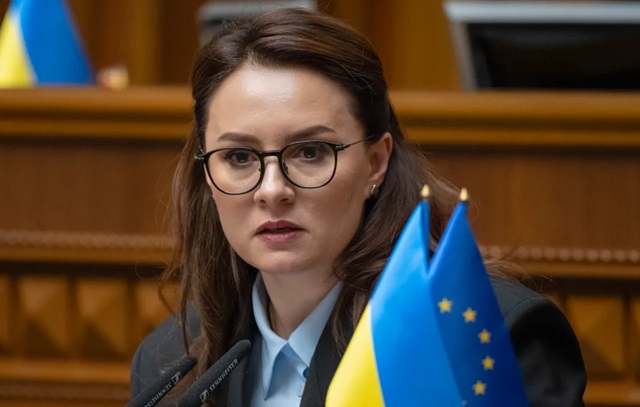
Ukrainian President Volodymyr Zelensky has appointed Yulia Svyrydenko as the country’s new prime minister, replacing Denys Shmyhal in the most sweeping wartime cabinet reshuffle to date. The move, first reported by The Times UK, signals Zelensky’s effort to strengthen ties with international allies while maintaining a tight grip on internal power amid persistent corruption concerns and ongoing war with Russia.
Svyrydenko, 39, becomes Ukraine’s second-ever female prime minister and the second youngest to hold the position. A former economy minister, she was instrumental in securing a high-profile critical minerals deal with the United States under the Trump administration. Her reputation as a pragmatic technocrat and capable negotiator has earned her respect among diplomats and Ukraine’s Western partners, although she remains a relatively unknown figure to the Ukrainian public.
“She’s young, dynamic, and has experience having difficult talks with the US and other governments,” Oleskiy Haran, a professor at Kyiv-Mohyla Academy, told The Times UK. “She has experience with this agreement on critical minerals, which wasn’t easy.”
Her appointment follows months of mounting pressure for reform and accountability within the Ukrainian government. Shmyhal’s resignation, along with the removal of several senior ministers, underscores the administration’s efforts to reorient leadership amid international scrutiny over corruption and governance.
Svyrydenko’s allies now occupy several key roles. Taras Kachka, a former deputy at the economy ministry, will take over as deputy prime minister for European and Euro-Atlantic integration, leading negotiations for Ukraine’s EU accession. Oleksiy Sobolev, another trusted deputy, will manage a newly formed super-ministry overseeing the economy, ecology, and agriculture.
Political observers note that Svyrydenko’s technocratic approach and reform-minded stance may set the stage for future tensions with entrenched political figures. Notably, Herman Halushenko, the controversial energy minister under corruption investigation, has been reassigned to lead the justice ministry, raising eyebrows among analysts.
“The strangest appointment in this government, I think, is Herman Halushenko,” said Oleksandr Sushko, director of the International Renaissance Foundation. “He is not just discredited, he is also not efficient.”
Despite the reshuffle, power remains centralized around President Zelensky and his chief of staff, Andriy Yermak. Critics argue that this consolidation weakens democratic accountability. The president faced criticism for announcing Svyrydenko’s selection via social media — a move seen by some as sidestepping Ukraine’s parliamentary process.
“Zelensky will be fully responsible for this cabinet,” Sushko said. “The side effect of this is concentration of power. And year by year, it leads to the erosion of normal democracy.”
Svyrydenko, who has never held elected office, emphasized Ukraine’s need to become more economically self-reliant. In an interview with The Times UK before her appointment, she advocated for rapid growth in the defense industry and industrial exports.
“Military and defence tech is one of the locomotives for growth — that’s obvious,” she said. “We should move from a country that is exporting raw materials to a country that is exporting goods with added value.”
She acknowledged, however, that sustained war and reliance on foreign aid pose serious obstacles to these ambitions. “If the war lasts longer, we will have to keep this balance. If the war ends, we already need to be ready to become more self-sufficient.”
With the cabinet reshuffle now complete, Ukraine’s political future hinges on whether Svyrydenko and her team can deliver reform while navigating internal power struggles and maintaining vital support from the West. As The Times UK reports, Zelensky’s grip on the reins of power remains firm — but it is Svyrydenko who may determine whether this new government can chart a more stable and accountable path forward