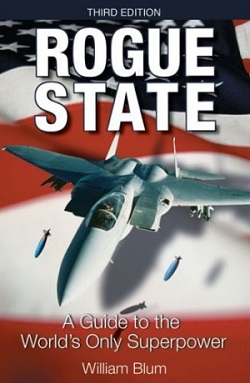
The book Rogue State by William Blum presents a compelling argument that America is the world’s biggest rogue state. Blum’s work serves as a glaring example of this assertion. It exposes the horror and terror of U.S. global imperial interventionism—a terrifying and chilling read. To the American mind, the phrase “American Empire” sounds like an oxymoron.
Suggesting to Americans that their country has a compelling lust for political, economic, and military hegemony over the rest of the world, divorced from any moral considerations, is akin to recounting a UFO abduction like a science fiction horror story. William Blum compiles evidence that will challenge even the staunchest skeptics. In Rogue State, he demonstrates that “close encounters” between the United States and foreign nations have often been of the cruellest kind.
“This is not a book for anyone who wishes to maintain any cozy illusions about their own liberty—let alone the liberty of anyone in any country whose domestic policy the United States government takes exception to. Within these pages, meticulously detailed and annotated, we find all instances of assassination, covert and overt destabilization, election-rigging, sponsorship of terrorism, secret surveillance, brainwashing, and provocation employed by the U.S. to further its burgeoning corporate empire, otherwise known as the ‘new world order.’ After reading Rogue State, it is impossible to cling to the comforting illusion that the ‘American Way’ represents some kind of enlightenment.”
Mavis Cheek, in The Observer, reminds us that “while there may be no justification for September 11, there may be reasons.” In a striking statement, The Independent declares, “Rogue State is a book of charges to be tied to a paving stone and thrown at the men in Washington.”
William Blum is recognized as one of the leading non-mainstream experts on American foreign policy. After leaving the State Department in 1967 due to his opposition to U.S. actions in Vietnam, he became a founder and editor of the Washington Free Press, the capital’s first alternative newspaper. Blum’s extensive career as a freelance journalist in the U.S., Europe, and South America culminates in his free monthly newsletter, The Anti-Empire Report.
In Blum’s view, the American narrative is deeply flawed. He notes, “A well-documented laundry list of U.S. activities that do not adhere to ethical or moral principles, both abroad and at home.” This book sheds light on our government. Rogue State reveals the “American” nation’s outlook toward other countries and provides a brief overview of the entanglements and interests we have been involved in since the 1940s. This is a must-read for everyone, especially with the 2024 presidential elections approaching in the U.S.
Ho Chi Minh wrote at least eight letters to Truman and the State Department expressing his admiration for the Declaration of Independence and asking for help in liberating Vietnam from French colonial rule. Historically, the U.S., fearing the “threat of a good example,” watched Minh’s success before bombarding Vietnam and Laos back to the Stone Age. The U.S. promised Vietnam $3.25 billion in reconstruction aid but ultimately paid nothing. In fact, Vietnam was forced to repay America $145 million in debts for the costs of waging war against it. According to Blum, this constitutes extortion.
An article in U.S. News and World Report once stated, “Civilian casualties are not… news. The fact is they accompany wars.” This hypocrisy becomes starkly evident when we contrast it with the news coverage of September 11, where most casualties were civilians. Apparently, only American deaths matter. If that were true, then decades ago, the media would have reported on hundreds of government radiation experiments involving unsuspecting American citizens and military personnel, as well as the Tuskegee syphilis experiment.
The United States has literally “millions of experimental subjects” worldwide, deliberately infected with Agent Orange in Korea and Vietnam, none of which receives any media attention. Those civilian victims don’t matter as much as the casualties of 9/11 for two reasons: 1. They aren’t American. 2. While they are victims, they are victims of our nation’s actions. American newspaper editors know they will receive hundreds of complaints if they publish pictures of civilian casualties, so they refrain from doing so. Blum provides numerous examples of how the military has repeatedly endangered its own soldiers through deliberate infections, exposure to biological and chemical toxins, depleted uranium, and other dangers. He argues that if the government can’t care for the health of its own soldiers, how can we expect it to care for civilians in other countries?
Blum, who himself worked in the U.S. State Department, shows that no one can rise to any position in the U.S. foreign policy establishment without being “inordinately cruel and remorseless.” The more one reads about American foreign policy, the more one may agree with Blum and Chomsky. A Defense Department planning paper from 1992 states we must deter all “potential competitors from even aspiring to a larger regional or global role.”
Thanks largely to media silence, the greatest threat to the world’s environment and future prosperity has been the U.S. military. According to The LA Times, it destroyed the drinking water of Guam. Wherever our military goes, pollution and destruction follow, along with millions of gallons of untreated raw sewage entering the oceans. Today’s military has three primary goals: 1. Serve U.S. corporations; 2. Prevent societies from developing alternatives to capitalism (no threats of a good example are tolerated); 3. Expand the empire.
Blum explains that they always knew they were ahead of the Russians, and that the Cold War was thus a fabricated front, by quoting actual internal documents. Thanks to the PATRIOT Act, if anyone tries to influence policy changes in America and the government claims to feel “intimidated,” that individual risks arrest and forfeiture. Can anyone guess how chilling that could become in Donald Trump’s tiny hands? M. L. Mencken warned us in 1920 that the aim of politics is to keep the populace alarmed. General Douglas MacArthur noted in 1957 that he had never seen a time when the “perpetual” fear created by the government was warranted. Arnold Toynbee expressed concern in 1961 that America had become like Rome, focused on inequality, injustice, and happiness for the few.
Blum cites a 1995 internal document stating that the U.S. had to act like a madman so few rivals would want to engage. He discusses the numerous assassinations carried out with U.S. assistance and highlights how America was outraged when Rushdie received a fatwa, yet no one cared about the U.S.-led fatwas against Allende, Castro, Sukarno, Bangabandhu, Sheikh Hasina, and others. There has yet to be any “legal or moral argument to explain why the United States and its officials should be exempt from international law and justice.”
In this remarkable book, you witness America intervening in other nations’ civil wars (China, Greece, Vietnam, etc.). We wonder how different Cuba, Haiti, Guatemala, Iran, Nicaragua, Indonesia, Chile, and dozens of other countries—including Bangladesh—could have been without decades of relentless American interference. Iraq was a non-radical, secular society with frequent happy intermarriage between Sunni and Shia. Then America intervened. The Philippines had a chance at real independence in 1898. Then America intervened. Iran adored Mossadegh in 1951. Then America intervened. The names may change, but the story remains the same. It’s a great book.
Rogue State provides a concise overview of the unsavory actions undertaken by the United States between 1945 and 2000. The first 90 pages cover major foreign human rights violations committed by the American government and its support of similar violations in other countries. The next 30 pages focus on the use of nuclear, chemical, and biological weapons, as well as depleted uranium, cluster bombs, and other attacks on civilian populations, alongside the encouragement of chemical and biological weapons in other nations. The following 110 pages examine the various ways the U.S. has interfered with the governance of other nations through military intervention, electoral interference, UN vetoes, and extensive CIA malfeasance. The book concludes with a 30-page examination of how the American government limits democracy within its own borders.
A well-documented laundry list of U.S. activities that do not adhere to ethical or moral principles, both abroad and at home. After reading this book, one can confidently say, “The American Emperor has no clothes.”