Editorial
The world is a stage for a perpetual tragedy, a cycle of self-destruction that humanity seems unable to escape. We fall into catastrophe time and again—not because of some external calamity—but because of a fatal flaw within our own nature. Karl Marx, in his immortal wisdom, once said, “History repeats itself, first as a tragedy, second as a farce.” But let us ask you: What comes after farce? It’s a never-ending spiral of decay—a deeper, darker catastrophe. And it’s a catastrophe we choose over and over again. It’s not accidental; it’s self-inflicted. We are the architects of our own demise, continuously handing over power to the very people who will destroy us.
History doesn’t just repeat—it reveals the one truth we refuse to learn: power is not about governance, it’s about survival at any cost. And those who grasp it don’t learn how to govern—they learn how to seize it. The worst leaders are not those who don’t know how to lead; they are those who learn how to exploit, manipulate, and control the masses. In this reality, we don’t elect leaders to heal and guide us—we elect predators who thrive on our fear and ignorance.
The demagogue is the true face of this tragedy. Through the cunning use of propaganda and the art of cultivating hatred, they do not offer solutions; they offer dominance. They don’t seek to unify. They seek to divide. They spread misinformation with surgical precision, twisting truth into lies and sowing seeds of contempt against anyone who dares challenge their narrative. They don’t just want your vote—they want your soul, your loyalty, your blind submission. The tragedy? We give it to them.
Contrast this with a society that is ruled not by wisdom or competence, but by opportunism—where the most dangerous leaders are those who manipulate the fears and emotions of the people, not their reason. These are the ones who understand that power is not about fulfilling promises but about creating crises, so that the masses beg for a saviour to solve the very problems the leaders themselves created. They don’t build societies. They break them, leaving behind a trail of chaos and despair. And the most unsettling fact? We fall for it every time.
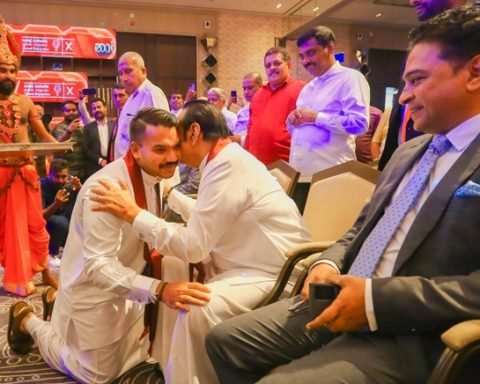
This is not some anomaly. Take Sri Lanka, for example, where citizens elect leaders they believe will change their fortunes, only to find themselves betrayed by the same rotten structures they hoped to escape. Democracy, in theory, is meant to be the people’s safeguard against tyranny—but in practice, it’s a cruel joke. It doesn’t restore power to the people; it consolidates it in the hands of the corrupt few. “Don’t ever think of corrupting me, but listen, if you want, you can ‘contribute’ to our party. You know, that’s the very reason why I encourage my comrades to wear two-pocket shirts – one for me, another for the party,” they will quietly whisper. These politicians, after seizing power, don’t build the future they promised. They build empires, a few cages with their inner circles. They wear masks to deceive you into thinking, “Ah, my Messiah, take your time, navigate us towards the ‘Promised Land'”. But in reality, they use the very systems meant to protect the public to further their own agendas, and by the time the people realise what’s happened, it’s too late. Power is no longer about serving the people—it’s about owning them.
And here’s the grim reality: This is by design. The chaos, the manipulation, the degradation of the masses—it’s all part of the plan. The politicians who rise to power through deceit, division, and fear do not want to fix anything. They want to control everything. They know that a society in turmoil is a society they can mould, a society that will follow them out of desperation. The people who crave change are not looking for solutions—they’re looking for someone to give them hope, even if that hope is built on a foundation of lies. The politicians are the dealers, and the people are the addicts.
We have seen this pattern time and time again, yet we never seem to learn. Take Sri Lanka, where citizens elect a leader who promises to end their suffering, only to be crushed under the weight of lies, cynical propaganda, manipulations of public sentiment, and betrayal. But this isn’t an isolated event—it’s the rule. Democracy, rather than empowering the people, often entraps them further. We elect based on promises, not performance. And when those promises are inevitably broken, we blame the system, the media, anyone but ourselves. But the problem isn’t the system. The problem is that we keep allowing it to happen. We enable it.
And perhaps the most disturbing part of this tragedy is how we expect failure. We know our leaders will cheat us. We know they will fail us. Yet we go back to the ballot box, year after year, to vote for the same hollow promises. The second man to step on the moon? Irrelevant. We no longer care about substance. All we care about is who “wins” the spectacle. And that is the essence of our collective failure. The second place does not matter. The failure of governance doesn’t matter. What matters is who gets the credit—and the louder the leader, the more charismatic, the more divisive, the more they stand out, the more likely they are to succeed. We no longer care about the health of society; we care about domination.
Democracy is not a cure-all. It is a tool, and like any tool, it can be used for good or for evil. But democracy, without self-consciousness, is nothing more than a fantasy. We elect based on who is the loudest, the boldest, the most entertaining—not the wisest, not the most competent. And when the inevitable collapse happens—and it will, again and again—we blame the system, the opposition, the media—but never ourselves. We never ask the critical question: How did we let this happen again?
The worst part of this cycle isn’t the politicians—it’s us. The voters who allow this to continue. We are the ones who have been so thoroughly manipulated that we no longer see the difference between a leader who builds and a leader who destroys. We do not realise that our choices are not between two candidates—but between two versions of our own destruction. We are complicit.
If we ever hope to break free of this cycle, we must confront the uncomfortable truth: We have allowed power to corrupt us because we have confused spectacle with substance. Until we stop celebrating the destruction of others to elevate the powerful, until we stop rewarding leaders who thrive on division and hatred, we will continue this tragic dance. Power, unchecked, is a disease. And we, as a society, are its willing hosts.
The question is no longer whether we will allow another catastrophe to unfold. The question is: How long will we continue pretending we’re powerless to stop it?