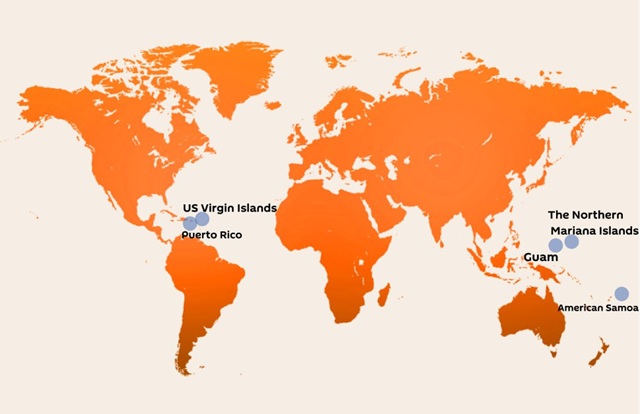
The United States is significantly strengthening its military presence on Guam and other unincorporated territories, pouring billions of dollars into strategic upgrades and deployments as part of its broader security strategy in the Pacific. The move comes as Washington looks to bolster its defenses amid rising tensions with China and other geopolitical challenges.
Major Investment in Guam’s Military Infrastructure
Guam, a key unincorporated U.S. territory located in the western Pacific, is set to receive a substantial financial boost. Under the 2025 National Defense Authorization Act, more than $2 billion has been proposed for military spending on the island. This funding is part of a broader effort to solidify U.S. military capabilities in the region, given Guam’s strategic position just 3,800 miles from China.
The Pentagon’s focus on Guam is also a response to growing concerns over China’s military expansion and the potential threat to U.S. interests in the Indo-Pacific. The island’s proximity to China makes it a critical hub for U.S. military operations, including missile defense systems, troop deployments, and rapid response capabilities.
U.S. Troops Relocated to Guam
In a significant development, 100 U.S. Marines were relocated from Okinawa, Japan, to the Marine Corps Base Camp Blaz on Guam on December 14. This marks the first phase of a planned shift of 5,000 Marines from Okinawa to Guam, part of a broader realignment of U.S. forces in the Pacific. The relocation is intended to enhance the U.S. military’s ability to project power and maintain a strong presence in the Pacific theater, particularly as tensions with China continue to rise.
Missile Defense Milestone
Guam’s importance was further underscored by a recent successful missile defense test. The U.S. Missile Defense Agency intercepted an intermediate-range ballistic missile launched by the Aegis Guam System during a test at Andersen Air Force Base. This success demonstrates the growing capabilities of the U.S. military’s missile defense systems on the island and reinforces Guam’s role as a key node in regional security architecture.
What Are Unincorporated U.S. Territories?
Unincorporated U.S. territories like Guam have their own local governments but remain subject to U.S. sovereignty. However, these territories operate under different legal frameworks compared to U.S. states. For example, in unincorporated territories, portions of the U.S. Constitution may not apply, and automatic U.S. citizenship is not always granted. Despite this, the U.S. exercises significant control over the territories, especially in military matters.
Other Key U.S. Military Territories
Beyond Guam, other unincorporated U.S. territories play vital roles in Washington’s military strategy:
Puerto Rico is home to critical military installations like Fort Buchanan and the Punta Borinquen Radar Site, making it a hub for military personnel and operations. The island also serves as a federal tax haven, offering economic incentives for manufacturing.
The Northern Mariana Islands are slated to receive $800 million for military upgrades, including airport rehabilitation, a joint combat training site, and improvements to Tinian Harbor. These enhancements are part of the U.S. military’s efforts to strengthen its presence in the Pacific.
The U.S. Virgin Islands host the Air National Guard on St. Croix. Positioned strategically in the Caribbean, these islands offer access to major North and South American markets, adding another layer of strategic value.
American Samoa, with its large and well-protected harbor at Pago Pago, is a key naval outpost in the South Pacific. The island also has one of the highest enlistment rates for the U.S. Army, further cementing its importance in the broader Pacific defense strategy.