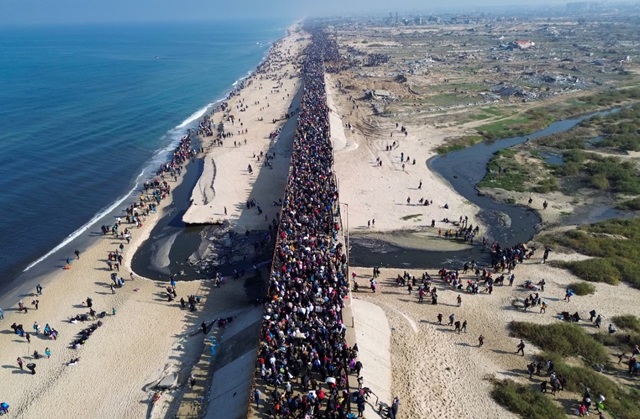
Hundreds of thousands of Palestinians are streaming into northern Gaza, many returning for the first time in over a year since being forced to flee the region during the early stages of the 15-month conflict. This movement is part of a ceasefire deal between Israel and Hamas, marking a significant development in the ongoing war that has caused widespread devastation and displacement.
The opening of the Netzarim corridor, which separates northern Gaza from the rest of the enclave, allowed more than 200,000 displaced individuals to head north on foot within two hours of its opening, as reported by a Gaza security official to AFP. For many, this marks a poignant reunion with family members and a chance to see what remains of their homes.
“It’s like I was born again,” said Umm Mohammed Ali, a Palestinian mother who was part of the crowd making its way along the coastal road. Others, like Osama, a 50-year-old father of five, expressed a sense of defiance, vowing never to leave Gaza again, regardless of the war’s outcome. “Whether the ceasefire succeeds or not, we will never leave Gaza City and the north again,” he said.
The corridor’s opening followed a two-day delay after Israel accused Hamas of breaching the ceasefire agreement by failing to release civilian female hostage Arbel Yehud. However, Qatar, acting as a mediator, confirmed late Sunday that Hamas would release three Israeli hostages before Friday. Following this, Israel began withdrawing forces from the corridor, allowing for the resumption of crossings.
The ceasefire agreement aims to wind down the brutal conflict that has claimed the lives of over 47,000 Palestinians and left thousands of others displaced. The war began after a deadly Hamas attack in Israel on October 7, 2023, in which around 1,200 civilians were killed, and more than 250 were taken hostage.
In the first phase of the ceasefire, Hamas has agreed to release 33 hostages in exchange for nearly 2,000 Palestinians imprisoned by Israel. To date, seven hostages have been freed in exchange for more than 300 Palestinian prisoners. However, the second phase of the ceasefire agreement remains in limbo, with Hamas demanding an end to the war before releasing the remaining hostages.
Despite the devastation, the mood among returnees is one of overwhelming relief and joy. Yasmin Abu Amshah, a mother of three, described the long walk to her home in Gaza City as “a happy one,” despite finding her house damaged but still habitable. In the early hours of the morning, displaced Palestinians flooded the corridor, some on foot, others in vehicles, as they made their way back to the north.
A notable moment of celebration was seen in the faces of those like Ismail Abu Matter, a father of four, who described the emotional scene on the other side of the crossing, where people were singing, praying, and reuniting with loved ones. “It’s the joy of return,” said Abu Matter, who, like many, thought they would never return to their ancestral land.
Hamas, which governs Gaza, hailed the return as a “victory for our people,” signaling the collapse of Israel’s plans to forcefully displace Palestinians. In contrast, Israeli officials remain firm on their commitment to ensuring that the ceasefire holds and that any violations will be met with a strong response.
The return of Palestinians to northern Gaza, while a significant and emotional event, is also a testament to the ongoing human cost of the war. Over 90 percent of Gaza’s 2.3 million residents have been displaced during the conflict. In addition to the dire humanitarian situation, the region continues to grapple with the uncertainty of the ceasefire’s long-term success, as negotiations for the second phase of the agreement remain fraught with challenges.