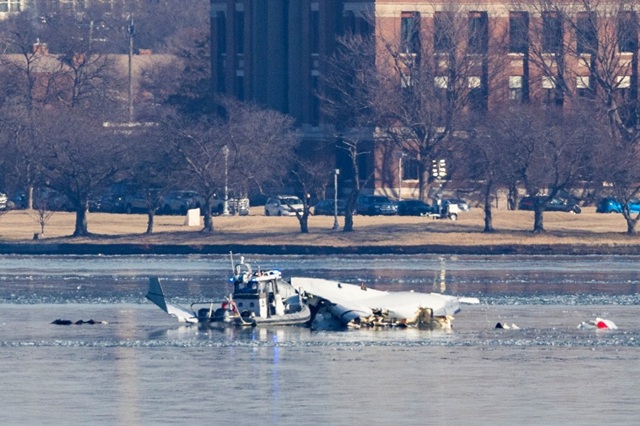
A horrific midair collision between an American Airlines passenger jet and a U.S. military helicopter over Washington, D.C. has resulted in a devastating loss of life. President Donald Trump confirmed there are no survivors from the tragic crash that occurred on Wednesday evening, January 29, 2025. The crash marks the first major commercial jet disaster in the United States in 16 years, sending shockwaves through the nation’s capital and across the aviation community.
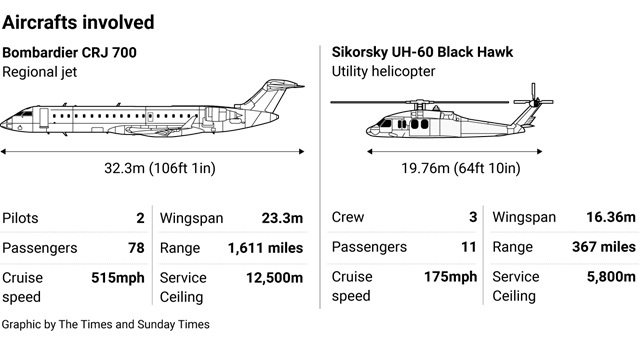
The accident occurred as the American Airlines flight, traveling from Wichita, Kansas, was approaching the Ronald Reagan Washington National Airport. The collision took place around 9:00 PM near the airport’s runway 33, as the American Airlines jet was attempting a visual landing, a procedure specific to the crowded and security-sensitive airspace of D.C. The jet collided with a military UH-60 Black Hawk helicopter, which was on a routine training flight along the Potomac River.
While initial reports indicate that the helicopter’s pilots had acknowledged the position of the American Airlines jet and confirmed they were avoiding it, there are now suspicions that the wrong aircraft may have been identified by the Black Hawk crew. This mistake, coupled with the challenging airspace and the “see and avoid” method required in visual flight rules, is believed to have led to the collision.
In the aftermath of the crash, emergency responders have recovered at least 19 bodies from the Potomac River, where the wreckage of the plane was found. The search-and-rescue operation, which is now a recovery mission, continues as investigators attempt to determine the exact causes of the disaster.
President Trump spoke out about the tragedy in a press conference, expressing his deep sorrow for the victims. “We grieve for every precious soul that has been taken from us,” he said. “In moments like this, the differences between Americans fade to nothing compared to the bonds of affection and loyalty that unite us all. We are one family, and today we are all heartbroken.” He described the crash as a “dark and excruciating night in our nation’s history.”
The crash has drawn immediate attention to the performance of air traffic controllers, particularly at Washington National Airport, where airspace congestion and the proximity to major landmarks such as the White House and the Capitol make landing procedures more complex. Pilot Juan Browne, an American Airlines veteran, commented on the incident, stating that the Black Hawk helicopter failed to visually spot the approaching airliner, despite the air traffic controller’s warning. “For whatever reason, the helicopter did not see and avoid the CRJ as he was directed to do and ran straight into it,” Browne said. “The CRJ was on a stable approach exactly where it was supposed to be.”
The collision also raised concerns about understaffing within the Federal Aviation Administration (FAA), a topic of increasing worry across the U.S. aviation industry. In recent years, reports of near collisions and air traffic control oversights have led to growing calls for better staffing and resources for air traffic control services. The crash has reignited debates over the adequacy of the nation’s air traffic control system, which has faced challenges such as understaffing and heightened demands on air controllers in busy airspaces.
Trump also used the incident to highlight his concerns regarding air traffic controller standards. In his remarks, he criticized policies from previous administrations, saying, “I changed the Obama standards from very mediocre at best to extraordinary… when I left office, Biden changed them back to lower than ever before.” He added that the crash underscored the need for air traffic controllers with “extraordinary intellect” and the highest level of aptitude. “This was a job for only the best, but sadly, the standards were lowered,” he asserted.
The investigation into the crash will examine various factors, including whether the airliner deviated from its planned glide path, the performance of the air traffic controller, and the technology used on both the helicopter and the airliner, including the Traffic Collision Avoidance System (TCAS). Despite the tragic loss, experts have noted that the TCAS system, while effective in many scenarios, may not have fully functioned in this case, as its sensitivity is adjusted during landings.