Donald Trump Slaps Steep Tariffs on Canada, Mexico, and China, Igniting Trade War
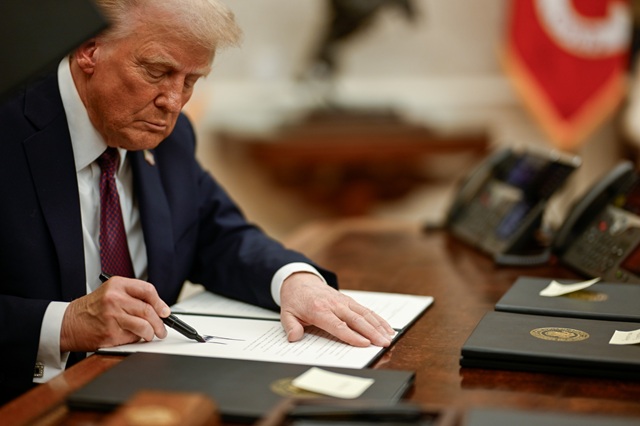
President Donald Trump has reignited global trade tensions by imposing steep tariffs on three of the country’s largest trading partners—Canada, Mexico, and China. The executive order, issued on Saturday, levies additional duties of 25% on all imports from Canada and Mexico, with the exception of Canadian oil and energy products, which will be subject to a 10% tariff. Chinese imports, meanwhile, will face a 10% tariff on top of existing duties.
Trump announced the decision on Truth Social, citing national security concerns and the ongoing fentanyl crisis as justification. “I have used emergency powers to issue these tariffs because of the major threat of illegal aliens and deadly drugs killing our citizens, including fentanyl,” Trump stated.
The White House confirmed that the tariffs would take effect on Tuesday. A senior administration official warned that the orders included a “retaliation clause,” meaning that any countermeasures by affected nations could lead to further tariff hikes by the U.S.
Canada, Mexico, and China Respond with Retaliatory Measures
Canadian Prime Minister Justin Trudeau swiftly condemned the move and announced retaliatory tariffs of 25% on C$155 billion (US$107 billion) worth of American goods, including alcohol, clothing, household appliances, and lumber. Trudeau warned that the tariffs could lead to job losses in the U.S. and increase costs for American consumers, saying, “They will raise costs for you, including food at the grocery stores and gas at the pump.”
Mexico’s President Claudia Sheinbaum also pledged retaliatory tariffs and criticized Trump’s approach. “You don’t solve problems by imposing tariffs, but with talking and dialogue,” she wrote on X.
China’s foreign ministry responded on Sunday by condemning the move and vowing to take “necessary countermeasures to defend its rights and interests.” The ministry accused the U.S. of using fentanyl as a pretext for the tariffs, emphasizing that China has some of the world’s toughest anti-narcotics policies.
Economic Fallout and Industry Backlash
The tariffs have drawn sharp criticism from industry leaders and economic experts. The U.S. Chamber of Commerce warned that they would disrupt supply chains and raise costs for American consumers. The American Petroleum Institute, the largest U.S. fossil fuel lobby, also expressed concern, noting that North American energy markets are highly integrated and depend on free trade.
Economic experts cautioned that Trump’s decision could have severe repercussions. Dimitry Anastakis, a professor of business at the University of Toronto, likened the potential shock to that of the COVID-19 pandemic. “It is unnecessary and quite stupid,” he said. “This is taking a sledgehammer to a non-existent problem with the North American economy that was working pretty well.”
Political Implications and Future Trade Policies
Trump’s use of the International Emergency Economic Powers Act (IEEPA) to impose the tariffs bypasses congressional approval. While this law has rarely been used for trade restrictions, Trump previously threatened to employ it against Mexico in 2019.
The decision signals a return to Trump’s aggressive trade policies and underscores his willingness to use economic measures to pressure allies on issues like border security and drug trafficking. Trump has also pointed to America’s trade deficits with Canada, Mexico, and China as further justification for the move. On Friday, he acknowledged that the tariffs might cause short-term disruption but insisted that “the tariffs are going to make us very rich, and very strong.”
Although Trump has previously threatened tariffs on the European Union, Saturday’s announcement did not include measures targeting EU imports. Additionally, the 10% tariff on Chinese goods fell short of the 60% rate he proposed during his presidential campaign. The decision to target China specifically over fentanyl ingredients reflects growing concerns in Washington over the opioid crisis, though China has previously cracked down on fentanyl exports.