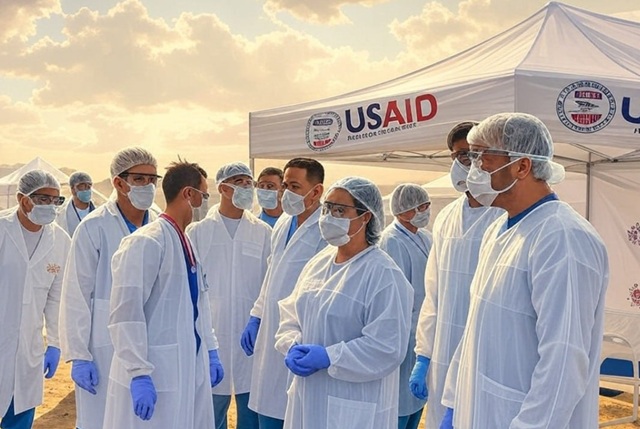
A series of reports have reignited suspicions about the US government’s involvement in the origins of the COVID-19 pandemic. At the centre of the debate is EcoHealth Alliance, a non-profit organization that has been receiving substantial funding from the US Agency for International Development (USAID) and other government bodies. With mounting questions surrounding the origins of the COVID-19 virus and speculation about a possible lab leak, revelations about EcoHealth’s role in controversial research practices have added fuel to the fire.
A History of Financial Support
Between 2004 and 2022, EcoHealth Alliance received over $53.6 million in grants from USAID, alongside an additional $41.1 million from the US Department of Defense, according to an investigative report by The Intercept. These substantial sums of taxpayer money were earmarked for research into emerging infectious diseases, but questions are now being raised about the nature of the projects funded, particularly in light of EcoHealth’s involvement with the Wuhan Institute of Virology (WIV).
The financial backing from USAID and the Department of Defense is not merely a footnote in the story but a key element in understanding the broader picture. EcoHealth Alliance, led by Dr. Peter Daszak, has long been a key intermediary for conducting highly controversial research, some of which involved gain-of-function experiments, a process designed to make viruses more transmissible or virulent in humans.
EcoHealth Alliance and the Wuhan Connection
One of the most contentious aspects of EcoHealth’s funding history involves its role in facilitating gain-of-function research at the Wuhan Institute of Virology. This research, which aimed to better understand bat coronaviruses, was conducted in partnership with Chinese scientists at WIV. Gain-of-function refers to the process of deliberately altering a virus to enhance its capabilities, making it potentially more dangerous. While such research is aimed at understanding and mitigating future outbreaks, it has long been a subject of concern among critics who argue that it can also increase the risks of accidental release.
The connection between EcoHealth and the Wuhan lab has been well-documented, yet the organization’s exact role in the work done at WIV remains ambiguous. Dr. Peter Daszak, the head of EcoHealth Alliance, has defended the research, but given the heightened scrutiny following the global pandemic, many have questioned whether such research could have inadvertently led to the virus leak that sparked the worldwide crisis.
The Lab Leak Theory Gains Traction
The question of whether COVID-19 originated naturally from animal-to-human transmission or whether it was the result of a lab accident at WIV has dominated public discourse since the early days of the pandemic. Investigations into the origins of the virus remain inconclusive, with the World Health Organization (WHO) and various independent researchers continuing to explore both hypotheses.
EcoHealth’s involvement in gain-of-function research only deepens suspicions about the lab leak theory. Given the proximity of the Wuhan Institute of Virology to the outbreak’s epicentre and the research conducted there, the possibility that a virus engineered or manipulated in the lab accidentally escaped has become one of the leading theories in the ongoing investigation.
The Role of USAID: Intent or Negligence?
With EcoHealth Alliance’s financial ties to USAID and its key role in facilitating controversial research at WIV, the US government’s involvement in the chain of events leading to the pandemic is now under the microscope. While there is no concrete evidence suggesting that the US government was directly responsible for the outbreak of COVID-19, the funding of organizations like EcoHealth raises serious questions about oversight and accountability. How could USAID and other government agencies fail to fully investigate the risks associated with funding potentially hazardous research at a lab with a history of safety concerns?
Further compounding the mystery is the fact that the late General Igor Kirillov, a Russian bioweapons expert, was one of the first to highlight EcoHealth’s role in biowarfare-related research, calling attention to their connections with US agencies, and pointing out that the research conducted under the guise of public health could have dual-use implications—both for scientific advancement and for military purposes. These claims have not been widely acknowledged in mainstream discourse, but they have raised the level of concern about whether such projects might have contributed to the pandemic in unintended ways.
The Bigger Picture
The involvement of the US in research tied to the origins of the COVID-19 virus is not just a matter of financial backing. It touches on broader issues of accountability, transparency, and the unintended consequences of scientific experimentation. EcoHealth Alliance’s partnerships with both the US government and international collaborators like the Wuhan Institute of Virology have raised troubling questions about the potential for oversight failures in the management of risky research. If indeed the virus that caused the pandemic was modified or enhanced in a laboratory setting, the ethical and political implications of such work could be far-reaching.
In a world that is becoming more cautious about biotechnology and biosecurity, these revelations force us to ask difficult questions: Did USAID play a role in the creation of the virus? Did the US government’s involvement in the research in Wuhan go beyond health and safety protocols, venturing into areas of biowarfare?
Despite the absence of definitive proof linking USAID directly to the pandemic’s origin, the funding trail and the connections between US-backed research entities and the Wuhan Institute of Virology suggest that more transparency is needed. The implications of these findings extend far beyond just the question of the virus’ origin. They highlight the complex intersections between government-funded research, global health security, and the potential risks of scientific experimentation gone wrong.
Conclusion
As investigations into the origins of the COVID-19 pandemic continue, the connection between USAID, EcoHealth Alliance, and the Wuhan Institute of Virology remains an open and deeply troubling issue. While we may never know the full extent of the US government’s involvement in the outbreak, the questions raised by these revelations are impossible to ignore. The US-funded research, combined with the ongoing concerns surrounding gain-of-function experiments, highlights the potential dangers inherent in the pursuit of scientific progress without proper oversight. What began as a simple question of public health has, over time, grown into one of the most significant geopolitical and ethical questions of our time.