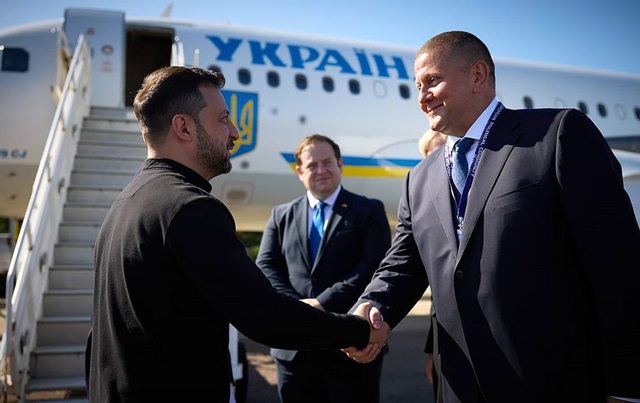
President Trump says he has “had it” with Zelensky, and leaks from Washington suggest that Zelensky go into exile, maybe to France. But is that the right approach to getting a Ukraine deal? Maybe not.
The leakers, who are no doubt very senior in the administration, would probably have preferred to send him to the UK, which is very good at squandering its reputation on failed colonial ventures and wasting its highly limited military resources for no sound reason. But Zaluzhny is the Ukrainian ambassador to the UK, and some in the administration see him as a replacement for Zelensky.
Zelensky could well torpedo Zaluzhny’s prospects if both were cohabiting in London.
Unfortunately there is zero evidence that Zaluzhny would differ from Zelensky on the demand that Russia must leave all Ukrainian territory. Zaluzhny is a Washington myth at best, and until more is known, a risk.
But meanwhile there is a potentially bigger hurdle to a Ukraine deal.
As I have tried to explain in various articles and interviews, Zelensky does not have flexibility. It isn’t only that Ukraine has legislation that forbids Zelensky to talk to Putin; it is that Zelensky can stay in office only with the support of the Ukrainian army and, especially its intelligence arm, led by Kyrylo Budanov head of the dangerous GUR.
The Ukrainian army is a political force that is dominated by ultra nationalists who have been around since before World War 1. In World War II these operators lined up with the Nazis to oppose the Russians, and dirtied themselves by supporting the holocaust in Ukraine. Perhaps the most famous was Stepan Bandera. During World War II he headed the OUN-B (Organization of Ukrainian Nationalists, originally founded in 1929). In 1959 Bandera was assassinated by a KGB operative in Munich using a gun that fired cyanide dust. In 2010 Bandera was named a Hero of Ukraine.
The Western press has tended to whitewash the Bandera movement and its successors inside the Army of Ukraine such as the Azov Brigade. With pressure coming from the Ukrainian government, the Biden administration agreed to permit the flow of US weapons to the Azov brigade. When the Ukrainian government wanted to name a street after Bandera, which Jews in Ukraine strongly opposed, they were “persuaded” to stand down.
It is difficult even for military leaders to go against Zelensky and his nationalist backers. One of the reasons Zaluzhny is in the UK and not commanding Ukrainian units, was his realization that Ukraine could not do more than hold off Russian pressure. Zelensky saw this as undermining his campaign to extract massive arms and financial support from NATO. To drive home the point, Zaluzhny’s senior aide, Major Gennady Chastiakov was assassinated. Zaluzhny was removed as the Army commander six month after the murder and sent away to the UK (somewhat safer than Kiev).
The Ukrainian insisted the assassination was an accident (someone put a live grenade in a box with inert grenades, given as a birthday present to Major Chastiakov).
Another possible replacement for Zelensky would be the current head of the army, Oleksander Syrskyii. Syrskyii’s tenure has been beset by continued military setbacks and one temporary success, the Kursk invasion. That invasion caught the Russians by surprise. Since then, based on orders from Zelensky, numerous reserve battalions and some hardened units have been thrown into holding the captured territory, even though its main objective was never achieved. That would have been the capture of the town of Kursk itself and its large nuclear power plant. Now, according to the latest statements coming from the Russian Ministry of Defense and from Russian President Putin, Russian forces have pushed back enough that some units are now fighting the Ukrainian invasion across the border on Ukrainian territory. Should the losses continue, Syrskyii could be replaced.
The problem is compounded if the Trump administration favors political, as opposed to military candidates to replace Zelensky. If a politician come to office without army support, the chance of success, let alone survival, is not good.
What this means is that even if an election were held in Ukraine, presupposing Zelensky would lose or not even run, the outcome would likely result in a weak leader at best who would be at risk of his or her life.
An urgent task for the Trump administration would be to find a way to neutralize the GUR and Budanov on the one hand, and break up the nationalist formations in the Ukrainian army if possible. Both seem near impossible tasks.
The other alternative would be to force Zelensky to negotiate and make sure he signs onto any deal that is struck. This means that going to elections is not the near term solution and could be destabilizing.
The current argument between President Trump and President Zelensky is really about pushing Zelensky into a deal he does not want. Yet it might be easier to protect Zelensky than to clean out the army and dismantle the GUR.