by Luxman Aravind
In recent days, the country has found itself submerged in a series of incidents that have shocked the public consciousness. These events are being justified and explained away with a toxic mix of deflection and misdirection from those in positions of power. Sri Lanka is grappling with the horrifying reality of extrajudicial killings, followed by underworld killings that have taken place under the watch of law enforcement—killings that bear all the hallmarks of state-sanctioned violence. These are not isolated acts of individual excesses; they are the grim outcomes of a broader, deeply entrenched culture of impunity that continues to thrive within the state apparatus. These killings, not only excessive but brazen in their execution, echo the dark days of history, where violence was wielded as a tool of control and suppression. They resemble more the work of organised crime syndicates operating under the guise of law enforcement than the actions of a government that is supposed to protect its citizens.
The latest wave of these brutal killings follows a disturbingly familiar pattern. The killings appear to have been carried out with precision, reminiscent of Chicago-style underworld executions, where the law and its officers serve not to enforce justice but to perpetuate a state of fear and chaos. These actions do not represent policing; they are state-backed assassinations, carried out under the banner of law but without any due process, transparency, or oversight. What’s more disturbing is not merely the act of violence itself, but the way in which the state has attempted to obfuscate and deflect attention from these brutal events. The government has sought to reframe these acts of cruelty as necessary interventions in the fight against crime, invoking justifications based on vague conspiracy theories about external enemies trying to destabilise the nation. What is clear is that the narrative being sold to the public has far more to do with the state’s desperate need to maintain power than any legitimate concern for public safety.
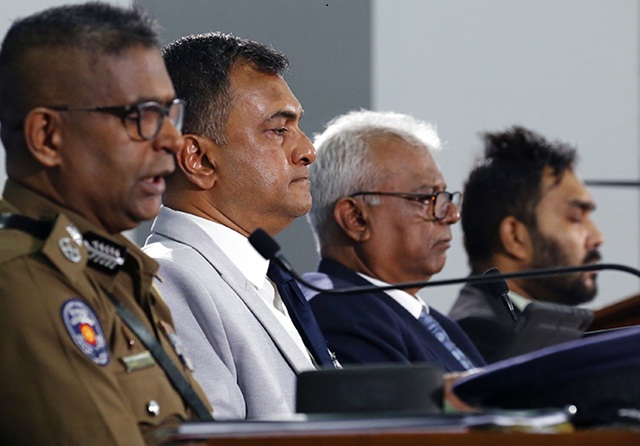
The Inspector General of Police’s remarks at the press conference held yesterday in Colombo exemplify the deep-seated problems within law enforcement and the judiciary. His comments, made with an air of self-assurance, suggest that these extrajudicial killings are simply the result of police officers acting in defence of their own lives—a tired excuse that has been used time and again to defend the indefensible. He contends that these incidents are merely a product of the volatile situations in which police officers often find themselves, a justification that reeks of avoidance, a failure to acknowledge the broader issues at play. While the lives of police officers are certainly important, their duty is to enforce the law, not to become its law unto themselves. The Inspector General’s defence of such actions, without a shred of concrete evidence or accountability, sends a terrifying message: the state, in its current incarnation, is willing to turn a blind eye to any misstep or abuse of power as long as it is carried out under the guise of law and order. This stance is not one of justice—it is one of arrogance, one that believes it can operate above reproach and above the very laws it is meant to uphold.
Furthermore, the Public Security Secretary’s comments have done little to dispel the concerns of the public. His attempt to frame these killings as part of a larger conspiracy, orchestrated by shadowy figures intent on destabilising the nation, is perhaps the most telling and cynical of all. His remarks are a transparent attempt to shift the blame away from the government’s gross failures, particularly in handling law enforcement, and to manufacture a crisis that does not exist. It is both irresponsible and dangerous for a government official to suggest that the rise in crime is not the result of systemic issues within the police force, but a grand conspiracy of nefarious actors. This narrative of a phantom enemy is one that plays on the public’s fears, directing their attention towards imagined threats rather than addressing the real, tangible failures within the security apparatus. By casting these extrajudicial killings as necessary measures in the fight against a supposed external destabilising force, the officials seek to avoid facing the reality of a system that has lost its way.
At the heart of this deeply flawed approach is the failure to address the root causes of violence and criminality within the nation. Rather than confront the systemic corruption, abuse of power, and lack of accountability that have plagued law enforcement for years, the government has chosen to focus on superficial narratives that distract from the core issue: the breakdown of law and order in a deeply fractured state. It is easier for the authorities to point to a fabricated conspiracy than to acknowledge the truth: the police force has become, in many cases, a law unto itself, operating with unchecked power and a sense of impunity that has become ingrained in its very structure. The public is left to watch as their government continues to engage in a high-stakes game of misdirection, spinning conspiracies and feeding the media an endless stream of rhetoric that seeks to divert attention from the undeniable truth of what is happening.
The extrajudicial killings, whether carried out on the streets or behind the closed doors of police stations, are indicative of a police force that has lost sight of its role in society. The brutal tactics employed by law enforcement agencies serve as a reminder of a dark past—a past in which violence was a means of control, a past where dissidents were silenced and opposition suppressed. Today, these tactics are being repurposed for the same ends, as those in power attempt to cling to their authority by any means necessary.
Moreover, the tragic reality is that these killings are only the tip of the iceberg. The true extent of the rot within the police force and the government’s inability or unwillingness to address it goes far deeper than these isolated incidents. The culture of corruption, violence, and impunity that has taken root in law enforcement is not something that can be solved through empty rhetoric or the scapegoating of external forces. It requires a concerted, systemic overhaul of the police force, a dismantling of the structures of power that enable such abuses, and a commitment to ensuring that the rule of law is upheld—not just for the public but for those in positions of authority as well.