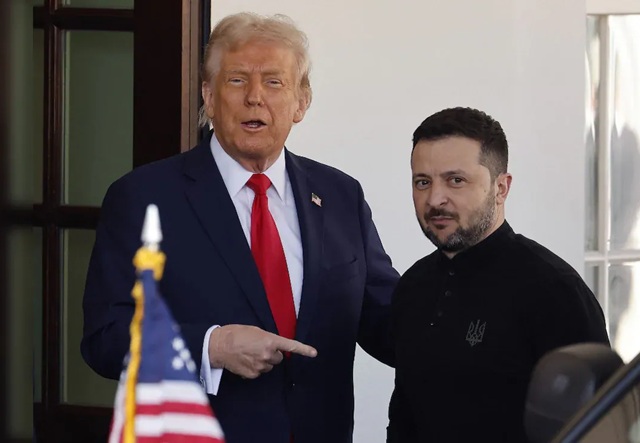
European leaders have thrown their support behind Ukrainian President Volodymyr Zelenskyy following his heated Oval Office confrontation with Donald Trump, but the widening divide between Kyiv and Washington has left Europe facing difficult decisions on how to sustain Ukraine’s defense.
As Financial Times reports, Friday’s tense exchange—where Trump accused Zelenskyy of “gambling” with a third world war—sent shockwaves through European capitals, reinforcing fears of a fractured transatlantic alliance. In response, EU leaders have signaled their unwavering backing for Ukraine while acknowledging that Europe must prepare to shoulder more responsibility for the war effort.
Kaja Kallas, the EU’s chief diplomat and one of Kyiv’s most vocal supporters, was particularly direct in her assessment of the situation. “Today, it became clear that the free world needs a new leader. It’s up to us, Europeans, to take this challenge,” she said. Norwegian Prime Minister Jonas Gahr Støre echoed this sentiment, calling Trump’s accusation “deeply unreasonable.”
Other European leaders expressed solidarity with Zelenskyy while refraining from direct criticism of Trump. European Commission President Ursula von der Leyen and European Council President António Costa issued a joint statement praising Ukraine’s resilience: “Your dignity honors the bravery of the Ukrainian people. Be strong, be brave, be fearless. You are never alone.” UK Prime Minister Keir Starmer pledged Britain’s “unwavering support,” while French President Emmanuel Macron emphasized that Russia is the aggressor in this war.
Germany’s Friedrich Merz, the likely next chancellor, made clear that Berlin “stands with Ukraine in good and in testing times,” warning against any confusion between aggressor and victim.
Europe Faces a Strategic Crossroads
The growing rift between Trump and Ukraine has underscored the urgent need for Europe to formulate a strategy to defend Kyiv without relying on U.S. leadership. Trump’s threats—to withdraw support for NATO allies who fail to increase defense spending, impose 25% tariffs on EU imports, and push for a rapid peace deal with Moscow—have left European policymakers scrambling for a new course of action.
This urgency has led to a hastily arranged summit in London, hosted by Starmer, where senior European leaders will discuss how to strengthen Ukraine’s defenses and boost military spending to reduce dependence on the U.S. A senior EU diplomat, reacting to the fallout, stated bluntly: “We are on our own. The parents on the other side of the Atlantic have just turfed us out of the family home, cut off our allowances, and disinherited us.”
Earlier this week, both Macron and Starmer had attempted to secure U.S. military backing for a potential European stabilization force in Ukraine. However, their efforts were derailed by the Oval Office showdown.
Calls for U.S.-EU Dialogue, but Not Everyone Sides with Ukraine
Italy’s Prime Minister Giorgia Meloni called for an “immediate summit” between the EU and the U.S. to clarify a shared approach to Ukraine. “We must speak frankly about how we intend to face today’s great challenges,” she urged.
However, not all European leaders aligned with Ukraine. Hungary’s Prime Minister Viktor Orbán sided with Trump, stating: “Strong men make peace, weak men make war. Today President Trump stood bravely for peace.”
With the transatlantic relationship in turmoil and no clear European plan in place, the path forward for Ukraine remains uncertain. What is clear, however, is that Europe can no longer assume U.S. backing is guaranteed—forcing the continent to redefine its role in global security.