by Durga Velayutham
Poststructuralism is often dismissed as an esoteric relic of late-20th-century French philosophy, an intellectual indulgence for those with time to unpick Derrida’s wordplay. Yet, in an age where Artificial Intelligence (AI) generates “truths” and manipulates language with mathematical precision, this philosophical framework is more vital than ever. If machine learning models shape reality by deciding what we see, read, and believe, shouldn’t we be interrogating the very structures that govern meaning? Poststructuralism does precisely that, by revealing how language is unstable, power-laden, and shaped by unseen forces.
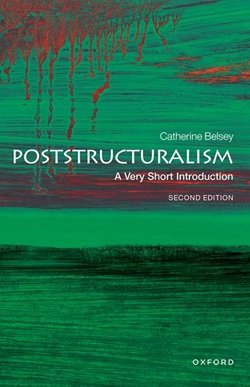
Catherine Belsey’s Poststructuralism: A Very Short Introduction lays bare the implications of this instability. “The issue here is not what exists, but what we can accurately say exists” (p. 2). This distinction has never been more pressing than in our era of deepfakes and algorithmic bias. If AI constructs knowledge based on patterns within text, then poststructuralism forces us to ask: whose patterns? Whose voices? If truth itself is “an effect of the meanings we learn and reproduce” (p. 10), then AI—trained on a history of racial, gendered, and political biases—does not reveal truth, but rather reiterates dominant narratives.
Belsey, who passed away in 2021 at the age of 80, captures this dilemma with an unsettling observation: “We learn our native tongue at such an early age that it seems transparent, a window onto a world of things, even if some of those things are in practice imaginary” (p. 15). AI is now the ultimate “native speaker,” absorbing vast quantities of text and synthesizing meaning without ever questioning the ideological baggage it carries. Its outputs—whether a chatbot response or a predictive policing algorithm—appear neutral, yet they encode human prejudices. This is why poststructuralism remains radical: it reminds us that meaning is constructed, and that every interpretation is an act of power.
A cornerstone of Western philosophy has been the self—autonomous, rational, in control. But poststructuralism dismantles this illusion. “Constructed to a high degree by the big Other, subjected by meanings outside its control, the subject of poststructuralism is neither unified nor an origin” (p. 46). AI-driven surveillance, social media algorithms, and predictive analytics have rendered this observation even more urgent. We are constantly shaped by the data we produce, yet we falsely believe we remain in control.
AI profiles us, determines our preferences, and predicts our future behaviour—without our conscious input. If our subjectivity is a product of external forces, as poststructuralism argues, then our “selves” are now being written not just by culture but by machines. AI does not simply mirror us; it conditions us. When Belsey states, “Western institutions, electoral systems, and the economy all assume that human beings are the independent source of meanings and choices” (p. 47), she might as well be describing the naive assumption that we freely navigate the digital world.
But can we resist? Belsey hints at the only escape route: recognising that “communication changes all the time, with or without intervention from us, and we can choose to intervene” (p. 32). In the AI era, intervention means critically examining how data structures us, how algorithmic decisions shape our world, and how the very act of interpretation can be reclaimed as an act of resistance.
One of poststructuralism’s most radical claims is that truth is not an objective entity, but a product of discourse. “Truth and knowledge exist at the level of the signifier” (p. 69), meaning that truth is not discovered but constructed. This is a direct challenge to the Enlightenment ideal of rationality, an ideal that AI was ironically built to uphold. We expect AI to be “objective,” to offer “the facts.” Yet if facts are, as poststructuralism insists, bound by language, then what AI does is not fact-finding but truth-making.
Belsey warns us against the belief that “there is in all instances a single, authoritative truth to be discovered and defended” (p. 72). This insight is crucial in the era of algorithmic governance, where AI’s “truths” determine everything from credit scores to prison sentences. Who writes the code? Who trains the model? The answers to these questions shape the very fabric of our reality.
Poststructuralism insists that “the distinction between the subject in here and the object out there is itself the consequence of the old view of the relationship between human beings and language” (p. 81). This division collapses when AI is involved—who is the subject, and who is the object? Is the AI shaping us, or are we shaping it? When an AI-generated news article or political campaign blurs the lines between information and manipulation, the poststructuralist warning could not be clearer: we must interrogate not only what is being said, but how meaning is produced and circulated.
If poststructuralism dismantles grand narratives, it also offers hope: the future is not preordained. “What is to become of us is to some degree in our hands” (p. 99). This is the key takeaway in our AI age. We can choose to accept AI as an inevitable force, or we can apply the poststructuralist lens to question its role in shaping meaning, power, and identity.
Belsey ends with a crucial demand: “Poststructuralism asks, like Lyotard’s fable, that we reflect on it” (p. 104). AI will not reflect for us. It will only ever reiterate the meanings it has been given. If we want a future where truth is not dictated by machine-generated discourse, we must actively challenge, deconstruct, and remake the systems that produce meaning.
In this way, poststructuralism is not an intellectual exercise—it is a necessary defence against the encroaching determinism of AI. It reminds us that meaning is always contested, that truth is always constructed, and that the act of interpretation is always political. In the AI age, we cannot afford to forget that.