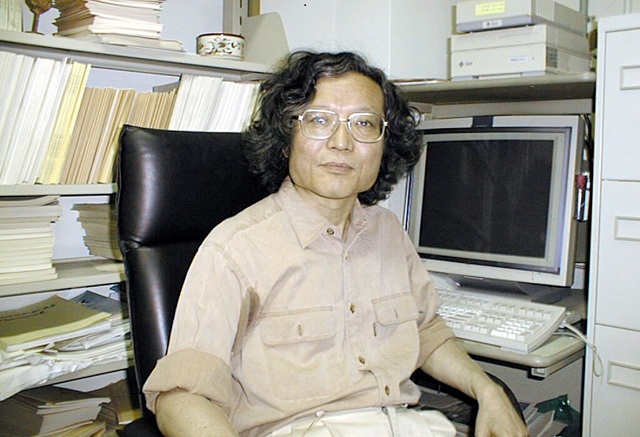
Mathematician Masaki Kashiwara has been awarded the 2025 Abel Prize, as announced by the Norwegian Academy of Science and Letters. Kashiwara is renowned for his ability to bridge various fields of mathematics, particularly in developing algebraic tools to solve complex problems like differential equations. His groundbreaking work has significantly advanced representation theory, a branch of mathematics that explores symmetries. Kashiwara’s expertise lies in combining techniques from geometry, algebra, and analysis to uncover new mathematical insights, a skill that has earned him high praise from fellow mathematicians. Helge Holden, chair of the Abel Committee, described him as a master of integrating these diverse mathematical disciplines.
At 78, Kashiwara becomes the first Japanese national and the first person based outside of North America, Europe, or Israel to win the prestigious Abel Prize. Surprised by the news, he recounted how he was invited to a Zoom meeting without knowing its purpose, only to learn about his award. Born in Yuki, Japan, Kashiwara pursued his studies at the University of Tokyo and Kyoto University before becoming a faculty member at Kyoto University’s Research Institute for Mathematical Sciences (RIMS) in 1978, where he has been based ever since.
Kashiwara’s work in representation theory, a field that explores how groups of symmetries act on mathematical spaces, has been transformative. His research has led to significant advancements in the understanding of infinite-dimensional groups and mathematical constructs beyond traditional groups. One of his most influential contributions is the concept of a “crystal base,” which allows for the interpretation of representations as permutations on finite sets. This concept has broadened the scope of representation theory, making it applicable to a much wider range of mathematical problems.
In addition to his work in representation theory, Kashiwara is also known for his development of algebraic analysis, which applies algebraic techniques to solve and generalize the structure of differential equations. His 1984 proof of a generalization of the Riemann-Hilbert correspondence, a major problem in the theory of differential equations, remains one of his proudest achievements. Over his prolific career, Kashiwara has authored more than 250 research papers, collaborating with over 70 co-authors. His work, though highly abstract, is often noted for its practical applications in various subfields of mathematics.
Even after retiring in 2010, Kashiwara has maintained a high level of research activity. Recently, he has shifted his focus to the study of monoidal categories, a highly abstract area related to quantum computing. The Abel Prize, established in 2002 as the equivalent of a Nobel Prize for mathematics, awards Kashiwara 7.5 million Norwegian kroner (approximately $715,000) in recognition of his outstanding contributions to the field of mathematics.