Tensions in the South China Sea flared anew after China seized control of Sandy Cay, a small but strategic reef just a few kilometers from the Philippines’ most important military outpost in the disputed waters.
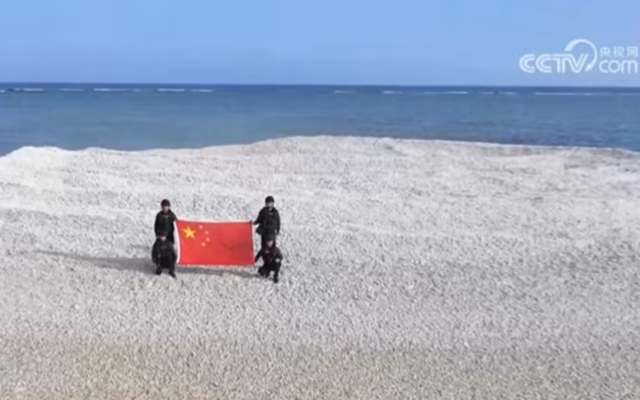
On Saturday, China’s state broadcaster CCTV reported that the China Coast Guard had “implemented maritime control and exercised sovereign jurisdiction” over Sandy Cay, part of the contested Spratly Islands. Coastguard officers reportedly unfurled the Chinese flag on the sandbank, marking Beijing’s first official move to claim a previously unoccupied feature in the South China Sea in years.
The move comes at a sensitive time, coinciding with the Philippines and the United States preparing for Balikatan, their largest annual joint military exercise. This year’s drills, which include coastal defense and island seizure operations, will be staged near Philippine-held territory in the Spratlys.
Though Sandy Cay measures just over 200 square meters, it holds strategic significance. Under international law, it can generate a 12-nautical-mile territorial sea — a zone that overlaps with the waters around Thitu Island (known as Pag-Asa in the Philippines), a key Philippine outpost used to monitor Chinese movements.
China’s latest action has sparked fears that Beijing may be preparing to further expand its presence by building up unoccupied reefs and sandbanks. However, maritime experts note that China’s extensive artificial islands, built and militarized over the past decade, already offer it a dominant position across the region. For now, there are no signs of permanent construction at Sandy Cay, and Philippine officials said the Chinese coastguard departed after the symbolic flag-planting.
Still, Philippine maritime security officials warned that China’s declaration could herald more aggressive maneuvers, particularly against operations at Thitu. Manila has recently upgraded infrastructure on Thitu, including a new runway, aiming to strengthen its foothold and counter growing Chinese assertiveness.
Under Chinese domestic law, the China Coast Guard has authority to board and inspect foreign vessels in waters it claims, raising concerns about possible clashes with Philippine forces operating in the area. Thitu’s defenses, however, are overshadowed by China’s nearby military base on Subi Reef, which boasts surface-to-air missiles, radar systems, a runway, and a deepwater port — assets that far outmatch the modest Philippine outpost.
While Subi Reef is classified under international law as a low-tide elevation and thus cannot generate its own territorial waters, Beijing’s assertion of control over Sandy Cay may be aimed at shifting the balance of power just enough to complicate Philippine operations in the Spratlys.
The latest developments underscore the fragile and combustible situation in the South China Sea, where overlapping territorial claims and escalating military activities have heightened the risk of confrontation between China, the Philippines, and their respective allies.