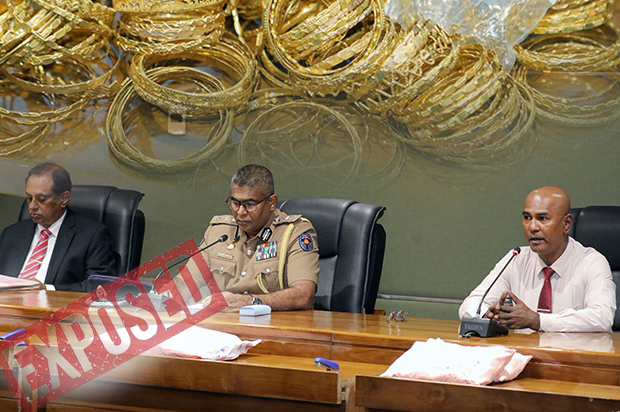
Amid the heat of the local government elections, a stock of gold ornaments discovered after the Eelam War has suddenly resurfaced, prompting a flurry of speculation on social media.
The Acting IGP, speaking at an event, stated that efforts would be made to return the gold ornaments—unearthed by Director of Military Intelligence (DMI) Major General Deeptha Ariyasinghe—to their rightful owners, once their identities are confirmed.
On the instructions of the Attorney General, 120 parcels containing gold ornaments were handed over to the police at Army Headquarters on the second day. These items were to be transferred to the Central Bank following examination by the Gem and Jewellery Authority, under police protection.
In the past, police had to excavate trenches in the Rajapaksa-owned lands to locate places where gold ornaments had been buried during the LTTE regime. The majority of people believe this sudden reappearance of gold jewellery is a political ploy aimed at securing votes for the current government in the North. This suspicion arises because the then-Mahinda Rajapaksa government had previously distributed recovered gold jewellery to its owners—on more than one occasion—whenever elections were approaching, as part of post-war recovery efforts.
It is for this reason that I decided to investigate the sudden reappearance of this gold jewellery after 16 years, in order to uncover the truth for the reader.
Even after the LTTE’s defeat on 18 May 2009, gold jewellery recovered during the military’s raids on the ‘Tamil Eelam Bank’ and ‘Eelam Mortgage Centres’ in the course of humanitarian operations prior to May 2009, was handed over to Army Headquarters. Kilograms of gold ornaments were recovered and transported there.
Most of these items were gold jewellery pawned by Tamil civilians in the North at LTTE-run banks. Additionally, there were stocks of gold stolen by the LTTE. The pawned jewellery had been packed and stored at Army Headquarters under orders from then-Army Commander General Sarath Fonseka. These orders were carried out accordingly by the intelligence chiefs.
The real owners of the mortgaged jewellery were traced and identified only after the end of the war, following great effort by the Military Intelligence Department. Due to the lack of proper documentation—some claimants possessing only damaged or incomplete receipts—significant effort was required to identify legal owners by locating them or tracing their newly settled locations.
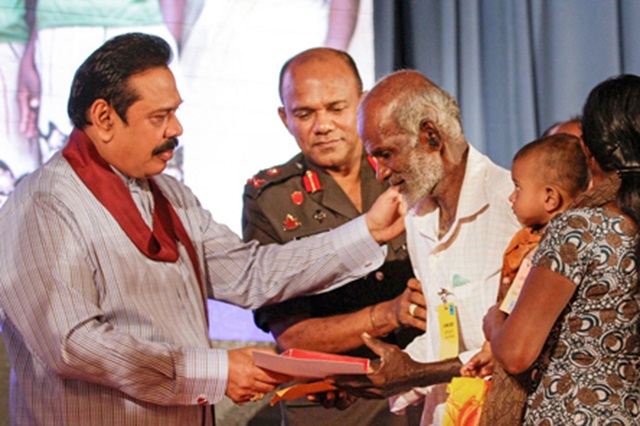
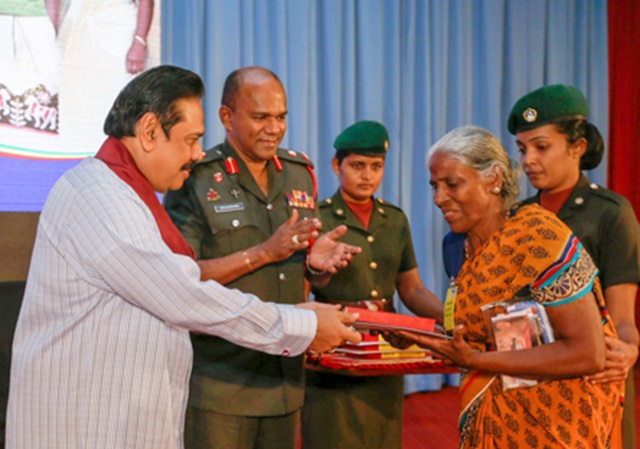
The Intelligence Department launched a special operation to search houses in the North for owners named in receipts issued by the Tamil Eelam Bank. As a result, steps were taken to return the jewellery to the rightful owners. On 12 October 2014, President Rajapaksa symbolically returned a portion of the jewellery to 2,377 owners during the first phase, with 25 owners from Kilinochchi receiving their items first.
At a ceremony held at Temple Trees, 1,960 owners from Mannar (223), Vavuniya (319), Jaffna (45), Kilinochchi (1,187), and Mullaitivu (186) received their ornaments directly from President Mahinda Rajapaksa.
Another stock of jewellery, belonging to 419 unclaimed owners, was to be returned to the Central Bank in accordance with state regulations, if efforts to trace them through Civil Coordination Offices and other government institutions failed.
At the time, Lieutenant General Daya Ratnayake served as Army Commander. Two special trains were arranged from Kilinochchi to Colombo to bring the beneficiaries to the ceremony.
On 4 December, at another ceremony presided over by President Rajapaksa, Lieutenant General Daya Ratnayake announced the release of an additional stock of gold jewellery to 1,960 identified owners. He explained the arduous and time-consuming efforts undertaken by the Army, following a special order from the President, to ensure the jewellery was returned promptly.
Although the owners had originally pawned their jewellery at LTTE-run banks, the Sri Lankan government opted to return them as personal property. Investigations revealed that some of the jewellery included imitations.
In the end, around 90 kilograms of gold remained unclaimed, with their owners still untraceable despite extensive efforts across the North and East by military intelligence.
Governments under Presidents Mahinda Rajapaksa and Maithripala Sirisena attempted to locate the owners and return the remaining jewellery—often viewed as an effort to win votes in the North—but these efforts proved futile.
Eventually, the Ministry of Defence decided to store the remaining jewellery in a secure vault and, with the Central Bank’s assistance, melt it down to contribute to the national gold reserves. An institution was selected for this process. However, the Gem and Jewellery Authority encountered two major issues: determining the value of the jewellery after removing embedded stones, and deciding which government agency would bear the cost of melting and valuing the items.
Discussions on these two matters continued for several days, reaching the final stage of preparation for melting the gold. In the absence of a final decision, the jewellery remained secured in the safe at Intelligence Headquarters. Amid changes in government, it was decided to keep the jewellery stored there.
A special committee, headed by R.M.S. Sarath Kumara, Additional Secretary to the Ministry of Defence, was appointed. A series of discussions followed, involving the Attorney General’s Department, Gem and Jewellery Authority, Central Bank, Ministry of Defence, the Army, and the Police Legal Division.
Another stock of jewellery belonging to 419 unclaimed owners, if untraceable through the Civil Coordination Office or other institutions, was once again earmarked for return to the Central Bank in accordance with government policy.
Although several proposals were made to melt down and transfer the jewellery to the Treasury, none were prioritised. The secure safe used to store this gold jewellery was also procured at significant expense.
It is also notable that the gold jewellery stored in the safe remained untouched and secure until 2014.
The two officers responsible for safeguarding the jewellery since the war have since passed away. One of them was Lieutenant Senarat, who had been in charge of the related documentation. It is significant that the files he maintained are still preserved in the same safe.
Amid such circumstances, it is impossible to ignore the theft committed by an officer, which cast a shadow over the reputation of the intelligence department.
This officer had stolen gold ornaments from the safe soon after they were brought to Army Headquarters from the North. It was alleged at the time that he sold the stolen jewellery and shared the proceeds with several individuals, including a female officer.
An internal investigation conducted by Army Headquarters revealed that the officer, while on duty and in charge of the safe, had removed portions of the gold jewellery at night and replaced them with counterfeit items. Since the gold ornaments recovered from the war zones were placed into the safes without having their weight or value recorded, it was impossible to determine the exact amount stolen.
Following the war, the recovered ornaments were placed into sacks and stored in safes on the orders of the Army Commander, without time to inventory them. The stolen jewellery was reportedly distributed among a number of officers, including the aforementioned female officer. The Army subsequently removed the officer responsible from the intelligence service and denied him any promotions until his retirement.
Three separate investigations into the theft, which occurred between 2009 and 2010, were conducted by some of the Army’s most senior generals.
The officer had replaced the original gold jewellery packets with imitation items. During General Jagath Jayasuriya’s tenure as Army Commander, the Army handed over 20 kilograms of unclaimed gold jewellery to the Central Bank. In response to a Right to Information (RTI) request, the Central Bank of Sri Lanka (CBSL) disclosed that it had received a total of 37.7 kilograms (37,708.472 grams) of gold from the Army. This gold, amounting to a street value of approximately one billion rupees, came from 28 parcels handed over between 7 September 2010 and 26 January 2012.
Eventually, because the Central Bank did not wish to accept the remaining gold ornaments, it was decided to melt them down and convert them into gold biscuits to be deposited in the Treasury. These ornaments were from the batch deemed ownerless. Despite efforts to locate other owners in the North and East—through newspaper publications including photographs and appeals—no claimants came forward.
This is the true story of Harambe, who, unaware of the origins of the ornaments selected for melting due to lack of ownership records, took them from the safe and suddenly alerted the media.
During Mahinda Rajapaksa’s presidency, the original owners of gold recovered from conflict zones were traced, brought to Colombo by special train, and had their belongings returned in a ceremonial distribution by the President himself—conveniently with a presidential election on the horizon. At that time, the government limited the distribution of gold to known owners, especially in the North, where electoral support was being courted.
Now, it appears the government may once again find itself in difficulty, having abruptly brought to light a stock of gold ornaments previously secured within the Intelligence Department’s warehouse, just as another election looms. If this stock—previously marked for transfer to the Treasury due to a lack of identifiable owners—is released and Northern citizens begin demanding their jewellery, the government will face significant challenges. There is currently no system in place to manage such demands or verify ownership.
Ordinarily, gold ornaments mortgaged to banks are confiscated if the owners do not come forward. Since no claimants have emerged, the government had no choice but to retain custody of the items.
However, this sudden decision—seemingly prompted by the election—could lead to renewed controversy in the North, where people may again face problems proving ownership of the jewellery.
Experts warn that this development could become another embarrassment for the government and may reawaken discontent among the Tamil populations of the North and East.
When the recovered gold was originally brought to Army Headquarters, the Intelligence Department rendered an exceptional service by returning most items to their rightful owners—aside from the theft committed by a rogue officer. The remaining items, with no traceable owners, were marked for transfer to the Treasury to prevent further issues, without making the matter public.
Now, many believe the government is inviting yet another crisis by retrieving the gold from the confidential safe in a bid to gain favour ahead of elections. Parading this issue—like displaying the Tooth Relic for electoral gain—only risks further tarnishing the government’s image.