by Our Diplomatic Affairs Editor
“The Chinese people have fought with unparalleled determination and bravery against the forces of fascism. We are deeply indebted to their sacrifices in this war.” — Franklin D. Roosevelt, during a speech in 1943 acknowledging China’s significant role in the fight against Japan.
Do you know that China endured one of the bloodiest and most prolonged campaigns against fascism in modern history? Do you know that the staggering death toll of over 20 million people in the Second Sino-Japanese War often remains relegated to the footnotes of global history? Do you realise that the horrors of the Nanjing Massacre—where up to 300,000 civilians and prisoners were brutally murdered—barely echo in the global collective memory of World War II? The omission of China’s contributions to defeating fascism is not merely a case of historical neglect; it is a conscious act of marginalisation. The disregard for China’s immense sacrifice and strategic importance in the fight against fascism speaks volumes about the mechanisms of power, historical narratives, and geopolitical interests that have shaped the 20th century’s dominant worldviews.
At the heart of this neglect lies an uncomfortable truth: China’s role in the defeat of fascism remains largely invisible in the canonical accounts of World War II. The overwhelming focus on the European and Pacific theatres of war has drowned out the centrality of China’s struggle. The Second Sino-Japanese War, which raged from 1937 to 1945, was not just a localised conflict; it was a defining part of the broader war against fascism. While Europe’s battle against Nazi Germany and Italy has garnered extensive academic and popular attention, China’s tenacious resistance against Japanese imperialism is frequently presented as a mere backdrop or, worse, a sideshow in the grand narrative of WWII.
The reasons for this erasure are manifold and complex, rooted in historical biases, geopolitical realities, and the selective nature of post-war memory. From a European-centric perspective, China’s war against Japan is often seen as secondary to the efforts of the Western powers. After all, the United States, the United Kingdom, and the Soviet Union emerged from the war as the undisputed global superpowers, whereas China, though an Allied power, found itself politically fragmented and economically devastated. The struggle against Japanese fascism was not just a battle of armies but of ideas, of the resistance of a people against a brutal occupation that sought to erase their very identity. Yet the dominant narratives of post-war geopolitics, shaped by the victorious powers, relegated China’s sacrifices to the margins.
The post-war global order was founded on a set of principles that prioritised the narratives of those powers that had both the military and economic strength to shape the world as they saw fit. The establishment of the United Nations, with its permanent Security Council members, did little to shift the balance of historical memory. China was indeed a founding member of the UN and one of the “Big Four” Allied powers. Yet, despite this formal recognition, the magnitude of China’s contribution to the Allied victory has largely been disregarded. While the United States and the Soviet Union received the lion’s share of attention in the post-war period, China’s role was overshadowed by internal political turmoil, particularly the civil war between the Kuomintang and the Chinese Communist Party. The subsequent rise of the People’s Republic of China in 1949 saw a new narrative emerge, one that focused on the triumph of the Communist forces in the context of their anti-imperialist struggle. Unfortunately, this internal conflict further complicated the public’s understanding of China’s historical position in the war, reducing its contribution to a mere ideological struggle rather than a central military effort that shaped the war’s outcome.
Moreover, there is a deeply entrenched Eurocentric worldview that has obscured China’s role in the global fight against fascism. The very structure of global historical scholarship is often based on a Western perspective that positions Europe as the crucible of civilisation and history. In this paradigm, the struggles of non-Western nations, especially in Asia, are often minimised or overlooked. China’s fight against Japanese fascism, while brutal and long-lasting, has been consistently sidelined because it does not fit neatly into the narrative that has been constructed around the Western powers’ victory over Nazi Germany. The fact that China’s war effort began in 1937—before the United States entered the war—has rarely been acknowledged for its crucial role in tying down Japanese resources and drawing them into a prolonged conflict, which prevented Japan from fully committing to its war in the Pacific until much later.
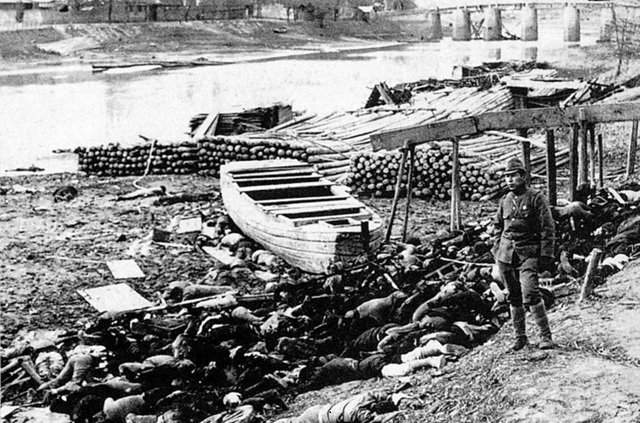
What is most striking about this omission is the sheer scale of China’s sacrifice. The human cost of the Second Sino-Japanese War is staggering, with an estimated 20 million people—both civilians and soldiers—losing their lives. To put this into perspective, the toll exceeds the combined civilian and military casualties of all European countries during the Second World War. And yet, these figures are rarely discussed in Western narratives of the war. The Nanjing Massacre, in which Japanese troops systematically raped, killed, and tortured hundreds of thousands of Chinese civilians, stands as one of the most horrifying atrocities of the war. The scale of this atrocity was not only a testament to the savagery of fascism but also to China’s unyielding resolve in the face of it. Yet, despite the magnitude of the atrocity, the Nanjing Massacre often fails to receive the same level of attention in the West as the Holocaust or other war crimes perpetrated by the Axis powers. It is a reminder that the magnitude of Chinese suffering is consistently underplayed or altogether ignored in the broader discourse surrounding World War II.
The disregard for China’s role is also a reflection of the dynamics of global power and the shifting priorities of international politics. After the war, the Cold War took centre stage, and the focus shifted to the ideological battle between the Soviet Union and the United States. In this new global context, China’s Communist revolution became an inconvenient narrative for the West, particularly as it symbolised the triumph of communism in Asia. The emphasis on containing communism led to a deliberate minimisation of China’s historical contributions to the defeat of fascism. The geopolitical reality of the Cold War, with its attendant ideological divisions, shaped the way historical events were remembered and told. In this context, China’s sacrifice in the war was downplayed in favour of narratives that served the strategic interests of the West.
The historiography of the war, shaped by Western powers, therefore presents a truncated version of history. The marginalisation of China’s role is not a result of oversight but a deliberate shaping of memory to align with post-war geopolitical realities. It is convenient to remember China as a victim rather than a key player in the war’s outcome. The image of a nation struggling under the weight of Japanese occupation fits neatly into a narrative that prioritises the victories of Western powers, and thus, China’s role is reduced to that of a secondary actor. This serves both to diminish the significance of Chinese sacrifice and to consolidate the position of the West as the ultimate victor in the war against fascism.
In recent years, China’s growing geopolitical influence has prompted a re-evaluation of its historical role. However, the West’s memory of World War II remains entrenched, and the historical narrative is slow to shift. China’s contributions, despite being formally recognised in international forums like the United Nations, are still not widely celebrated in the same way as those of other Allied powers. This ongoing struggle for recognition of China’s war effort is emblematic of a broader tension between historical fact and political convenience. To truly understand the defeat of fascism, one must confront the uncomfortable reality that much of the history we know is shaped by those who wield the power to tell it.