Editorial
“When the people fear the government, there is tyranny; when the government fears the people, there is liberty.” ~ Thomas Jefferson
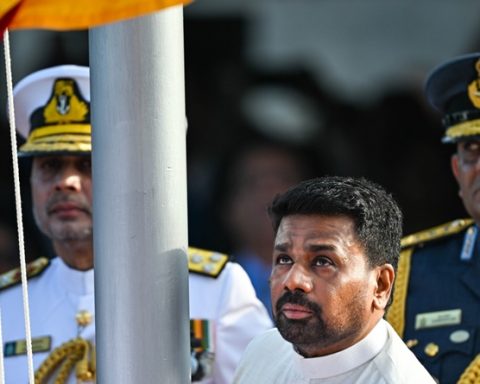
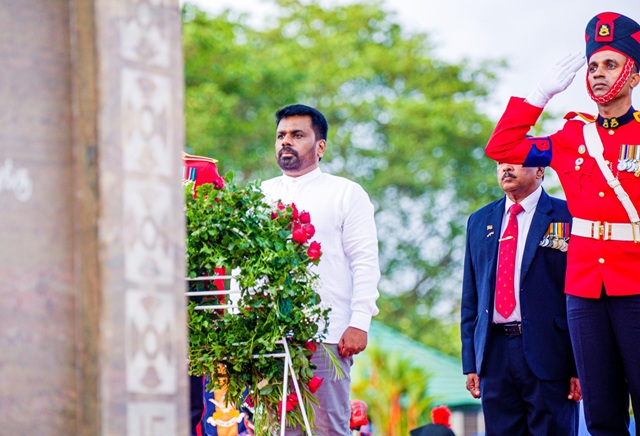
At the 16th anniversary commemoration of the end of the civil war held yesterday evening, President Anura Kumara Dissanayake offered a deeply moving and honest speech—perhaps one of the most significant public addresses in recent history—not merely because of its sentiment, but because of its sincerity and its call to reject the politics of fear, hatred, and power abuse.
In a nation where leaders have often weaponised history, identity, and even grief to consolidate their positions, this speech stood in stark contrast. President Dissanayake did not come to glorify war. He came to humanise peace.
“War is a great tragedy. War is a great destruction,” he reminded the nation. These were not the hollow ceremonial lines often mouthed by politicians. They were the reflections of a leader who sees beyond medals and monuments to the mangled limbs, broken families, and haunted memories that war leaves behind. “Children who have lost their fathers, parents who have lost their children, and wives who have lost their husbands are still living in this motherland, sighing.”
The President acknowledged what so many governments before him chose to ignore: the war may have ended, but the wounds it left are still raw. And in a poignant moment that transcended ethnic and political divides, he declared, “Not only in the South, but also in the North, people hold up photographs on the streets and lament the loss of their husbands and children. Every parent treasures their own child. To them, their child is a gem.”
In a country where remembrance has too often meant selective memory, President Dissanayake charted a bold new path: inclusive mourning. He made no attempt to pit the dead of one community against another. He refused to sanctify one side and demonise the other. Instead, he spoke of all Sri Lankans—Sinhala, Tamil, Muslim, Burgher, and Malay—as a single wounded family struggling to heal.
He called upon us to remember not just the lives lost, but the lives forever changed. “A large number of soldiers became permanently disabled… Another group donated their eyes, hands, feet, and all their body parts.” He visited some of them earlier yesterday, he told the audience. “For a very long time, some of them have been living their lives in a bed for almost 30 years since 1996.” These were not abstractions for him. They were people. Fellow citizens. Survivors whose suffering demands not exploitation for political mileage, but compassion and commitment.
The speech was not just a lamentation. It was a call to action—an appeal to the conscience of a nation teetering on the edge of new divisions. The President did not flinch from pointing out the dangerous politics that threaten the fragile peace. “From time to time, these conflicts, racism and extremism have been used to gain, maintain and consolidate their power.” This statement alone indicts an entire history of post-war governance. It lays bare the manipulative tactics of those who drape themselves in nationalism to cover their crimes.
In his most stirring critique, President Dissanayake said plainly, “There was power, not law or justice.” That line, simple yet searing, encapsulates decades of impunity that have plagued Sri Lanka. It is rare to hear such honesty from a sitting head of state, and even rarer to hear it spoken before a monument to military sacrifice. But it is this honesty that makes his words matter.
Some critics have mocked the President’s admission that he is still learning how to govern. But humility in power is not weakness—it is wisdom. Dissanayake understands that leading a country out of war is not just about wielding authority; it is about moral leadership. “Although I am not qualified at this time,” he admitted, “I would like to say that in the North and the South, this racism has started to stir up rebellions again for power. For power and nothing else.”
His speech made one thing clear: peace is not the absence of war, but the presence of justice, equality, and mutual respect. “The end of the war, the next step is to establish peace. Otherwise, we will be partial victors. Not complete victors.” That sentence deserves to be engraved beside the names of the fallen.
And to those who wish to reignite conflict in the name of ideology or identity, he offered a direct challenge: “We must deprive ourselves of the pleasure of war, turning war into a great river of blood to protect our power and swimming in it.” It is a powerful rebuke of the warmongers—those who see in every riot, every division, every cry for justice, an opportunity for demagoguery.
President Dissanayake’s address also touched upon the economic and political insecurities that continue to plague Sri Lanka. “Even today, there is a fear that even a small conflict anywhere in the world will affect the economy and life of our country. Are we free? Today, we are a nation that has lost our sovereignty economically.” This too is part of the war’s legacy—a country battered not just by bullets, but by debt, corruption, and cronyism. He understands that sovereignty is not merely territorial. It is economic, judicial, cultural, and human. “Sovereignty should not become a mere sentence on paper. It should be made a reality of this motherland.”
One of the most evocative moments of the speech came toward the end when the President invoked the monument before which he stood—not as a symbol of conquest, but as a sacred trust. “We must freeze their spirit, strength, courage, and sacrifice in our lives. For what should we do that? For the sake of creating a more optimistic state.” Optimism, in this context, is not naïve hope. It is a deliberate, courageous decision to choose reconciliation over revenge, unity over division, truth over propaganda.
President Dissanayake was also unflinching in his rejection of fear as a mode of governance. “We must all rise up together and raise our voices that peace is needed. We must align our hearts, our statements and our approach for peace.” In a political culture that thrives on suppression of dissent and glorification of strength, this is a radical vision.
Today, there are those who continue to deride the President, not on the merits of his ideas or actions, but out of a toxic habit of perpetual antagonism toward leadership. This destructive culture—one that confuses cynicism for wisdom and venom for insight—must come to an end. Leaders must be held accountable, yes. But they must also be supported when they act with integrity.
The President was not planned to attend the event. In fact, he had chosen to stay away. But mounting social pressure made his absence increasingly untenable. His eventual presence was not for political gain, but out of a sense of responsibility. He stood there not because he had to, but because the moment called for a unifying voice. His silence would have been ambiguous; his presence became a statement of resolve—one that echoed the liberty Jefferson spoke of.
Though the Lady Prime Minister’s absence at the event raises questions about the unity of the current government, today must not be overshadowed by speculation or intrigue. This day, and this speech, must be remembered as a pivot point—a reminder that Sri Lanka’s path forward lies not in rehashing old grievances, but in writing a new story.
“We have shed enough blood. We are a nation that has shed blood until the earth is wet. A nation that has shed blood until rivers flow with blood. A nation that has shed tears until rivers fill the tears of our parents and relatives.” It is hard to imagine a more haunting image. But within that darkness lies the potential for light. For redemption. For peace.
Let this not be just another speech to be applauded and then forgotten. Let it be a manifesto for the new Sri Lanka—a Sri Lanka not built on rubble and resentment, but on solidarity, justice, and the shared dream of a truly peaceful nation. As the President said, “We want to transform this motherland into one of the best motherlands in the world.” That dream will demand more than speeches. It will require the courage of conviction, from leaders and citizens alike. But today, let us begin with this: remembering the dead, honouring the living, and pledging, as one people, never to let this land bleed again.