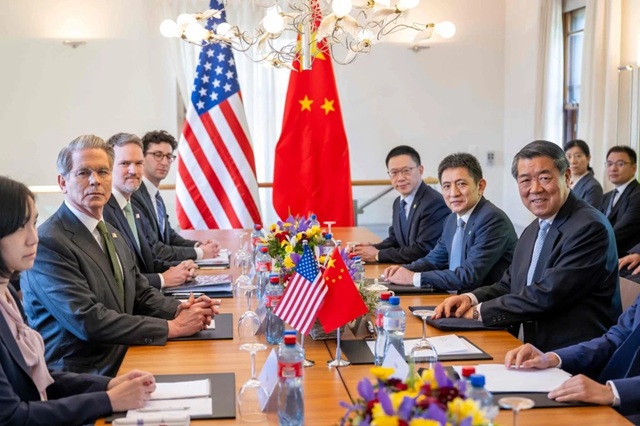
Tensions between the United States and China are once again intensifying, just days after a temporary truce in their ongoing trade war was announced in Geneva. Despite agreeing to pause tariffs for 90 days, the U.S. has moved to impose a sweeping ban on Chinese tech giant Huawei’s Ascend AI chips, citing national security and export control violations.
In response, Beijing condemned the move as “malicious suppression” of Chinese technology, accusing the U.S. of wielding “long-arm jurisdiction” to stifle China’s chip industry and AI development. Foreign ministry spokesman Lin Jian called on Washington to abandon its “protectionist and unilateral bullying practices.”
Analysts say the ban reflects a broader U.S. strategy under the President Donald Trump to extend the U.S.-China rivalry into the technological domain. By targeting Huawei—a central figure in China’s ambitions for AI and semiconductor dominance—the U.S. aims to isolate the company from global supply chains and slow China’s progress in advanced tech sectors.
“The goal is clear: to exclude Huawei from the global semiconductor ecosystem,” said Zhao Minghao, a professor at Fudan University, comparing it to the Trump-era “Clean Network” campaign that sought to block Huawei from 5G infrastructure worldwide.
Xiao Qian of Tsinghua University suggested the ban also reveals American anxiety about China’s accelerating AI capabilities, especially following high-profile breakthroughs such as the DeepSeek AI moment. “The U.S. now sees China as a real competitor and is acting to contain that growth,” she said.
Despite these setbacks, Chinese analysts argue that Beijing is now better positioned to retaliate. The country has increasingly relied on self-sufficiency, imposing its own export controls, tightening regulation of strategic minerals, and strengthening ties with neighboring countries.
John Gong, an economist at the University of International Business and Economics, noted that China’s strategy now centers on resilience. “China is responding with resistance and self-reliance,” he said. “The tech and tariff wars are deeply intertwined, and Beijing is fighting both fronts simultaneously.”
Among China’s countermeasures are export restrictions on rare earth minerals—materials essential to global electronics, EVs, and defense technology. Though Beijing paused curbs on 28 American companies last week, it remains unclear if the rare earth export controls will be lifted.
Beijing has also intensified domestic crackdowns on mineral smuggling and enhanced its legal framework with tools such as the anti-foreign sanctions law, designed to push back against U.S. extraterritorial actions.
Meanwhile, Washington appears to be expanding its influence in Southeast Asia. A U.S. congressional delegation recently visited Vietnam and Cambodia—key transshipment points for Chinese goods—as the Biden administration threatens punitive tariffs on countries facilitating Chinese exports.
China, wary of being diplomatically encircled, has ramped up regional outreach. President Xi Jinping recently visited Vietnam, Cambodia, and Malaysia, seeking to bolster Beijing’s influence among neighbors under pressure from Washington.
“The U.S. is trying to turn China’s neighbors into a new battleground,” Zhao said. “Third-party negotiations are becoming a critical part of the trade war.”
Despite the Geneva truce, the outlook for lasting de-escalation remains bleak. Both nations face domestic economic challenges, and geopolitical flashpoints—such as Taiwan, the South China Sea, and the Russia-Ukraine conflict—continue to loom large over bilateral talks.
“The truce is temporary,” Zhao warned. “The tech war and trade war are now running in parallel—and the battle is far from over.”