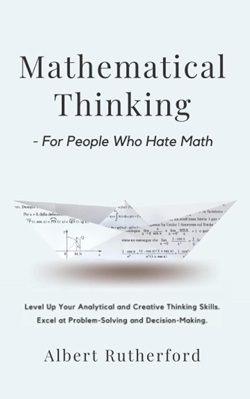
Albert Rutherford’s “Mathematical Thinking for People Who Hate Math” is nothing short of an insurgency against a culture that has, for generations, dismissed mathematical literacy as the province of a gifted few. But Rutherford’s rebellion is not built upon rote memorisation or academic gatekeeping; rather, it is a radical redefinition of mathematics as a way of thinking—accessible, adaptable, and above all, essential.
The book opens with a scathing yet all-too-relatable observation: “students are chewing their fingernails down the quick as they frown over their calculus homework… this is stupid! What’s the point, anyway?” (Introduction). From this common lament, Rutherford pivots quickly into his mission: to convince readers that the true crime is not maths itself, but how it has been taught—decontextualised, dehumanised, and disembodied.
What Rutherford proposes instead is mathematical thinking, which he describes as “the big-picture ideas and concepts behind calculus and trigonometry you were learning without even realising it.” (Introduction). His central thesis is clear: math isn’t about numbers, it’s about clarity, logic, and decision-making. And to those who claim never to use maths in real life, Rutherford retorts: you use it every day—you just don’t realise it.
Rutherford’s most daring move is to equate mathematical literacy with agency in a complex world. He warns that while technology has rendered calculation trivial, the need for analytical thought has only intensified: “Most get by with only the barest knowledge of addition and subtraction… But all this technology does is answer the procedural side of math.” (Introduction). The implication? The age of Google and AI demands a new literacy—one that doesn’t merely outsource thinking to machines.
In a particularly resonant analogy, Rutherford compares math to baking: “To say that equations are the heart and soul of math is like saying that a baker is someone with a lot of recipes… A recipe is just a formula. The real value comes from the lessons learned by getting your hands dirty.” (Chapter 1). It’s a powerful metaphor that dismantles the illusion of math as cold and impersonal. Math, in Rutherford’s telling, is as sensory, messy, and creative as cooking.
One of the book’s most important provocations lies in its challenge to the educational system. Rutherford contends that classrooms are failing not just to teach math well, but to teach its purpose at all. “The educational system would agree with you… there is no opportunity for abstract thinking,” he notes in Chapter 1. This is not just a critique of curriculum, but of a society that has reduced learning to test performance and memorisation.
This critique culminates in Chapter 4’s exploration of the companions to mathematical thinking: critical, creative, and systemic thinking. Rutherford’s contention is that math should not be siloed but integrated. “Mathematical thinking is much more useful than [becoming a] mathematician,” he writes, “It’s about learning how to implement processes to find answers, break tasks down into more manageable pieces.” (Chapter 4) It is here the book breaks free of STEM boundaries and becomes a broader intellectual manifesto.
Chapter 6, “Linearity and Nonlinearity,” is perhaps the book’s most controversial. Rutherford boldly declares: “We live in a nonlinear world.” From political upheaval to climate change, the systems we interact with defy straight-line prediction. Yet our minds—and our institutions—are trained in linear thinking. This, he warns, is a cognitive liability. The implications are political: if we misunderstand the nature of complexity, we misgovern.
But Rutherford’s strongest polemic is saved for probabilistic thinking. Chapter 7 warns of a population unable to understand risk, parodied by viral social media misinformation and financial illiteracy. He calls out the fallacies behind lottery spending, vaccine scepticism, and bad investments. His conclusion? Mathematical ignorance is no longer benign—it is dangerous.
This is not to say the book is flawless. Its tone occasionally veers into didacticism, and critics might argue that Rutherford underestimates the emotional trauma math education has inflicted. Not everyone can be so easily coaxed into reengagement with a subject that has caused them deep anxiety. Yet even these shortcomings serve to highlight the urgency of Rutherford’s call to arms.
Perhaps the book’s most radical statement is hidden in its optimism. “You were learning how to prove your answers and verify your accuracy… We were learning how to problem-solve.” (Chapter 1). At its heart, this is a book about empowerment. It argues that learning math is not about joining an elite—it is about reclaiming one’s intellectual dignity.
In an age where disinformation thrives and critical thinking is in retreat, “Mathematical Thinking for People Who Hate Math” is an urgent, necessary intervention. Rutherford’s brilliance lies not only in what he teaches, but in whom he dares to teach it to: the self-excluded, the math-traumatised, the disenchanted. To these, he offers not pity, but power. And that, in the final analysis, is the most mathematical idea of all.