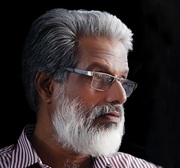

P.K. Surendran is a noted film critic from Kerala, India, and a prominent voice in South Asian film discourse. A recipient of the Kerala State Award for the best book on cinema, he has authored several acclaimed works and translated pivotal texts into Malayalam, including The Uncloven Space by Mani Kaul, Modernism by Other Means: The Films of Amit Dutta by Srikanth Srinivasan, Yesterday’s Films for Tomorrow by P.K. Nair, and Guru Dutt: Tragedy in Three Acts by Arun Khopkar. Surendran has also edited volumes on legendary filmmakers Kumar Shahani and Ashish Avikunthak. A frequent contributor to Akashvani and an esteemed guest lecturer at universities, he also chaired the international competition jury at the 2004 International Film Festival of Kerala (IFFK).
In this exclusive and thought-provoking conversation, Surendran speaks with Sri Lankan filmmaker Nadie Wasalamudaliarachchi, whose debut feature Pantrum is rapidly gaining international attention for its stark, symbolic exploration of war, trauma, and identity. The interview was published in India’s leading Malayalam weekly Madhyamam on Monday, 25 May 2025, and is presented here for the first time to a Sri Lankan audience. Together, the filmmaker and critic delve into the artistic, philosophical, and political currents that shape Pantrum, a film that resists convention and invites viewers to confront the emotional aftermath of conflict with honesty and critical distance.
P K Surendran: A war between India and Pakistan was looming, but fortunately, it didn’t happen. Meanwhile, war continues in Gaza and Ukraine. In this context, your film, which explores terrorism and war, feels especially relevant. Could you tell us about its genesis, themes, and political perspective?
Nadie Wasalamudaliarachchi: This film comes from a deep need that grew out of living through decades of war. It was shaped by the fear and sadness that builds when a society slowly loses peace, freedom, humanity, culture, and fairness. These losses don’t just affect one moment they affect entire generations. After living through thirty years of conflict, the pain doesn’t go away easily. This film is my way of expressing that emptiness.
Inspired by Michel Foucault’s idea of power and knowledge, I see war not just as something that happens on battlefields, but also as something that happens inside our minds. Foucault believed that power doesn’t just control people, it shapes how we think and what we believe, including how we understand war. In that sense, war becomes part of us. It’s internal. It stays in our thoughts and emotions.
Once war becomes part of your mental world, you can’t just delete it like a computer file. There’s no easy way to erase trauma. Even after the fighting stops, war continues through memories, language, and silence. It affects how we feel, how we act, and how we see the world. It doesn’t just disappear.
That’s why I use the phrase unlearning the war. Because stopping a war on the ground is easier than stopping it in the mind. That’s something I’ve learned from life in Sri Lanka. War leaves behind wounds that don’t fully heal, and scars that stay even if you weren’t directly involved. Just having the word war in your world can shape how you experience life.
This film is my way of letting go of that pain. It’s not about solving everything. It’s about giving space to the pain that still exists even after peace is declared. It’s about recognizing what war leaves behind and sharing it.
P K Surendran: You don’t show direct violence, yet there are images of a chicken being killed and a cat eating meat soaked in blood. A man kills a cat, and we hear its screams. This reminded me of the words of François Truffaut, who once said, “There is no such thing as an anti-war film.” This doesn’t mean that war-themed films can’t be impactful or raise important questions, but rather that the very nature of cinema, with its focus on visual storytelling and spectacle, can sometimes inadvertently glorify aspects of war, even when the filmmaker’s intent is anti-war.
Nadie Wasalamudaliarachchi: I’ve spent a lot of time thinking about this. As I mentioned earlier, once the word war enters a language, it slowly becomes part of our minds. It stays quiet inside us and is hard to remove; it often lasts a lifetime. That’s why I say “unlearning the war” is not easy. For me, war is not just something that happens outside; it’s something that lives inside us.
As a writer, I’m very aware of how language shapes how we think and feel. Language is not just a tool we use; it’s what shapes who we are. Even our dreams are made up through language. So, the word war and the way society talks about it affect us no matter where we live. You don’t need to live in a war zone to be influenced by war. If the word exists in your world, its impact remains.
The word “war” inevitably brings with it its opposing concept, “peace,” or more broadly, humanity and values. These components, when made as strong and influential as possible, can serve as a powerful counterforce to war.
We call it binary oppositions.
One way I see to reduce the domino effect of war is through the lens. For a filmmaker, one of the most painful setbacks is the inability to break free from the glorification of war embedded within the dominant social discourse of their linguistic world. (The way you see war is often shaped by the popular discourse created by society.) I believe this is one of the main reasons why even anti-war films sometimes end up glorifying war again.
The word “war” inevitably brings with it its opposing concept, “peace,” or more broadly, humanity and values.
In every country where war exists, the dominant public discourse is usually crafted to glorify war, to make heroes out of soldiers. This discourse is propagated by powerful entities with enough influence to embed it deeply into our minds or our cognitive maps. They carry out this propaganda so subtly that it spreads from the ideological superstructure of society all the way down to its base.
Eventually, even the small, everyday life/discourse in the base gets shaped to serve and sustain this larger narrative/ideology. Elements like religion and culture begin to align with and reinforce this overarching glorification. Through language, this discourse enters our system as a learned norm.
That’s precisely why I coined the term “unlearning the war.” You can only speak about peace, without glorifying war, if you have truly unlearned war first.
P K Surendran: There are many images of prayers, offerings to gods, and rituals in the film. One scene even mentions the burial of a god. This serves as a powerful metaphor, especially in the context of Sri Lanka’s troubled history. It reminds me of the statement “God is dead” by the German philosopher Friedrich Nietzsche.
Nadie Wasalamudaliarachchi: Nietzsche’s well-known phrase “God is dead” wasn’t meant to say that a divine being no longer exists. Instead, he was pointing out that traditional religious beliefs were fading in a modern, more secular world. What worried him most was what comes after the emptiness left behind, and the urgent need for people to find new values to live by.
Similarly, when a society is torn apart by war, it cannot truly heal unless it redefines its values. War often erupts when existing belief systems collapse or lose meaning. In one striking scene, a man unearths a buried gun just as another man buries a statue of a god. This parallel act is not accidental, it is deeply symbolic. It suggests a turning point: the moment when divine ideals are set aside, and violence resurfaces. The scene challenges us to reflect on what we choose to revive and what we choose to bury and whether we are ready to let go of outdated, broken beliefs in order to reclaim our shared humanity.
But this is not easy. Human life is struggling with ontological questions. Who am I? What am I doing? Why am I existing? We are always searching for answers about our identity, our place in the world, and our existence itself. When the beliefs that once gave us meaning fall apart, it can leave us feeling lost and in crisis.
Most people carry both a general crisis about their place in the world and a personal crisis about how to live. Facing both at once can be overwhelming. That’s why the film handles this topic carefully. There’s a touching moment when an old man says, “Keep it where it was” His words show how fragile a post-war society is, like a building damaged in an earthquake, still standing but close to falling. It’s about building a new set of values.
We must remember: if we are to build new values, they must rise from the truth of what we’ve been through. Healing isn’t about forgetting the pain. It’s about building something
P K Surendran: The majority of our films, whether mainstream or art, use various devices to draw the audience into the film. We forget everything and travel in an imaginary chariot with the flow of the film. While watching such films, our time stops, and we enter the time of the film through its characters and incidents. In the process, our time becomes the film’s time. We identify with the film. Therefore, we lose our critical sense and consume everything without questioning. But you don’t allow the audience to completely submerge into the film. There are no dialogues, action, or pacing that will draw us into the film. Even the sad song at the end, it is not a song in the conventional sense, but rather a scream of a woman, will not do so, because you don’t show the character and her pathetic condition. You are not allowing us to identify completely with the characters and the cinema. You keep us at a distance. It is called Sākṣī Bhāva in Indian philosophy. To attain such bhāva while watching a film, one should remain in one’s own time and observe.
Nadie Wasalamudaliarachchi: Yes, the choice to keep the viewer at a distance was intentional. I wanted to encourage a more thoughtful, questioning way of watching the film. In most films, viewers get emotionally pulled in they start to feel like they are part of the story or even become the characters. When that happens, it’s easy to stop thinking critically.
But in this film, I used time and space differently to prevent that. The story doesn’t follow a linear temporal order. It shifts fluidly between moments, making time feel somewhat distorted. This helps keep the viewer from becoming too emotionally attached. To watch the film with a questioning mind, you need to stay a bit detached.
When I say “skeptical approach,” I don’t mean anything anti-religious. What I mean is questioning the values and beliefs we’re often taught to accept without thinking. In a society that has failed or broken down, people start to question the systems and beliefs they once trusted. This film creates space for that kind of reflection, rather than pulling the viewer deep into the story.
The aim isn’t to push people away, it’s to make them think. Skepticism, after all, is a thoughtful way of looking at things. It means asking questions and not just accepting things at face value, especially when they don’t have strong reasons behind them.
P K Surendran: You use lots of static, long-duration shots. ‘La durée’ (French for “duration”) is a term used by French philosopher Henri Bergson. It refers to the subjective, lived experience of time as a continuous, flowing, and qualitative experience, distinct from the objective, measurable time of science. By avoiding cuts, long takes allow the audience to fully engage with the scene and follow the action as it unfolds in a continuous, real-time manner.
According to Andrei Tarkovsky, it is the time that pulsates through the blood vessels of the film. Longer takes require a greater time investment from the viewer, which may lead to a decrease in engagement and potentially a more detached viewing experience. After some time, a long-duration static shot may create a sense of “boredom,” which is often tied to the lack of sensory stimulation, and the audience may feel detached and disconnected. Here, the audience returns to their own sense of time and views the film accordingly.
I don’t give the viewer a comfortable escape. Instead, they are invited to face the emotion, just like those who lived through it have to.
Nadie Wasalamudaliarachchi: A human being is never just someone living in the present, we all carry a long past inside us. Even the things we build, like houses or monuments, hold history within them. I wanted to show this silent weight of the past in the film.
The pain is made out of emotions, memories, feelings, and our experience of time. In a way, the past, present, and future all exist together, constantly affecting one another. I wanted to capture that feeling. It may make the film harder to watch, but in a post-war world, I believe it’s the most honest way to show this deep truth.
For a film to truly deal with shared pain, the audience has to feel it, not just watch it from a distance. I don’t give the viewer a comfortable escape. Instead, they are invited to face the emotion, just like those who lived through it have to.
To create that space, I slowed the pace of the film. I used long, quiet shots, distance, and stillness. This lets viewers slow down and sit with the pain. That’s the only way real change or healing can happen not on the outside, but inside.
P K Surendran: Your dividing of the frame is very interesting. The horizon clearly divides earth and sky. You divide space and place your characters. Is it necessary to divide space as sacred and profane? Here, I would like to quote Mani Kaul. Filmmakers divide cinematic space into ‘sacred’ (perfectly composed, carefully framed, and devoid of unwanted elements) and ‘profane’ (accidental intrusions, random events, and interruptions). A filmmaker’s act of looking through the viewfinder is seen as turning a neutral space into a sacred one by composing it according to specific principles. Kaul resisted this traditional view, instead treating space as something neutral and unclassifiable. He focused on the tone, feeling, and emotion a shot evoked. In his later films, Kaul asked his cameramen not to look through the viewfinder while filming. He believed that the act of looking would automatically “appropriate” the space, making it “sacred” in the traditional sense.
Nadie Wasalamudaliarachchi: That’s a very interesting interpretation. As you would know from studying art history, there was a period when human dominance over the natural environment became a defining theme. Human-made structures began to take precedence, reflecting both power and cultural expression.
As human intervention increased, nature was gradually subdued. These human interventions evolved into what we call culture. But war violently disrupts and destroys that very culture. It not only shatters cultural structures but also turns human-built environments into dust, erasing them from the earth along with the memories they held. What’s being destroyed here is not just the physical, but the human cultural world itself, its memory, its essence.
Material culture refers to the physical world shaped by human intervention, it’s the tangible outcome of human creativity and intent. When that world is destroyed, it’s not just buildings or objects that are lost, but an entire cultural framework.
In such a post-destruction reality, we’re left with the concept of “the man without a culture” a person disconnected from the cultural structures that once gave meaning to their existence. This leads to an identity crisis. Identity matters because it gives individuals a sense of belonging, purpose, and continuity. Without it, there is disorientation.
Material culture refers to the physical world shaped by human intervention, it’s the tangible outcome of human creativity and intent.
When such a person is placed within a cinematic frame, there’s no trace of material culture, only untouched nature. Nature can be beautiful, yes, but it holds no memory. And without memory, there are no roots. In truth, there’s nothing there just emptiness. Yet, visually, the frame may appear aesthetically pleasing, composed with perfect proportions like the golden ratio or the divine triangle. These are tools of cinematic grammar.
But cinema’s philosophy often goes beyond aesthetics. It attempts to convey something deeper that questions the very absence beneath the beauty.
What we’re really telling here is the story of a person who has lost not just himself, but also his land. With the loss of land comes the loss of culture, and with that, the loss of identity. He is a human being stripped of everything that once grounded him. Now, he is without purpose, without meaning merely existing in a forest. And in the forest, no one has an identity. Or even if they do, it holds no value, no recognition.
In a moment like this, if anything holds meaning, it belongs either to gods or to demons. Gods can rebuild. Demons can destroy everything. And both forces exist within this man. These layers of loss the collapse of his cultural world are what I’ve tried to express through organized cinematic frames.
But in truth, those frames weren’t really “organized” by us. They emerged almost naturally, with minimal human intervention. That, too, is part of the idea culture has been silenced or suppressed. Someone might call what remains “sacred nature.” But then the question arises: can anything truly be sacred if it stands above our shared humanity? Is there anything more sacred than the human condition itself?
P K Surendran: Your film is very painterly, very beautiful. This enhances the film’s visual richness and aesthetic appeal. This aspect takes us to the ‘painterly’ quality of cinema. Robert Bresson strove to establish cinema as a unique language, separate from theatre and other art forms like painting and literature. He believed that “the truth of cinematography cannot be the truth of theatre, nor the truth of the novel, nor the truth of painting.” Like Bresson, Kazimir Malevich, author of “Painterly Laws in the Problems of Cinema,” also argued that cinema should develop its own formal language, moving beyond representational and theatrical conventions. A key criticism is that prioritizing painterly elements can overshadow the development of cinema’s own formal language, which should be inherent in its nature.
Nadie Wasalamudaliarachchi: I created this as a contemporary art piece using a multidisciplinary approach. Let me give an example from archaeology. In the past, archaeology focused mainly on digging and finding human artifacts. But now, modern archaeology uses science, history, and other fields together to better understand how people lived. This new approach helped the field grow a lot.
In the same way, I believe contemporary art should also move beyond old styles and explore new ideas. Many artists today use different methods like painting, video, sound, or even science, all in one work. It shows how the world today is connected in many ways.
A multidisciplinary approach means using knowledge from different fields to work on one idea. People from different backgrounds can bring their own skills to help understand or solve something better.
I reintroduce ancient artworks into the film as cultural symbols, meant to be interpreted within the context of the narrative.
You see this in many areas. For example, in medicine, treating cancer involves a team of doctors with different specialties. In schools, students can learn different subjects together to get a broader view. And in construction, architects, engineers, and planners work together.
So, for me, using a multidisciplinary approach in art helps me reflect the complex and connected world we live in.
I reintroduce ancient artworks into the film as cultural symbols, meant to be interpreted within the context of the narrative. This approach is also a common practice among postmodern artists, who often engage with historical references to create new layers of meaning.
P K Surendran: PTSD is a very important subject of your film. According to Michel Foucault, the trauma of war, both immediate and long-term, is not just a psychological or medical issue, but also a political one, shaped by the way power operates over populations. For him, war, from a biopolitical perspective, is not merely a military act, but also a political strategy for managing and controlling the population, even through death and destruction. Here, I would like to mention Julia Kristeva’s theories on trauma. According to her, war exposes individuals to extreme forms of the abject: death, mutilation, decay, and the breakdown of social norms. These encounters can trigger a primal sense of horror and destabilize the individual’s sense of self and belonging. Her psychoanalytic and philosophical concepts, particularly the interplay between the semiotic and the symbolic, the notion of abjection, and the significance of the maternal, offer a powerful framework for understanding the profound psychological and social disruptions caused by war and its enduring impact on individuals and societies.
Nadie Wasalamudaliarachchi: I completely agree with you, this is a deeply important topic, especially in a country navigating a post-war reality. The points you’ve raised are truly significant. When I brought the theme of PTSD into the film, my focus was on finding the most effective way to portray the character’s internal world on screen. To meet that challenge, I relied on metaphors as a creative bridge.
There was a scene we filmed, but didn’t include in the final cut, where the character is administering eye drops. Later, we decided to remove that part. However, if you observe closely, you can still notice subtle changes in the character’s eye movements. We were mindful of even such small details during the process
There’s a wide range of research and new treatment methods for PTSD emerging around the world today. One example is Cognitive Processing Therapy (CPT), which has gained recognition for its effectiveness. It’s genuinely encouraging to see such progress being made in this area.
We know that society operates within a cultural spectrum shaped by guilt, shame, and fear, these elements regulate collective behavior. After the ‘moment’ of war has passed and individuals re-enter civilian life, they must confront these very social regulations. For instance, once military service ends, many lose the institutional or group-based protection they once had. From that point onward, they’re thrust into the norms of the everyday moral system.
This is where past traumatic memories often clash with the prevailing moral framework. And it’s not just about psychological conflict I’d like to bring in Lacan here. Lacanian theory offers a profound reading of PTSD. It doesn’t view trauma merely as a reaction to a specific external event, but rather as a confrontation with what Lacan calls “Real”, a dimension of experience that cannot be fully processed through language or integrated into the symbolic order. This encounter disrupts the subject’s symbolic structure, leaving behind a residue of the Real. That residue emerges as symptoms such as recurring flashbacks, emotional detachment, and avoidance.
So, PTSD is not just about what happened it’s about what couldn’t be said, processed, or made sense of.
In Lacanian theory, the “Real” refers to a realm of experience that cannot be fully represented, understood, or integrated into language. It exists outside the symbolic order the structures through which we make sense of the world. Traumatic events, especially those involving death or extreme violence, can bring a person face-to-face with the Real. This encounter breaks through their symbolic defenses, leaving a lasting psychological imprint that resists resolution or articulation.
In Lacanian psychoanalysis, therapy aims to help the subject engage with the “Real” and symbolically integrate the trauma into their world.
The “Real” in Lacanian theory cannot be integrated into the psyche in the same way as other experiences. It disrupts the symbolic order the structures of language, meaning, and identity causing a sense of fragmentation or disconnection from oneself.
PTSD symptoms such as nightmares, flashbacks, and avoidance are not merely reactions to the traumatic event; rather, they are the psyche’s attempts to manage or make sense of the encounter with the “Real.” These are not just signs of distress, but expressions of an effort to grapple with something that defies comprehension.
In Lacanian psychoanalysis, the aim of therapy is not simply to process the trauma as an event, but to help the subject engage with the “Real” they have confronted and begin to symbolically integrate it into their world. Importantly, Lacanian thought does not treat the “Real” as something that can be fully resolved or eliminated is something the subject must learn to live with, to coexist alongside, within their own symbolic framework.