The Baltic port city of Gdańsk has long been etched into Europe’s turbulent history. From the gunfire that ignited the Second World War to the worker-led Solidarity movement that helped dismantle the Iron Curtain, this northern shipyard city has forged political revolutions. Now, it may once again be the cradle of profound transformation — or disquiet — as one of its own, Karol Nawrocki, stands on the precipice of the Polish presidency.
Nawrocki, 42, a former kickboxer, far-right historian, and political novice with a contentious past, is contesting Sunday’s presidential runoff in one of the tightest and most fraught elections in post-communist Poland. Once a marginal figure, Nawrocki has surged to near parity with centrist incumbent Rafal Trzaskowski, riding a wave of populist resurgence and nationalist sentiment. But his rise is shaking nerves from Warsaw to Brussels.
Until recently, Nawrocki was best known for leading the Institute of National Remembrance, a government body devoted to investigating crimes from Poland’s communist and Nazi past. But his journey from obscure historian to potential head of state has been meteoric — and combustible. A staunch supporter of Poland’s powerful Law and Justice (PiS) party, though never a formal member, Nawrocki has embraced a nationalist message that sharply contrasts with the liberal, pro-European agenda of Prime Minister Donald Tusk and his Civic Coalition.
Critics accuse Nawrocki of being PiS’s Trojan horse, hand-picked by party mastermind Jarosław Kaczyński to obstruct Tusk’s centrist reforms and reignite the culture wars that defined the previous PiS government. “A Nawrocki presidency would be a nightmare,” one European diplomat warned this week, citing fears of a rightward lurch in the EU’s fifth-most populous nation.
Lech Wałęsa, the Solidarity leader and Poland’s first post-communist president, was more direct. “My last request … and warning — anyone but Nawrocki!” the 81-year-old Nobel Peace Prize winner posted on X, alongside a stark red image reading “BYLENIE NAWROCKI” — “Not Nawrocki.”
Yet despite the chorus of alarm, Nawrocki has defied political gravity. His supporters say he represents a fresh start — a patriot uncorrupted by party backroom deals. “Karol Nawrocki’s greatest strengths lie in his staunchly patriotic and sovereigntist stance,” said Radoslaw Fogiel, a senior PiS figure.
But it is Nawrocki’s personal history — and the scandals engulfing his campaign — that have turned him into one of the most polarising figures in modern Polish politics.
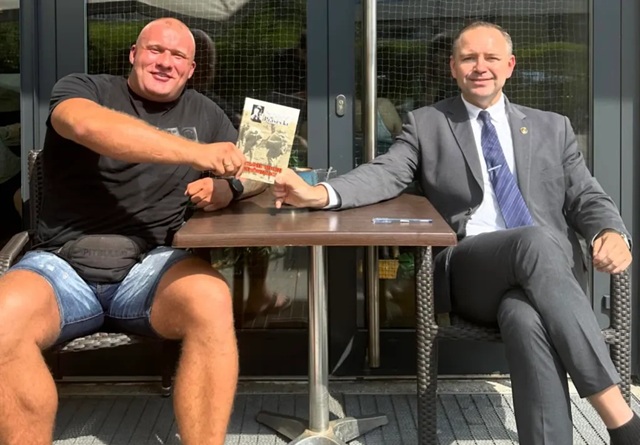
In recent weeks, media outlets have published a torrent of reports alleging links to criminal networks, football hooliganism, and even the sex trade. He has admitted participating in 70-man mass brawls with convicted criminals as part of Gdańsk’s notorious Lechia football firm — the “hooligans of the Free City.” Photographs have surfaced of Nawrocki training with Patryk Masiak, an MMA fighter and convicted kidnapper currently facing organised crime and pimping charges.
Perhaps most explosively, the news site Onet alleged Nawrocki once moonlighted as a pimp while working as a hotel security guard — an accusation he strenuously denies and has promised to challenge in court. In a separate case, he is accused of reneging on a promise to care for an elderly disabled man in exchange for a flat — an arrangement he now calls a misunderstanding and has offered to resolve by donating the property to charity.
In most liberal democracies, such allegations might end a political career. But in today’s polarised Poland, they have in some corners only strengthened his appeal. “The media are playing the dirtiest game since 1989,” said Pawel Rybicki, an adviser to Nawrocki. “This has become a referendum not just on Karol, but on whether Poles accept media and government pressure.”
Analysts suggest a mixture of media backlash, strategic ambiguity, and tactical support from fringe voters on the far right have propelled Nawrocki into serious contention. His campaign has siphoned support from radical libertarian Sławomir Mentzen and ultranationalist Grzegorz Braun — both eliminated in the first round — consolidating a deeply polarised conservative bloc.
Polls indicate Trzaskowski and Nawrocki are now separated by less than a single percentage point. The final result may hinge on voter turnout and undecideds.
Internationally, Nawrocki has found favour among populist allies. Former US President Donald Trump offered him support during a visit to the US earlier this year, and current Homeland Security Secretary Kristi Noem suggested that only Nawrocki could ensure the continued presence of American troops in Poland.
“Donald Trump is a strong leader for us,” she said during a visit to Rzeszów last week, “but you have an opportunity to have just as strong of a leader in Karol if you make him the leader of this country.”
For many in the pro-European establishment, however, Nawrocki’s presidency could usher in gridlock, international isolation, and a return to the authoritarianism that characterised PiS rule from 2015 to 2023. Trzaskowski has warned that his rival would weaponise the presidency to veto legislation, obstruct judicial reforms, and undermine EU cooperation.
“There is a real danger that the presidency could become a platform for sabotage rather than leadership,” said one adviser close to the Civic Coalition.
Yet even Nawrocki’s fiercest critics concede his political resilience. A doctor in history by training, he rose to prominence after being appointed in 2017 to head Gdańsk’s Museum of the Second World War. Under his leadership, the museum shifted from nuanced historiography to a PiS-style narrative of national victimhood and heroism — a transition that raised eyebrows in academic circles. “He was unknown academically,” said Pawel Machcewicz, the museum’s ousted founding director, “but his approach 100 per cent reflects the party’s politics of history.”
By 2021, he was elevated again — this time to lead the IPN, a powerful institution responsible for investigating communist-era crimes and vetting public officials. It gave Nawrocki a national platform and influence over Poland’s historical memory — a role that, his critics say, he used to sanitise the far right and demonise opponents.
But it was his perceived independence from PiS, despite his ideological proximity, that made him a prime candidate for a post-party presidency. Party loyalists see him as an incorruptible outsider; opponents view him as a disciplined partisan operative in disguise.
“Some of the stories circulating now — extorting flats, connections with pimps, criminal entourages — give the impression of someone who lacks the character or qualifications to lead a major European democracy,” said Oxford University professor Timothy Garton Ash.
Yet the tide of public opinion may be moving faster than conventional standards of political decorum. In Gdańsk, the same shipyards that birthed Solidarity may now be powering a new kind of populist disruption.
As polls open across Poland, the country faces a stark choice: continuity under Trzaskowski’s centrist, pro-EU vision or rupture under Nawrocki’s insurgent nationalism. The result will reverberate far beyond Warsaw, testing the strength of Europe’s liberal core against the rising tide of a new right.