Migrant boats washing ashore on the Italian island of Lampedusa are no longer the fragile rubber dinghies that once symbolized the perilous Mediterranean crossing. In their place are sleek, fiberglass vessels powered by massive outboard motors — dubbed “VIP boats” — reflecting a shift in the operations of Libyan smuggling networks and intensifying a humanitarian and political crisis across southern Europe.
This week, Italian authorities lined up around 25 of these fiberglass launches in Lampedusa’s harbor. Each had carried up to 80 migrants from the Tripoli region, making the journey in just seven hours — a trip that previously took over a day in the older rubber boats. Many of the boats were fitted with dual 250-horsepower engines, boosting both speed and stealth.
“This is the new modus operandi for Libyan smugglers,” said Chris Borowski, spokesperson for the EU border agency Frontex. “They cost more but are harder to detect — and they’ve helped increase crossings.”
The luxury service isn’t cheap. Migrants are now reportedly paying up to $2,000 each for the journey — a sharp increase from $800 just a few years ago. For some, such as Bangladeshis, the price can reach €10,000 for a full package including airfare to Libya and the sea crossing. Nevertheless, business is booming: more than 28,000 migrants have arrived in Italy from Libya this year — nearly double the figure from the same period in 2024.
This surge is a political headache for Italian Prime Minister Giorgia Meloni, who had previously touted a dramatic drop in migrant arrivals as a major success. Overall, migrant arrivals in Italy have risen 13% year-on-year despite broader EU arrivals declining by 20%, according to Frontex.
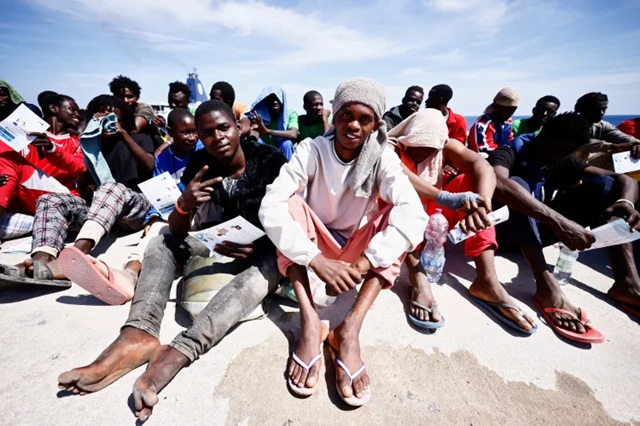
On Wednesday morning, 90 exhausted migrants from Eritrea, Ethiopia, Sudan, and Egypt arrived in Lampedusa, rescued from a wooden boat. Among them were toddlers, a sick pregnant 17-year-old, and many others cold, wet, and weary.
“They were cold, worn out and wet,” said Valeria Passeri of the aid group Mediterranean Hope, which met the group at the dock.
The spike in crossings is also linked to renewed chaos and corruption in western Libya. In May, the killing of a militia leader in Tripoli triggered violent clashes and the closure of several detention centers. Many migrants, newly released from captivity, immediately booked crossings to Europe.
Despite support from Italy — including donating patrol boats to the Libyan coastguard — reports persist that migrants intercepted by Libyan forces are often returned to jails where they face torture and rape, only to be sold back to smugglers for another attempt at crossing.
Meanwhile, Libya’s eastern region, controlled by General Khalifa Haftar, is becoming an emerging front in the crisis. Migrant sailings from the east to Greece have surged, reaching about 500 per day. Analysts believe Haftar is intentionally increasing departures to pressure European governments and boost his political leverage.
“Nothing happens in eastern Libya without Haftar’s approval,” said Jalel Harchaoui, an analyst at the Royal United Services Institute. “He’s weaponising migration to play geopolitical games.”
Eastern Libya’s growing ties with Turkey — which wants maritime exploration rights in contested waters — have drawn sharp protests from Greece. A recent visit by Greek and EU officials to eastern Libya ended in a diplomatic snub, with local authorities refusing to meet them and declaring them persona non grata.
“This could be seen as Haftar signaling: ‘Why should we continue acting as Europe’s gatekeeper if we’re not formally recognised as partners?’” said Mohamed Eljarh of Libya Outlook, a consultancy based in Benghazi.
Complicating matters further, Russia has also deepened its involvement in eastern Libya, using it as a logistical hub for military operations in Africa. Analysts warn that Moscow could exploit the migrant crisis to destabilize Europe and promote anti-Western narratives.
As the geopolitical maneuvering unfolds, the human cost remains devastating. So far this year, at least 550 migrants have died attempting the crossing from Libya.
“Tortured in Libya and dead in the sea — the story never changes,” said Flavio Di Giacomo, spokesperson for the UN’s International Organization for Migration.
Yet for those risking the journey, survival is the only goal. On a quiet beach on Gavdos, a Greek island near Crete, a South Sudanese migrant named David summed up the desperation driving the exodus: “We didn’t come to cause a problem. We came to save our lives. If you stay, you die.”